The Iron Sky and the Carbon Fox: A Flight of Reckoning and Resilient Grace
CHAPTER 1: THE THRESHOLD OF IRON
The air inside the galley tasted of ozone, stale plastic, and the cold, sharp sweat of one hundred and sixty-four people staring into an open furnace. Norman Randall did not look back at the cabin. He kept his feet planted wide on the vibrating floorboards, his heavy, liver-spotted knuckles clamped to the aluminum doorframe of the cockpit like rusted C-clamps. Through the reinforced glass, the flight deck was a chaotic aviary of amber alarms and stuttering primary displays. The co-pilot was a dead weight over the center console, his forehead resting heavily against the throttle quadrant, while the captain sat pinned to his headrest, sightless eyes fixed on a ceiling panel while his chest remained completely hollow and still.
“Sir, you do not understand the gravity of the situation,” Kyle said. The name tag on his crisp navy vest read Lead Flight Attendant, but the authority in his voice was fraying at the margins, pitching upward into an unstable squeak. He shoved his palm against Norman’s chest—a transactional gesture meant to command, but it vibrated with a frantic tremor. “We have a medical emergency. The cockpit is a restricted environment. You’re a passenger. You’re an old man. You need to get back to 14B before the cabin loses structural discipline.”
Norman turned his skull toward the younger man with the slow, deliberate torque of an ungreased winch. His pale blue eyes, rimmed with the milky haze of eighty-three winters, held a terrifying, static stillness. He didn’t blink against the strobe of the master caution light. “I know exactly where I am, son,” Norman rumbled, his vocal cords grinding together like gravel shifted by an undercurrent. “I’m at thirty-four thousand feet in a thirty-million-dollar aluminum coffin that is currently fighting a weather matrix its digital brain wasn’t built to calculate. Your autopilot is flying dumb. Look at the pitch trim.”
Kyle’s gaze flicked instinctively toward the center pedestal through the door. A digital read-out was cycling through red numerical progressions. “Is this a joke?” Kyle muttered, his face flushing a dark, defensive crimson as a fresh shudder ran through the fuselage, causing the overhead luggage bins to rattle like old teeth. “We have radioed for ground support. The emergency protocols are active. We don’t need a civilian hero complex.”
“Your altitude has dropped four hundred feet in the last ninety seconds,” Norman said, his voice entirely devoid of panic, operating with the cold economy of a telemetry log. “Your air speed is bleeding into the red arc because the auto-throttles are hunting for an atmospheric baseline they can’t find in this chop. It isn’t a flight anymore. It’s a managed fall.”
Behind them, a younger flight attendant named Sarah scrambled up the aisle, her fingers white where they gripped the seatbacks. “Kyle! Denver center is burning up the emergency frequency. They say our transponder code just changed itself. They want an immediate state of pilot capability!”
“Tell them we have the cabin under control!” Kyle snapped, his focus remaining locked on Norman, his hand reaching down to grasp the security latch on the door frame. “Look at yourself, old man. You probably flew cloth-winged props during the Truman administration. This is a digital supercomputer. You’d be a greater hazard to the airframe than the stall.”
Norman didn’t argue the point. He simply reached into the inner breast pocket of his red jacket, his stiff fingers navigating the worn folds of a creased leather wallet. The hide was cracked along the spine, smelling faintly of old oil and zinc ointment. He pulled out a small, laminated Federal Aviation Administration card and held it steady between Kyle’s eyes and the strobe of the flight deck. The photograph was a relic of two decades past—a man with the same granite jaw but fewer lines in the skin—but the endorsements on the reverse side were legally valid. Multi-engine. Instrument rated. Commercial privileges.
“This doesn’t mean a damn thing on a triple-seven,” Kyle spat, though his hand loosened on Norman’s shoulder as the plane bucked violently forward. A sharp, metallic bang echoed from the mid-cabin as a beverage cart broke its brakes and slammed into the rear bulkhead. The overhead fluorescent tubes flickered once, died, and left the galley bathed in the ghostly, amber glow of the emergency floor paths.
Then, the mechanical voice of the primary computer began its synthetic chant: Stall. Stall. Pull up.
The autopilot disengaged with a piercing, continuous three-tone klaxon that tore through the cabin like shrapnel. The nose of the massive jet dropped ten degrees into the dark gray soup of the storm.
“Out of the way,” Norman commanded. He didn’t wait for an answer. He shoved his weight forward, his heavy shoulder clearing Kyle from the threshold as his boots crossed into the cockpit, his right hand instantly dropping onto the cold, cross-hatched grip of the captain’s control column.
CHAPTER 2: THE LOGIC OF FRICTION
The column was heavy, fighting back with a cold, hydraulic stubbornness that vibrated straight through the thin hide of Norman’s leather jacket and into the calcium-poor bones of his forearms. The aircraft wasn’t just falling; it was resisting. Under his boots, the rudder pedals kicked like living things, twitching against his soles as the computerized flight control systems scrambled to resolve the conflicting data screaming through the pitot tubes. The synthetic chant—Stall. Stall. Pull up.—filled the narrow, green-lit space, a flat, mechanical rhythm that offered no room for human breath.
Norman didn’t pull back. To pull back now, with the airspeed indicator tunneling toward the double-dashed bottom of the tape, would be to wash out what little lift remained on the massive supercritical wings. Instead, he leaned his weight forward, burying his sternum almost against the glare-shield, and forced the nose deeper into the churning soup of the storm.
“What are you doing?” Kyle’s voice was a shrill, ragged puncture through the noise of the klaxon. He had been thrown against the observer’s jumpseat, his hands clawing at the nylon harness straps to keep from sliding forward onto the pedestal. “You’re diving! You’re going to overspeed the airframe!”
“I’m giving her the only thing she needs to live,” Norman muttered, his eyes darting across the primary flight display with a cold, predatory focus. He wasn’t looking at the whole panel; his universe had narrowed to the tape on the left and the pitch lines in the center. “Weight for speed. It’s an old trade, son, but it’s the only one the sky accepts.”
The G-forces deepened, pressing them hard into their seats as the massive jet cleared thirty-one thousand feet, thirty thousand, twenty-nine thousand. The roar of the wind against the windshield changed from a low, hollow whistle to a high, metallic shriek—the sound of air turning to iron under immense pressure. Then, beneath the digital rattle, Norman noticed a discrepancy. The primary altimeter was spinning downward in neat, five-hundred-foot increments, but the analog standby instrument—the small, circular dial mounted low on the center panel, its glass face cloudy with decades of vibration—showed a three-hundred-foot lag. The needles were sticking, catching on a internal gear that had lost its lubrication, but its raw pressure reading was truer than the processed calculation on the glass screen above it. The digital brain was treating a minor pressure variance as an unrecoverable structural failure. It was a loop. A software logic gate that had closed and locked the doors against its own pilots.
“Sarah,” Norman rumbled, his left hand holding the nose down while his right reached blindly back toward the pedestal. “The center console. Below the weather radar. There’s a yellow guarded switch marked FLT CTRL DISC. Flip it.”
“Don’t touch that!” Kyle screamed, his fingers finally catching a grip on the captain’s headrest. His face was chalky, his hair no longer neat, a damp strand plastered to his forehead. “Sarah, if you touch any system configuration, you’re violating federal intervention laws. We wait for Denver! They’re routing an instructor to the radio!”
“Denver is five hundred miles behind the weather front, and this machine will be a lawn dart in forty seconds,” Norman said. He didn’t turn his head. His knuckles were white where they wrapped the yoke, his old skin stretched thin enough to show the blue, twisting lines of his veins. “Sarah. Now.”
The girl didn’t look at Kyle. She dropped to her knees on the track between the seats, her uniform skirt tearing slightly on the metal seat rail, her fingers digging into the recess behind the throttle quadrant. Her nails scraped against the rough, zinc-plated casing of the console until she found the plastic guard. She snapped it up—the click a tiny, plastic snap against the roar of the engines—and threw the toggle.
The three-tone stall warning didn’t fade; it cut out instantly, replaced by a sudden, heavy deadness in the controls. The artificial resistance vanished. The yoke became loose, almost light, in Norman’s hands. The computer had stepped back, leaving him connected to the control surfaces through nothing but raw hydraulic pressure and his own fading muscle.
“Now we fly,” Norman whispered.
Slowly, using the weight of his torso rather than the strength of his arms, he began to ease the column back toward his ribs. The aircraft resisted the pull, the massive tail surfaces fighting the tremendous friction of the air at four hundred knots, but the nose began its slow, heavy sweep upward. The line of the horizon on the screen crept back toward the zero mark. The sickening sensation of the drop slowed, then stabilized, until the vertical speed indicator flicked from its downward plunge back to a steady, level baseline at twenty-four thousand feet.
The plane was out of the dive, but the cabin was silent now, save for the low, rhythmic thrum of the engines running at seventy percent power. The storm outside was an unblinking wall of slate gray, the windows streaked with horizontal lines of rain that looked like ice under the glare of the instrument lights.
Kyle remained frozen behind the captain’s seat, his chest heaving, his fingers still locked into the leather upholstery. He looked down at Norman’s hands—old, spotted, slightly trembling now that the immediate physical strain had passed—and then at the standby altimeter, which had finally caught up to the primary display.
“You broke the redundancy,” Kyle whispered, his voice trembling with a mixture of terror and furious institutional outrage. “The manual says if you disconnect the primary flight bus without a ground-start override, the system locks the trim tabs in their last known position. You haven’t saved us. You’ve just locked us into a configuration we can’t change manually.”
Norman reached down, his thumb brushing the small, manual trim wheel on the left side of the yolk—a mechanical override that the designers had kept as a nod to the past, a rusted iron gate in a fortress of glass. He gave it a quarter turn. A low, metallic click groaned from beneath the cockpit floorboards as the cables tightened.
“The manual was written by men who sell planes, son,” Norman said, his eyes scanning the gray void ahead, looking for the first break in the shelf. “Not the ones who have to bring them down when the copper rots.”
CHAPTER 3: GHOST LEAD MATERIALIZES
The low, dry click of the manual trim tabs resonated through the aluminum ribs of the cockpit, a raw metallic vibration that Norman felt in the soles of his boots before it registered in his ears. The airframe groaned, settling its massive weight into the twenty-four-thousand-foot shelf with the sluggish reluctance of an old barge finding a current.
“You’re tracking blind,” Kyle said. His voice had dropped from its panicked pitch into a flat, brittle whisper, his knuckles still white where they clamped onto the gray leather backing of the captain’s seat. He remained frozen in the narrow gap between the pedestals, his eyes staring down at the analog standby dial as if waiting for the glass to crack under the pressure. “The secondary transponder isn’t talking to the ground. If Denver can’t verify our tail number on the secondary radar line, we’re just an unidentified radar return moving through closed military airspace.”
Norman didn’t look back at him. His large, vein-streaked thumb adjusted the trim wheel another two increments, feeling the steel braided wire drag against its grease-starved pulleys somewhere down in the dark belly of the electronic bay. A low, rhythmic whine began to thrum through the floorboards—a deep, resonant pitch that hit exactly four hundred hertz.
The sound hit Norman’s temple like a physical touch. For a fraction of a second, the glowing digital tape of the primary flight display dissolved into the green phosphor grid of an old APQ-120 radar scope. The smell of recycled air and cold plastic vanished, replaced by the choking, chemical stink of hot hydraulic fluid and the scorching heat of a twin J79 engine bay burning through its seals over the dark waters of Tonkin. His fingers tightened on the yoke, his knuckles locking with the precise, automatic muscle memory of a twenty-five-year-old lieutenant who had learned to read the sky by its friction alone. The machine was different, but the iron was the same. The laws of momentum didn’t care about the year printed on the tail.
“Sarah,” Norman rumbled, pulling his mind back into the dim cabin light with a slow, heavy breath. “The headset on the center console. The one with the black cord. Put it on.”
The young woman didn’t hesitate. She stepped over the threshold, her knee brushing the aluminum frame of the observer’s seat as she reached into the tray between the power levers. Her fingers were shaking, but she uncoiled the thick wire and slipped the plastic cup over her ear, her thumb searching for the toggle switch on the cord. “It’s dead, sir. There’s nothing but a low hiss. Like static.”
“It’s not static,” Norman said, his gaze fixed on the dense, featureless wall of gray cloud pressing against the thick windshield glass. “It’s a secure guard channel. The primary receiver is searching for an encrypted carrier wave. Give it ten seconds.”
“This is madness,” Kyle whispered, taking a single, tentative step backward into the galley, his fingers dragging along the plastic bulkhead as if searching for a manual or an exit that didn’t exist. “We need to reset the primary flight computer bus. If we don’t restore the automatic legal linkage before we enter the terminal area, they’ll treat this as an un-commanded intrusion. They have protocols for unidentified iron in the sky.”
“They do,” Norman said, his voice dropping into the flat, unyielding register of an old general who had written half the field manuals himself. “And we’re about to meet them.”
Through the thick, multi-layered acrylic of the left-hand window, the gray soup didn’t break—it sheared. A massive, dark shape materialized out of the cloud deck with the sudden, silent violence of a shadow falling across a wall. It was an F-35 Lightning II, its skin a desaturated, non-reflective matte gray that looked like charcoal under the dim cloud-light. The fighter sat completely stable, its angular, faceted nose tucked less than fifty feet from the 777’s wingtip, its canopy a dark, metallic bubble reflecting the amber strobe of the airliner’s navigation lights.
The fighter’s pilot was visible inside the cockpit—a dark, featureless silhouette against the green glow of a helmet-mounted display system. The machine didn’t shake; it hung there, locked into the same pocket of air by the invisible, tremendous force of its thrust, its wing-flaps twitching with micro-second adjustments that looked almost biological.
Sarah let out a short, sharp breath, her hand flying to the plastic casing of the headset. “Sir… someone’s talking on the guard line. It’s not Denver.”
“Read it to me, girl,” Norman said, his eyes never leaving the gray void ahead as he coaxed the heavy control column two inches to the left, initiating a long, calculated bank that began to turn the hundred-and-sixty-ton aircraft toward a new heading.
“They’re… they’re calling for an identity verification,” she whispered, her voice cracking as she leaned closer to the console. “They aren’t asking for the airline call sign. They keep repeating a sequence… Charlie-Alpha-Romeo-on-the-stick.”
“Give me the mic,” Norman said. He didn’t reach for it; he waited for her to place the plastic housing into his left hand, his right remaining clamped to the wheel like an iron vise. He didn’t clear his throat. He pressed the heavy black button with his thumb, the copper contacts inside clicking with a raw, unshielded snap. “Ghost Lead, this is Carbon Fox. Authenticate on the old wire. Five-by-five.”
The response didn’t come through the main speakers; it vibrated through the small speaker elements inside Norman’s headset, the voice young, crisp, and clean, stripped of any civilian hesitation. “Carbon Fox, Ghost Lead has visual contact. We have your tail locked. The sky is clear from here to Lincoln county, sir. General Thorne has the floor at Cheyenne Mountain. Just name the concrete.”
Kyle’s mouth opened slightly, his arm dropping to his side as he stared out through the side window at the massive stealth fighter riding their wing like an escort through a graveyard. The arrogance that had stiffened his spine for the last thirty minutes seemed to drain out of him all at once, leaving his uniform vest looking loose and oversized on his narrow shoulders. “Thorne?” he muttered, his voice barely rising above the low drone of the air vents. “Who… who are you?”
Norman didn’t answer him. He kept his eyes on the analog standby altimeter, watching the mechanical needle creep steadily across the white markers as the iron sky began to open up ahead.
CHAPTER 4: THE TOUCHDOWN AT NELLIS
The analog needle kept its agonizingly slow crawl across the white hash marks, vibrating within its brass frame as the Boeing 777 sheared through the final cloud shelf. Below them, the desaturated, sun-bleached grit of the Nevada desert spread out like a sheet of rusted iron under the glare of the noon sky. The two F-35 fighters remained welded to the wings, their dark, non-reflective surfaces shimmering with the heat of their engines, maintaining an unblinking, synchronized escort that offered no margin for error.
“Airspeed is spiking,” Kyle muttered. His voice had lost its institutional edge entirely, replaced by the hollow, raspy cadence of a man who had watched the ground rules of his profession dissolve in mid-air. He was leaning over the center pedestal now, his tie crooked, his eyes tracking a sudden, erratic jump on the electronic engine displays. “The auto-throttles aren’t balancing the fuel flow to engine two. It’s feeding raw kerosene without a computer limiter.”
Norman didn’t shift his posture. His hands remained wrapped around the plastic grips of the column, his boots applying constant, localized pressure to the rudder pedals to counteract a severe crosswind howling off the low desert ridges. “The computer is trying to purge the line because the digital valve got stuck in the dive,” he rumbled, his vocal cords dry, tasting the sharp copper tang of the thin flight-deck air. “She’s fighting her own plumbing. We do it manually.”
Before his hand could drop to the heavy, mechanical throttle levers, a sharp, metallic shudder clattered through the floorboards. It wasn’t the wind. It was a rhythmic, high-frequency vibration that rattled the backup instruments in their mounts and sent a sudden, spray-like hiss of atomized liquid venting somewhere down in the forward cargo bay. On the lower system display, a new warning indicator flared a dull, unblinking amber: HYD SYS L PRESS CLD. The hydraulic line feeding the left wing flaps was bleeding its fluid under the immense stress of the cold, rapid descent.
“We’re losing the primary loop,” Kyle whispered, his fingers twitching toward the master overhead panel. “The manual says if the left system drops below twelve hundred pounds, the landing gear won’t lock on gravity drop alone. We’ll slide on the belly.”
“The manual doesn’t know about the reserve cross-feed,” Norman said. He didn’t look at the switches. Without breaking his stare from the massive, distant gray finger of the Nellis runway currently rising out of the heat haze, he nudged Sarah with his elbow. “Look at the overhead panel, three rows down, far left. There’s an un-labeled zinc plug next to the secondary pump breaker. Pull the pin out with your fingers and turn it ninety degrees clockwise.”
Sarah dropped her headset onto the pedestal, her knees scraping the aluminum seat rail as she stretched her torso toward the ceiling panel. Her fingernails caught on the rough, unpolished metal of the emergency cross-feed pin. It was stiff, coated in decades of dry storage grease that smelled of paraffin and iron filings. She twisted her wrist, her breath coming in a short, ragged gasp until the internal valve clicked home, dumping the reserve hydraulic pressure directly into the gear-extension cylinders.
A dull, heavy thump-thump-thump resonated through the fuselage as the massive main gear doors tore open against the slipstream, followed by the solid, structural lock of three hundred thousand pounds of steel and rubber finding its geometric extensions.
“Three greens,” Norman muttered, his eyes tracking the three mechanical indicator flags that had popped up through the lower console—antiquated, physical targets that didn’t rely on the digital display bus. “The iron is down. Now we have to hold her straight.”
The runway at Nellis was a four-mile ribbon of cracked, heat-stressed concrete, flanked on both sides by a phalanx of emergency vehicles, foam trucks, and dark olive-drab military transport rigs with their light bars spinning in silence. The two F-35s peeled away simultaneously with a sharp, thundering roar, climbing into the vertical to clear the airspace as the massive airliner crossed the perimeter fence at one hundred and fifty knots.
The wind off the dry lake beds hit them like a physical wall, shoving the nose ten degrees off the centerline.
“We’re drifting,” Kyle yelled, his hands instinctively reaching out to grab the copilot’s column as if he could pull the jet back by force.
“Leave it,” Norman commanded, his voice striking the small space like a hammer on an anvil. “You touch that yoke and you change the weight distribution on the main gear before the tires bite. Sit back.”
Norman waited. He let the wind carry the heavy machine down, keeping the nose pitched slightly down, using the raw weight of the airframe to smash through the thermal currents rising from the concrete. At thirty feet, he kicked the right rudder pedal with the full force of his leg, aligning the long, aluminum fuselage with the center stripe just as the tires hit.
The impact was a brutal, bone-shattering roar of rubber meeting aggregate. The 777 skidded once, its massive carbon-brakes groaning as Norman pulled the mechanical reverse thrust levers back into their stops with a single, continuous motion. The engine cowlings slid back with a screech of ungreased jackscrews, directing forty thousand pounds of thrust forward to fight the forward momentum.
The aircraft slowed, its tremendous weight grinding down the concrete lane until its speed dropped to a heavy, rolling crawl, eventually stopping completely fifty yards short of the waiting military lines. The sudden silence that followed was thick, broken only by the high, dying whine of the twin turbines cooling down in the desert air.
Norman didn’t unbuckle his harness. He sat there, his hands finally dropping from the column to rest flat on his thighs, his chest heaving under the stiff leather of his jacket. Outside the window, a lone figure in an Air Force general’s uniform stepped out of a idling staff car, his eyes fixed on the cockpit window as the emergency crews converged on the steel doors.
CHAPTER 5: THE RANDALL PROTOCOL
The last rhythmic vibration of the twin turbines died away, leaving only the sharp, metallic ping of cooling alloy expanding against the housing. Norman did not lift his hands from his knees immediately. His knuckles were gray, coated in a fine layer of sweat and oxidized aluminum dust from the manual trim wheel. He remained strapped into the captain’s high-backed seat, a fragile but unyielding mass of bone and faded red leather, his lungs drawing in the dry desert air that now flooded through the cabin vents.
The cockpit door groaned back against its tracks. General Marcus Thorne stood at the threshold, the silver stars on his collar catching the raw, unshaded light of the Nevada sun streaming through the acrylic windshield. He didn’t speak. He brought his right hand up to his brow in a salute so sharp the heavy wool of his sleeve caught against his insignia with a dry, distinct rustle.
“General Randall,” Thorne said, his voice dropping into a thick, gravelly register that seemed to carry the weight of thirty years of buried military history. “It is an honor, sir. The Pentagon logged the system override the moment you threw the flight control isolation switch. They knew it was you before the tires touched.”
Norman slowly reached up, his stiff fingers unlatching the nylon harness buckle with a heavy, plastic snap. He didn’t rise immediately; his joints were locked, resisting the sudden transition back to a world with gravity. He returned the salute with a tired, steady hand that didn’t rise an inch higher than his shoulder. “Good to be back on the dirt, Marcus. The automation on these heavy rigs has a short memory. It forgets that air still has weight.”
Thorne’s gaze flicked past Norman, landing directly on Kyle. The lead flight attendant was pinned against the galley bulkhead, his navy vest unbuttoned at the throat, his face a hollow mask of gray exhaustion and institutional shame.
“The flight data recorder logged your transmissions,” Thorne said, his voice turning into an icy, unyielding blade. “Your actions constituted an active obstruction of a classified asset during a national aviation crisis. Your credentials will be pulled before the staff car reaches the terminal gate. Your career in the sky is concluded.”
Kyle visibly sagged, his shoulder dropping against the plastic casing of the intercom panel as if the structure of his entire life had just lost its primary support. He looked down at his boots, his lips twisting into a silent, bitter calculation of a future that had just vanished into the desert heat.
“Easy, Marcus,” Norman rumbled, his old boots finding a firm purchase on the metal floor tracking as he stood up, his spine popping with a dry, rhythmic stiffness. “The boy was working by the book he was handed. When a man gets scared, he clings to the iron rules because he doesn’t have the calluses to trust his own hands. The fault isn’t in his fear. It’s in the logic of the system that told him a computer is smarter than eighty thousand hours of raw sky.”
Norman reached out, his calloused palm resting briefly on the glare-shield, feeling the baseline heat of the avionics bay cooling down beneath the metal skin. “Don’t break him for following a bad manual. Rewrite the manual.”
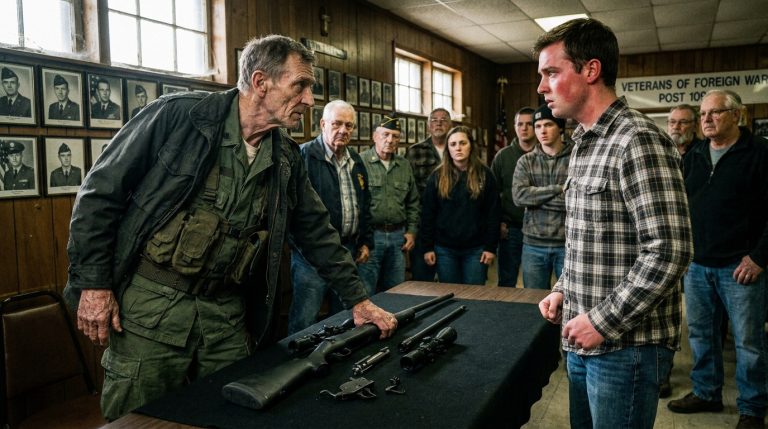
The transition of time left no skips in the leather, only the slow accumulation of dust. One quiet Tuesday morning three weeks later, the air inside the local VFW hall in Lincoln County tasted of stale tobacco, floor wax, and the dark, bitter scent of boiled coffee. Norman sat at his corner table under the slowly rotating blades of an old three-speed ceiling fan, a vintage screwdriver set spread across the scarred oak tabletop before him.
Between his grease-stained thumbs, he held the creased leather wallet he had carried through three wars. The edge of the inner flap was fraying, a single strand of nylon thread hanging loose from the seam where the faded Carbon Fox patch was sewn into the lining. Carefully, with the deliberate, unhurried pressure of a man who had spent a lifetime adjusting fine instruments under fire, he tucked the thread back beneath the hide and tightened the brass screw on a small leather punch, sealing the border down with a drop of clear oil.
The screen door at the front of the hall rattled on its spring, its wire mesh slapping the cedar frame with a double-crack that made the old iron radiators in the corner hum in sympathy.
Kyle walked in. He wasn’t wearing the navy uniform or the polished name tag. He was dressed in a heavy gray wool sweater that looked slightly too large for his frame, his hands buried deep in the pockets of his denim jacket as he stopped five feet from the edge of the table. He stood there for a long moment, the silence between them stretching until the ceiling fan completed a dozen slow, creaking revolutions.
He didn’t offer a dramatic explanation. He didn’t give a speech. He reached into his coat pocket and placed a steaming, heavy ceramic mug of black coffee directly on the oil-stained oak beside Norman’s tools.
“The FAA issued the revision yesterday morning,” Kyle said, his voice quiet, stripped of the brittle authority that had once defined his stride. “They’re calling it the Randall Protocol. Any multi-engine certified pilot with over five thousand hours of mechanical command time gets immediate cockpit verification if the automated bus drops offline. The system… the system doesn’t lock the doors anymore.”
Norman looked up from the leather wallet, his clouded blue eyes locking onto the younger man’s face with the same static, ancient calm that had held the 777 steady through twenty thousand feet of gray shadow. He didn’t smile, but his large hand reached out and wrapped around the warm porcelain of the mug, his thumb smoothing over a rough spot on the rim.
“The sky always finds the gaps in the code, son,” Norman said softly, his voice a low, gravelly vibration that belonged to the earth now. “But the iron stays straight if you know where the cables pull.”
He gave a single, deliberate nod—a dismissal that was also an acceptance, a quiet closing of the ledger after the final landing. Kyle stood steady for a second longer, then turned and walked back toward the screen door, his boots hitting the worn pine floorboards with a slow, even rhythm that carried no more fear. Norman picked up his small screwdriver, his calloused thumb settling back into the familiar groove of the work, while the noon sun threw the long, angular shadow of the ceiling fan across the rusted surface of his desk.