The Caldwell Station: A Gritty Tale of Property, Bloodlines, and Bureaucratic Reckoning
CHAPTER 1: THE LINE IN THE DUST
The toe of her white sneaker sat exactly two inches past the rusted surveyor’s pin.
I didn’t look at her face first. I looked at that shoe. Clean canvas, spotless rubber, pressed into the damp rye grass of my boundary line.
“Your little dirt hole is a public nuisance and a structural liability, Mr. Caldwell,” Karen Miller said. Her voice carried the sharp, grating tone of a supervisor calling out a late shift. “We’re having it filled with concrete by Friday. The $5,000 special assessment will be added to your dues.”
I slowly rotated the heavy brass drafting compass between my thumb and forefinger. The cold metal point bit into my callus. Twenty-two years in the Army Corps of Engineers teaches you two things fast: how to read terrain, and how to spot an amateur trying to take a forward position without support.
“That cellar was built in 1860, Karen,” I said. My voice stayed down in my chest, low and flat. “It predates your development by one hundred and thirty years.”
“History doesn’t grant you an exemption from Section 4, Subsection B,” she snapped, clutching her plastic clipboard like a shield. Behind her, the sprawling sea of identical beige McMansions glistened under the humid Virginia sun. “All detached structures must be approved by the Architectural Review Committee. It’s an unapproved, unsafe eye-sore. It drags down property values.”
Property values. The sacred phrase.
I didn’t answer. I let the silence stretch across the ditch between us until her jaw twitched. My grandfather had built the fieldstone walls of that root cellar with hand-cut timber and river granite. It had survived three major floods and two centuries of frost. It wasn’t falling down.
She took a half-step back, her sneakers slipping slightly on the damp slope, but her eyes held that ugly, bureaucratic hunger. She wanted a fight. She wanted me to raise my voice so she could write a citation for verbal harassment before the ink on her clipboard dried.
“Friday,” she repeated, turning on her heel. “Have your gear clear of the entrance.”
I watched her pastel tracksuit recede toward the paved cul-de-sac. I brought the brass compass up, sight-line level with the old oak door of the cellar, and closed its legs until the metal clicked shut.
She thought she was dealing with a broken veteran hiding on a quiet five-acre patch. She didn’t know I was already mapping the demolition of her whole operation.
CHAPTER 2: THE PAPER SHIELD
The cream-colored envelope felt heavy in my palm. Heavy paper stock, expensive watermarks, printed with the kind of bloated authority that only prospers in comfortable suburbs.
The Notice of Covenant Violation and Remediation Order was a masterclass in bureaucratic threat. Section 4, Subsection B. Section 7, Subsection 9. The words were formatted in aggressive bold serif, laying out an ultimatum designed to make a retired civilian panic and call an overpriced contractor.
Failure to comply within fourteen calendar days will result in daily fines of $100, followed by a mandatory special assessment for forced remediation.
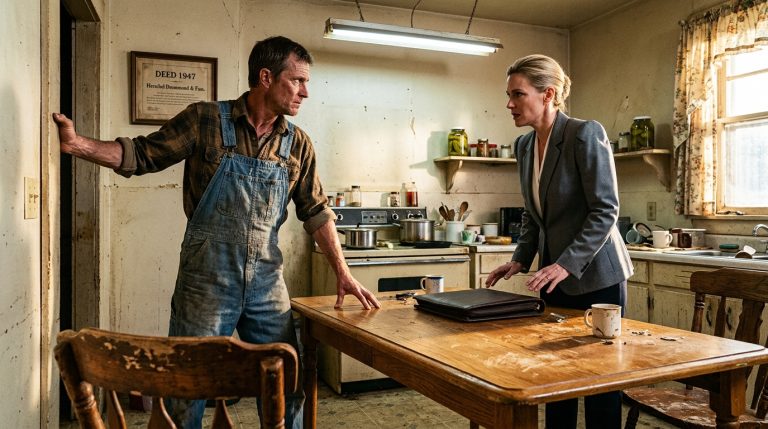
I laid the letter flat on my grandfather’s oak dining table. Next to it, I placed my old Army Corps drafting kit: a hardened steel ruler, a pair of micrometer calipers, and a roll of translucent tracing paper.
I didn’t reach for my keys. I didn’t drive to Karen’s house to yell on her manicured lawn. You don’t fight a dug-in position with a frontal charge when you lack air support. You drown them in their own paperwork until they suffocate on the process.
For three days, I treated my kitchen like a forward tactical command post.
I took thirty-two high-resolution digital photographs of the root cellar from every cardinal direction. I used the calipers to measure the exact mortar joints of the fieldstone entrance, mapping the 1860 construction against modern building codes to prove structural stability. I drew up complete schematics, section by section, rendering the hand-hewn oak rafters in precise 1:50 scale drafting ink.
On the third night, a detail on the neighborhood utility map caught my eye.
The HOA’s official boundary expansion plan showed a proposed storm-drain conduit running suspiciously close to the southern edge of my five acres. The easement line on their map drifted six feet into my tree line—right where the ground sloped down toward the root cellar.
I traced the line with my thumb. A thick smudge of graphite left a grey stain on my knuckle. This wasn’t about a sightline or beige paint. A commercial drainage run needed a clear grading path. The cellar wasn’t just an ugly stone mound in Karen’s eyes; it was a physical obstruction sitting directly on top of a low-cost runoff route.
I didn’t write a letter accusing her of land-grabbing. Accusations give the enemy something to deny. Instead, I gave her data.
I compiled a three-inch, navy-blue binder. Inside, I indexed six distinct sections:
Architectural elevation schematics.
Historical mortar composition analysis.
A certified soil-stability report from a regional engineering firm I kept on retainer for barn repairs.
Pest-inspection certifications confirming zero infestation.
A comprehensive structural integrity cross-section.
A formal Application for Historical Structure Preservation.
On the front cover, under a clear plastic sleeve, I slipped a single typed label: Active Application for Historical Structure Preservation — Caldwell Homestead Block 4, Lot 1. On the margin of page twelve, in the footers of the structural compliance code, I subtly cross-referenced the state’s public infrastructure guidelines under Section 106. I didn’t highlight it. I didn’t explain it. I let the law sit there like an unexploded shell buried in the mud.
The next afternoon, I walked into the HOA clubhouse.
The air inside smelled of artificial vanilla and fresh carpet powder. Karen sat behind the counter, flanked by Gary—a board member wearing a tight golf shirt—and Brenda, a thin woman who took notes on a legal pad.
I placed the three-inch binder on the counter with a heavy, solid thud that rattled the plastic pen holder.
Karen flinched, her eyes dropping to the blue vinyl cover before snapping up to mine. “What is this, Mark?”
“My submission for the Architectural Review Committee,” I said. My voice was calm, conversational, completely void of heat. “As required by Subsection B.”
Gary picked up the binder, grunting slightly at the weight. He flipped open the cover, his eyes skimming over dense CAD drawings, soil-compression figures, and pages of stamped engineering assessments. His brow furrowed. “This is… a lot.”
“I’m a thorough man, Gary,” I said. I looked past him, locking eyes with Karen. “I expect a formal, written response from the committee after your next meeting.”
Karen’s lips thinned into a pale line. She didn’t touch the binder. She looked at it like it was a biohazard delivered to her desk. “The committee will review it in due course, Mr. Caldwell. But the remediation deadline remains unchanged.”
“Of course,” I said, offering a curt nod. “Everything according to the rules.”
I turned and walked out through the double glass doors, leaving the three-inch wall of paper sitting between them like an iron door slamming shut. They wanted a paper war. I had just handed them a library.
CHAPTER 3: THE SHOW TRIAL
The glass doors clicked shut behind me, but the silence didn’t last. A week later, I was back in the same beige room.
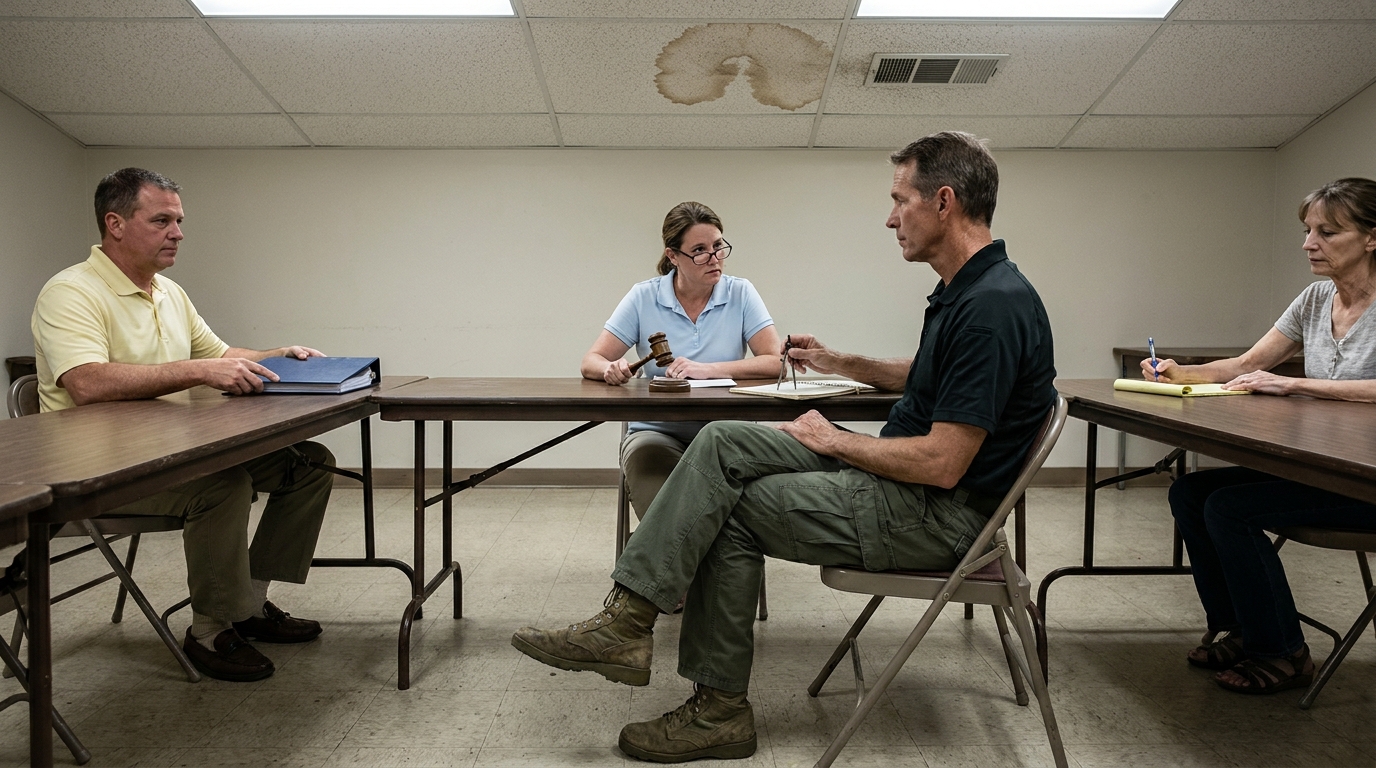
The conference space smelled of stale coffee, carpet cleaner, and cheap laminate. A drop-ceiling tile near the back air vent had a brown water stain shaped like a twisted lung. At the far end of a long folding table sat the board.
Karen held the gavel in her right hand, her knuckles pressed white against the wood. To her left was Gary, his polo shirt collar stiffened with starch. To her right sat Brenda, tapping the tip of a retractable ballpoint pen against a yellow pad. Click. Snap. Click. Snap.
My navy-blue binder sat on the corner of their table.
It hadn’t been moved. The plastic sleeve on the cover was pristine. No thumbprints on the side tabs, no creases on the CAD elevations, no broken spine. They hadn’t opened it once.
“We will come to order,” Karen said. She struck the rubber block with the gavel. The thud was tight and loud in the low-ceilinged room.
She didn’t look at the audience—four neighbors sitting on metal folding chairs behind me, including Arthur Abernathy, who lived three houses down, and Miguel Garcia from across the lane. Karen adjusted her reading glasses, clearing her throat with a dry, mechanical cough.
“Item four on the agenda,” she read from a single sheet of paper. “Structural compliance evaluation for Block 4, Lot 1. Submission by Mr. Mark Caldwell.”
Gary cleared his throat. He reached out, picked up my binder by the corner with two fingers, and set it down six inches closer to Karen. He didn’t unlatch the rings.
“The committee has completed its review,” Gary lied. His voice had the flat, practiced cadence of a man reading a script he hadn’t written. “While we note the volume of the material provided, the ARC finds that the detached subterranean masonry structure fails to satisfy Section 7.9 regarding community visual harmony.”
“Visual harmony,” I repeated. I sat straight in my chair, hands resting flat on my knees. “Did the committee evaluate page fourteen? The soil compaction metrics from the regional geotechnical report?”
Karen didn’t look down at the binder. “We don’t need to read a novel to recognize a hazard, Mr. Caldwell. A stone mound with exposed timber is an unapproved, uninspected excavation. It lowers surrounding valuations.”
“It’s a dry-stacked fieldstone root cellar built in 1860,” I said. “The timber is heart-pine. The mortar is lime-based. The load-bearing capacity exceeds five thousand pounds per square foot.”
“It is an eyesore,” Karen said. She leaned forward, the laminate table creaking under her forearms. “The Meadows at Liberty Crossing is built on uniformity. We do not allow dilapidated agricultural relics to ruin the aesthetic baseline of this subdivision.”
Behind me, Arthur Abernathy shifted in his metal chair. His shoe scuffed the linoleum with a sharp squeak. Karen’s eyes flicked over my shoulder toward him, cold and sharp as chipped flint, before locking back onto mine.
“To be clear for the record,” I said, keeping my tone perfectly level, “the Architectural Review Committee is formally denying the application without reviewing the submitted engineering certifications.”
“The application is rejected,” Karen said. She didn’t hesitate. She didn’t look at Gary or Brenda for a vote. She simply lifted the wooden hammer and brought it down. Crack. “The remediation order issued on the twelfth remains in full effect. You have seven calendar days to submit a certified demolition contract to this board.”
“And if I don’t?”
“Then we will execute the remediation under Subsection 9.4,” she said. Her mouth twitched into the ghost of a smile—tight, triumphant, devoid of heat. “We have already cleared the contractor access route through the southern easement. A commercial crew will fill the void with high-slump concrete on the twenty-eighth. The five-thousand-dollar contractor fee and daily non-compliance penalties will be attached as a super-priority lien against your deed.”
Southern easement.
There it was. The leak. She had just named the exact route where her brother-in-law’s grading crew needed six extra feet of clearance for the storm drain.
I didn’t argue. I didn’t raise my voice. I stood up slowly, pushing my chair back without letting the legs scrape the floor. I picked up my notebook, tapped my pen against the cover once, and looked Karen dead in the eye.
“July twenty-eighth,” I said. “I’ll make sure the gate is unlocked.”
She blinked, surprised by the lack of resistance, her hand still resting on the handle of the gavel. I turned and walked down the center aisle, the heavy oak doors swinging open before me into the humid evening air.
They thought they had backed an old man into a corner. They didn’t realize they had just signed their names to a written paper trail of bad faith—and the trap was officially baited.
CHAPTER 4: THE VAULT IN THE DUST
The heavy oak door of the clubhouse swung closed behind me, cutting off the hum of the air conditioner and the silent stares of Karen’s committee.
The night air outside was thick with rain that hadn’t fallen yet. I crossed the parking lot, my boots crunching rhythmically on the gravel, and reached my truck. They had given me their official refusal. They had put their intent to trespass and destroy in writing. The administrative trap was set, but a trap is useless without a locking pin.
I drove back up the narrow asphalt lane to my five acres. The main house sat dark against the treeline, its white lapstrake siding turning slate-grey under the moon.
I didn’t stop in the kitchen. I grabbed a rechargeable LED work light from the workbench in the porch pantry, slung a heavy canvas tool bag over my shoulder, and headed straight for the attic access hatch in the hallway ceiling.
The folding ladder creaked as I pulled it down. Dust—dry, ancient, smelling of cedar shavings and baked pine rafters—drifted into the beam of my light.
My grandfather had never thrown away a document that bore the Caldwell name. For twenty-two years in the service, whenever I came back on leave, I’d see him up here sorting through wooden crates, wrapping farm ledgers in oilcloth.
I set the LED panel on a joist, casting a hard, white flood across the attic floorboards.
To the left lay stacks of glass canning jars and folded wool horse blankets. To the right, tucked deep under the eave where the chimney brick met the roofline, sat a heavy iron-strapped trunk. It was painted flat black, its brass latches tarnished to the color of dark molasses. Stenciled in faded white lead paint across the top was a single name: Elias Caldwell.
I knelt on a joist, the rough pine biting into my kneecaps.
My fingers found the center latch. It was stiff, seized by fifty years of oxidization. I pulled a flathead screwdriver from my tool bag, wedged the tip beneath the brass clasp, and leaned my forearm weight into it.
Snap.
The iron spring gave way with a sharp metallic crack that echoed in the rafters.
I lifted the heavy lid. A dense scent of dried lavender, tobacco leaf, and old paper rose from the interior. Beneath two folded Union Army wool coats lay leather-bound farm ledgers from the 1880s, tax receipts from the Virginia Commonwealth, and a thick, tie-bound manila file folder wrapped in cotton twine.
On the cover of the folder, written in my grandfather’s precise, drafting-style block letters, was a single label: The Seller Archive.
My thumb rubbed the rough grain of the paper. I cut the twine with my pocketknife.
Inside were hand-drawn architectural sketches on linen paper showing the deep foundation footings of the cellar walls. Below those lay a stack of typed letters from 1978, bearing the letterhead of the Department of History at the University of Virginia.
I unfolded the top letter. The ink was faded, but the text was sharp:
…Confirming our field survey of the Caldwell Homestead. The subterranean stone vault, local structural inventory designated as the Caldwell Station, contains verified physical modifications consistent with mid-nineteenth-century clandestine transit stops…
I moved to the next document in the stack.
It wasn’t ordinary typing paper. It was heavy, embossed parchment stock, slightly yellowed at the margins, bearing a raised gold seal that caught the harsh glare of the LED panel.
At the top, in crisp, engraved black lettering, it read:
UNITED STATES DEPARTMENT OF THE INTERIOR
NATIONAL PARK SERVICE
This is to certify that the Caldwell Homestead Root Cellar (Caldwell Station) has been entered in the National Register of Historic Places.
Below the seal sat the official citation, referencing federal protection protocols under Title 54 of the United States Code and the mandatory review procedures governed by Section 106. The registration date was stamped in black ink: October 12, 1978.
I sat motionless in the dust of the attic, the heavy paper held steady in my hands.
My grandfather had never spoken of it. He was a man who mended his fences in silence and paid his taxes on time, caring nothing for plaques or public recognition. He had quietly secured the highest level of legal shield available under federal law to protect his land, filed the document away in an iron trunk, and gone back to farming.
I looked at the raised seal under the white light.
Karen Miller wasn’t just attempting a local covenant enforcement to clear a path for her brother-in-law’s drainage pipe. She was preparing to bring a commercial concrete truck onto a federally protected landmark.
I carefully slipped the parchment certificate into a clear plastic sleeve from my bag, zipped it inside my jacket, and pulled out my phone.
I dialed Dave Martinez’s direct line. It rang twice before he answered.
“Mark?” Dave’s voice came through sharp, background office noise buzzing behind him. “Tell me you didn’t punch a board member.”
“I didn’t,” I said, my voice low and quiet in the dark attic. “I need you to draft a notice of federal jurisdiction. I’m holding a 1978 Department of the Interior certificate.”
There was a three-second silence on the line. I heard the scuff of Dave’s chair as he pulled himself up to his desk.
“Read me the title on the seal, Mark,” he said, all the casual humor dropping from his tone. “Read it word for word.”
“National Register of Historic Places,” I said. “Caldwell Station. Title 54.”
Dave let out a long, quiet breath over the speaker. “They’re bringing the trucks on the twenty-eighth, right?”
“That’s their plan.”
“Don’t tell them,” Dave said. His voice was cold, precise, and completely focused. “Let them order the pour. Let them drive the truck onto the property. We lock the gate behind them.”
CHAPTER 5: THE CONCRETE TRAP
“Don’t tell them,” Dave had said over the phone. “Let them order the pour.”
The twenty-eighth arrived under a high, pale morning sun. The air smelled of dew, wet field grass, and the faint metallic tang of diesel exhaust floating down the lane from the subdivision.
I sat on the top step of my porch, a thermos of black coffee sitting on the cedar floorboard beside my boots. In my lap sat my leather binder. Inside the plastic sleeve was the Department of the Interior certificate, backed by Dave’s three-page notice of federal filing.
At 08:55 AM, the roar of a heavy engine echoed off the barn walls.
A four-axle yellow concrete truck from Apex Ready-Mix turned down my gravel driveway, its drum rotating with a heavy, rhythmic sloshing sound. Behind it drove a clean white SUV. Karen Miller sat behind the wheel, her face set in a mask of triumph. In the passenger seat sat Gary; in the back, Brenda.
The mixer truck groaned to a stop ten feet short of the stone entrance to the cellar. The air brakes released with a loud, pressure-stripping hiss that scattered a flock of sparrows from the roof of the barn.
Karen stepped out of the SUV. She wore a bright pink blazer that clashed against the green pasture. She carried her plastic clipboard in her left hand, tapping her manicured index finger against the aluminum clip.
“Morning, Mr. Caldwell,” she called out, stepping toward the fieldstone entrance. Her sneakers crunched on the gravel. “Last chance to voluntary surrender the site. Otherwise, the driver unhooks the chute, and the costs are added to your lien.”
I didn’t get up immediately. I took one last sip of coffee, set the thermos down, and picked up the binder.
The driver of the mixer truck—a thick-set man in a steel-toed boots and a high-vis vest—swung himself down from the cab. He pulled a metal release lever near the rear chute, swinging the steel trough toward the arched entrance of the root cellar.
“Hold on, friend,” I said, stepping off the porch. My boots hit the dirt with a quiet thud.
The driver paused, his hand on the chute pins. He looked at me, then at Karen. “Ma’am? We pouring or what? My drum’s on a forty-five-minute water clock.”
“Pour it,” Karen ordered, her voice rising an octave. “He has no legal standing. The HOA board holds remediation authority over this easement.”
I walked over to the driver, stopping two feet away. I opened the binder, pulled the laminate sleeve free, and held it out so he could see the raised gold emblem.
“This structure is the Caldwell Station,” I told the driver, keeping my voice steady. “It is a federally protected historic landmark registered under Title 54 of the United States Code. Under Section 106, bringing this slurry chute across this threshold constitutes a class E federal offense. You and your company owner will be held personally liable for willful destruction of national heritage property.”
The driver’s eyes widened. He looked at the gold seal, then at the formal seal of the Department of the Interior. He let go of the chute lever as if the steel were red-hot.
“Whoa, hold on,” the driver said, stepping back two paces. “Nobody said nothing about federal property. I’m just a transit operator.”
“He’s lying!” Karen yelled, her face flushing crimson beneath her makeup. She stomped over, her sneakers skidding on the loose gravel. “That’s a fake paper! He printed that off the internet! Driver, execute the order!”
“I ain’t pouring a drop of slurry into a federal site, lady,” the driver snapped, reaching into his pocket for his radio. “I’m calling my dispatch.”
“You work for us!” Karen shouted.
Before she could take another step toward the truck, the low, steady siren of a sheriff’s cruiser sounded down the driveway.
Two county law enforcement vehicles pulled in behind the concrete truck, blocking the driveway entirely. Dave Martinez stepped out of the lead cruiser’s passenger side, wearing a dark gray suit and carrying a leather briefcase. Following him was Deputy Sheriff Miller—a veteran officer with thirty years on the county force.
“What seems to be the problem here?” Deputy Miller asked, walking toward the group, his hand resting casually on his utility belt.
“Deputy!” Karen cried, spinning around. “This man is interfering with a lawful HOA easement remediation! I demand you cite him for obstruction!”
Dave stepped forward, opening his briefcase on the hood of the sheriff’s cruiser. “Deputy, I am David Martinez, legal counsel for Master Sergeant Mark Caldwell. We have filed a formal injunction in the County Circuit Court, along with a notification to the State Historic Preservation Office under Title 54.”
Dave handed a thick sheaf of stamped legal documents directly to the deputy.
“What is this?” Deputy Miller asked, scanning the top page.
“That,” Dave said, pointing a finger at Karen, “is proof that Mrs. Miller and her board attempted to knowingly destroy a registered Underground Railroad station—the Caldwell Station—in order to clear a path for an unapproved municipal drainage easement benefitting her relative’s contracting firm.”
Gary and Brenda, who had been watching from the edge of the driveway, froze. Brenda turned pale, her lower lip trembling as she took a slow step backward toward the SUV.
Deputy Miller looked from the paper to Karen. “Mrs. Miller, did you verify the historic registry status of this property before ordering a commercial demolition team?”
“It’s a dirt hole!” Karen shrieked, her voice cracking under the summer sun. “It’s an unapproved structure on our border! I have the authority! Section 4, Subsection B!”
“You don’t have authority over federal law, ma’am,” Deputy Miller said quietly. He turned to the concrete driver. “Operator, back your vehicle off this property immediately.”
“Gladly, officer,” the driver said. He scrambled back into the cab, fired the engine, and began the slow process of reversing his thirty-ton truck back toward the main road.
Karen stood isolated in the center of the gravel drive. Her clipboard slid out of her fingers, striking the rocks with a sharp plastic clatter. Her pink blazer seemed suddenly three sizes too big for her as she looked at the deputy, then at the neighbors who had gathered at the boundary fence—Arthur Abernathy, Miguel Garcia, and a dozen others watching in absolute silence.
“Mrs. Miller,” Deputy Miller said, pulling a pair of steel cuffs from his belt pouch. “I need you to step over to the cruiser. We have a judge’s civil order for harassment and fraud regarding these assessments, and the Commonwealth Attorney wants to ask you some very specific questions about that drainage contract.”
Karen didn’t yell. She didn’t move. She simply stared at the old fieldstone archway of the root cellar as the deputy escorted her toward the car.
CHAPTER 6: THE SANCTUARY AT CALDWELL STATION
The steel latch on the cruiser door clicked home with a dull, heavy thump.
The sound cut through the morning air like a hammer strike. I stood by the edge of the driveway, the leather binder still held loose in my right hand, as Deputy Miller navigated the cruiser down the gravel lane and out onto the main road.
Beside me, the diesel fumes from the departing mixer truck lingered over the damp grass, thinning under the rising sun. Gary and Brenda were already gone—their footsteps fast and uneven as they crossed back into the subdivision, leaving Karen’s abandoned white SUV parked on my shoulder like a stranded wreck.
Arthur Abernathy stepped through the break in the cedar fence, followed by Miguel Garcia. Neither of them spoke right away. They looked at the arched stone doorway of the cellar, then at the deep tire ruts left in the dirt where thirty tons of concrete had nearly been dumped.
“It’s over, Mark,” Arthur said quietly. His hand, weathered and spotted with age, rested against the rough surface of the fieldstone entrance. “She won’t be coming back with a clipboard.”
“No,” I said, my voice low. “She won’t.”
The legal fallout unfolded with the methodical, unyielding weight of an engine coming off its mounts.
Dave Martinez didn’t let up. Within seventy-two hours, the regional HOA management corporate office stepped in, cutting ties with Karen Miller, Gary Peterson, and Brenda How. The board was dissolved by an emergency ninety-two percent vote held in the high school gymnasium—a meeting where Arthur Abernathy and Miguel Garcia were appointed to the interim leadership.
The fraudulent drainage easement permits were formally revoked by the county planning board. The five-thousand-dollar assessments were erased from every property ledger in the subdivision, and the commercial contracts awarded to Karen’s family were terminated under strict conflict-of-interest statutes.
Six months later, the air carried the sharp, clean chill of late October.
The five acres were quiet. The grass along the boundary line had grown back thick over the old tire ruts, turned gold by the autumn frost. A neat, low-profile fieldstone walkway—built by hand using surplus river granite from the old barn foundation—led from my back porch straight to the cellar door.
In front of the archway stood a three-foot granite pedestal. Mounted to its angled top was a heavy cast bronze marker, its raised lettering polished bright against a dark patina.
Arthur stood beside me, adjusting his coat collar against the breeze. Miguel and his two kids were down by the garden fence, throwing fallen apples for my hound. A small group of neighbors sat on folding chairs along the lawn, their quiet conversations drifting over the yard.
“Read it for us, Mark,” Arthur said, nodding toward the bronze.
I stepped up to the stone, resting my palm against the cool metal. The lettering was crisp, cut deep into the alloy:
CALDWELL STATION
REGISTERED NATIONAL HISTORIC PLACE
UNITED STATES DEPARTMENT OF THE INTERIOR
CONSTRUCTED C. 1860 BY ELIAS CALDWELL. USED AS A SAFE SANCTUARY AND TRANSIT STOP ALONG THE UNDERGROUND RAILROAD. PROTECTED UNDER TITLE 54 OF THE UNITED STATES CODE AND SECTION 106 HISTORIC PRESERVATION ACTS.
DEDICATED BY THE COMMUNITY TO PRESERVE THE UNBROKEN LINE OF FREEDOM, SOVEREIGNTY, AND HISTORICAL MEMORY.
I ran my thumb over the raised numbers of the date—1860.
The metal felt solid, cold, and permanent. It wasn’t a paper notice taped to a door. It wasn’t a fine typed on cream stock by a committee trying to erase what didn’t fit their view of a pristine neighborhood. It was iron and granite, sunk three feet deep into the soil where my grandfather had walked.
I reached into my pocket, pulled out the old brass drafting compass I’d carried through every confrontation, and turned it over in my palm. The steel point was clean; the hinge was oiled and tight. I folded the legs together until the instrument formed a single, solid bar, then slipped it back into my coat pocket.
“You built something good here, Mark,” Arthur said softly, watching the kids laugh by the apple trees. “Not just for your family. For all of us.”
“My grandfather built it,” I said, looking down at the heavy oak door resting on its original iron hinges. “I just kept the gate locked.”
The sun dipped behind the western ridge, casting long, warm shadows across the fieldstone path. The land was silent, anchored deep into the earth, holding its place against the world.