The Golden Estate Could Buy Every Certified Nanny In New York, But One Little Girl Chose The Quiet Woman Standing In The Doorway With A Stack Of Folded Linens
CHAPTER 1: THE POLISHED MARBLE FLOOR
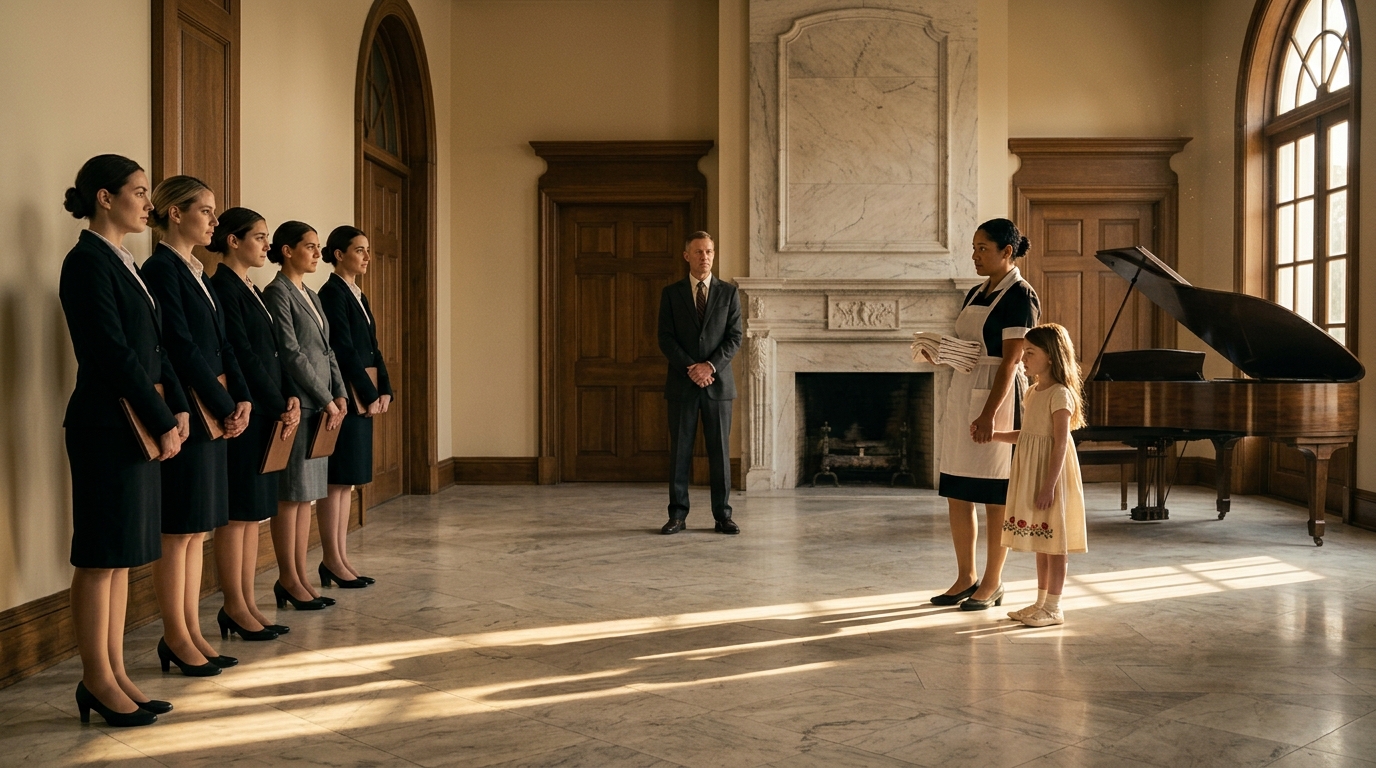
The marble floor in the Whitmore estate gleamed under the late afternoon sun pouring through the tall arched windows. Six women stood in a careful line near the grand piano, each holding a slim leather folder against her chest. They had driven up from New York in dark sedans, chosen from the most expensive child-care agencies to be measured by a seven-year-old girl.
Thomas Whitmore stood near the marble fireplace, his hands folded loosely in front of him. His daughter, Maya, wore her favorite cream-colored dress with embroidered roses along the hem. She walked slowly across the room, the way children walk when they know they are being watched.
Catherine, the first candidate, knelt down warmly. “My name is Catherine. I used to teach little girls how to ride. Maybe one day we could go to the stables together.” Maya looked down at the reflective tiles. “No, thank you,” she said softly. Olivia stepped forward next, offering three languages and piano lessons. Maya shook her head again. A third woman gestured toward the velvet couch, inviting her to sit.
From the wide doorway leading to the east hallway, Esther Brooke stood very still. She wore the simple gray uniform of the Whitmore House staff with a white apron tied neatly at her waist, holding a small bundle of folded linen napkins. Her hands bore the quiet, rough texture of eight years of cleaning and polishing. She had paused only because she sensed something shifting in a room she did not belong in.
Maya turned her head, catching Esther’s gaze across the marble. Without a word to her father or the six professionals, the little girl crossed the room with quick, certain steps. She walked straight to the doorway and wrapped her small hand around Esther’s fingers. “I choose her,” Maya said.
The air in the great room shifted instantly. Thomas lowered his hands to his sides, watching his daughter hold the cleaning lady’s hand. Catherine rose to her full height, her professional smile thinning at the edges. “Miss Brooks is a wonderful part of the household,” she said carefully. “She takes care of the house. A nanny takes care of you. Those are two very different jobs.”
Maya did not let go of Esther’s fingers. Esther kept her eyes lowered toward the floor, the stack of linens still pressed against her apron. Thomas felt a tight knot form in his chest, realizing the afternoon had just veered far off any path he had planned.
CHAPTER 2: THE PROFESSIONAL WARNING
Catherine adjusted her grip on the slim black folio, the synthetic leather creaking in the stillness of the great room.
“Mr. Whitmore,” Catherine said, her voice dropping an octave into the practiced register of a mediator handling a difficult client. “You are looking at this through the lens of sentimentality, but a household like this requires structural integrity.”
Thomas did not shift his weight. He kept his hands in his pockets, watching the dust motes drift through the column of sunlight coming off the Hudson.
“She’s a cleaning operative,” the silver-haired agency director added, stepping into the space Catherine had cleared. “Allowing staff to blur those lines is a well-documented failure mode in estates of this magnitude.”
A sharp clink of silver echoed from the distant pantry, cutting through the dense air.
“She gave the child water during a fever,” Thomas said quietly.
“Because it is convenient to be a savior when you are already inside the walls,” Catherine countered, her smile thinning until her lips pressed into a hard white line. “If you validate this disruption, you will spend the next five years negotiating bedtime with your own domestic staff.”
Thomas watched the way Catherine’s eyes darted toward the grand staircase, calculating her lost commission and the sting of being bypassed by a seven-year-old child and a woman in a gray uniform.
“Thank you for your time today,” Thomas said, turning his back on the line of professionals. “Mrs. Patris will see you out.”
CHAPTER 3: THE UNSPOKEN LEDGER
Thomas stepped over the threshold into Maya’s room.
The blue blanket on the bed was smoothed down, and a small picture book lay open on the center of the rug. Maya sat cross-legged beside her stuffed rabbit, her small hands turning a page with absolute care.
“We need to talk about downstairs,” Thomas said, his voice heavy against the quiet walls.
Maya did not look up immediately. She marked her place with a faded ribbon before raising her eyes to meet his.
“I’m not changing my choice,” she said.
“I know,” Thomas replied, sitting down on the edge of the mattress. “I just need to understand something.”
He thought of the clean corporate spreadsheets and structured timelines that governed his life, contrasting sharply with the raw, invisible architecture of care built in the dark hours of this house.
“When you were sick last year,” Thomas continued, leaning forward with his elbows on his knees, “you said nobody else was awake. How many other nights has Miss Esther been there?”
Maya looked down at her rabbit’s worn ear, her fingers tracing the fabric.
“A lot,” she whispered.
She told him about her birthday, when she had cried alone over the absence of a mother to bake a cake, and how Esther had appeared with flour and quiet comfort. She spoke of bad dreams and hot chocolate at the kitchen counter when the rest of the estate slept.
Thomas felt a sharp ache behind his ribs. He had been present in the house, eating breakfast, handing over backpacks, blind to the silent currents running beneath his roof.
“Do you want to see the note?” Maya asked softly, breaking the silence.
Thomas nodded, his throat tight. Maya walked to her white dresser, opened the top corner drawer, and retrieved a tiny square of folded paper hidden beneath a stack of handkerchiefs.
She handed it to him. Thomas unfolded the creased edges. The round, unpolished handwriting bore three simple words accompanied by a single sketched heart.
You are brave.
The weight of those three words anchored itself in his chest, heavier than any contract he had ever signed.
CHAPTER 4: THE KITCHEN THRESHOLD
Thomas stepped across the kitchen threshold, the floorboards groaning softly under his weight.
Esther turned from the sink, clutching a drying cloth with hands that had scrubbed this estate’s corners for eight uncounted years.
“Mr. Whitmore,” she said, her voice dropping into a defensive posture. “I was just finishing the prep counters for the morning.”
“Sit down, Miss Brooks,” Thomas said, gesturing toward the small wooden table near the window where the staff ate their meals.
Esther hesitated, her fingers tightening around the cotton fabric as she weighed the command against the invisible walls of her station. She finally crossed the room and sat on the very edge of the chair, her back rigid.
“Eight years,” Thomas said, pulling out the opposite seat. “You worked eleven years in Westchester before that, and night shifts in the city while your own daughter was in school.”
Esther lowered her gaze toward the grain of the wood. “Her name was Amalie,” she whispered. “She passed away when she was nine. Pneumonia. I was cleaning an office building uptown that night, and nobody heard her call.”
The copper pots above the stove caught the dim light, throwing long, still shadows across the table.
“That was the only reason I stopped when Maya came into the room,” Esther continued, her voice tightening with raw, suppressed grief. “I wasn’t looking for a promotion. I just made a promise in the dark that if any child cried out in a house where I worked, I would hear them.”
Thomas absorbed the heavy weight of her words, realizing how hollow his wealth had been while real human endurance bled silently in the corridors of his home.
“If I offer you this position officially,” Thomas said, his voice steady and low, “with a proper contract and full authority over Maya’s daily care, will you take it?”
Esther looked up, her dark eyes searching his face for any sign of hesitation or trap.
CHAPTER 5: THE OFFICIAL CONTRACT
Thomas lifted the receiver before the second ring could echo against the marble wainscoting.
“Mr. Whitmore,” Catherine’s voice snapped across the line, thin and devoid of its initial warmth. “We received word that your estate managers are restructuring the payroll codes. Surely you aren’t proceeding with that eccentric domestic assignment.”
Thomas leaned back against the mahogany desk, his gaze fixed on the quiet stretch of the Hudson visible through the tall mullioned glass.
“The decision is finalized, Catherine,” Thomas said, his voice flat and unyielding.
“You are dismantling thirty years of professional protocol,” Catherine countered, her pitch rising past the barrier of corporate composure. “When those school board circles and family associates find out you’ve elevated a cleaning woman to primary guardian, the social blowback will isolate your daughter entirely.”
“My daughter made her choice based on who actually showed up in the dark,” Thomas replied, his grip tightening around the receiver. “And I am standing by it.”
A sharp click echoed as the line went dead on the other end, the digital hum signaling the collapse of their leverage.
Thomas set the phone back onto its cradle.
Outside in the second-floor hallway, quiet footsteps moved toward Maya’s room as Esther began her morning rounds, carrying a fresh uniform and an established title that no amount of agency whispered pressure could dismantle.
CHAPTER 6: THE QUIET GARDEN
Thomas stood near the kitchen window, watching the two figures move in quiet synchronization along the perimeter.
The months had worn away the sharp edges of estate routine, replacing institutional distance with a steady, unforced rhythm. There were no longer whispered phone calls from agencies, nor was there the hollow echo of an empty chair at the end of the long dining table.
Maya pressed a final handful of dark dirt around a stem, her small hands smudged with earth.
“Is it straight, Miss Esther?” Maya asked, tilting her head.
“Straight as an arrow,” Esther replied softly, her gloved hand resting lightly on the child’s shoulder.
Thomas watched them from behind the glass, feeling the heavy friction of his past isolation finally dissolve into the simple, grounding reality of the present moment. He had spent years managing what the world saw on paper, missing the true human architecture built silently right under his roof.
The wind rustled through the maple leaves along the driveway, carrying no threats, no corporate pressure, only the sound of a little girl laughing as she reached for the watering can.
Family was never a matter of titles, contracts, or expensive agency placement. It was built by the person who stayed when the lights went out, who listened in the dark, and who possessed the quiet courage to call love by its real name.