The Frozen Ridge Where Mathematics Shattered an Elite Division Through Desperate Precision and Iron Will
CHAPTER 1: THE COLD HORIZON
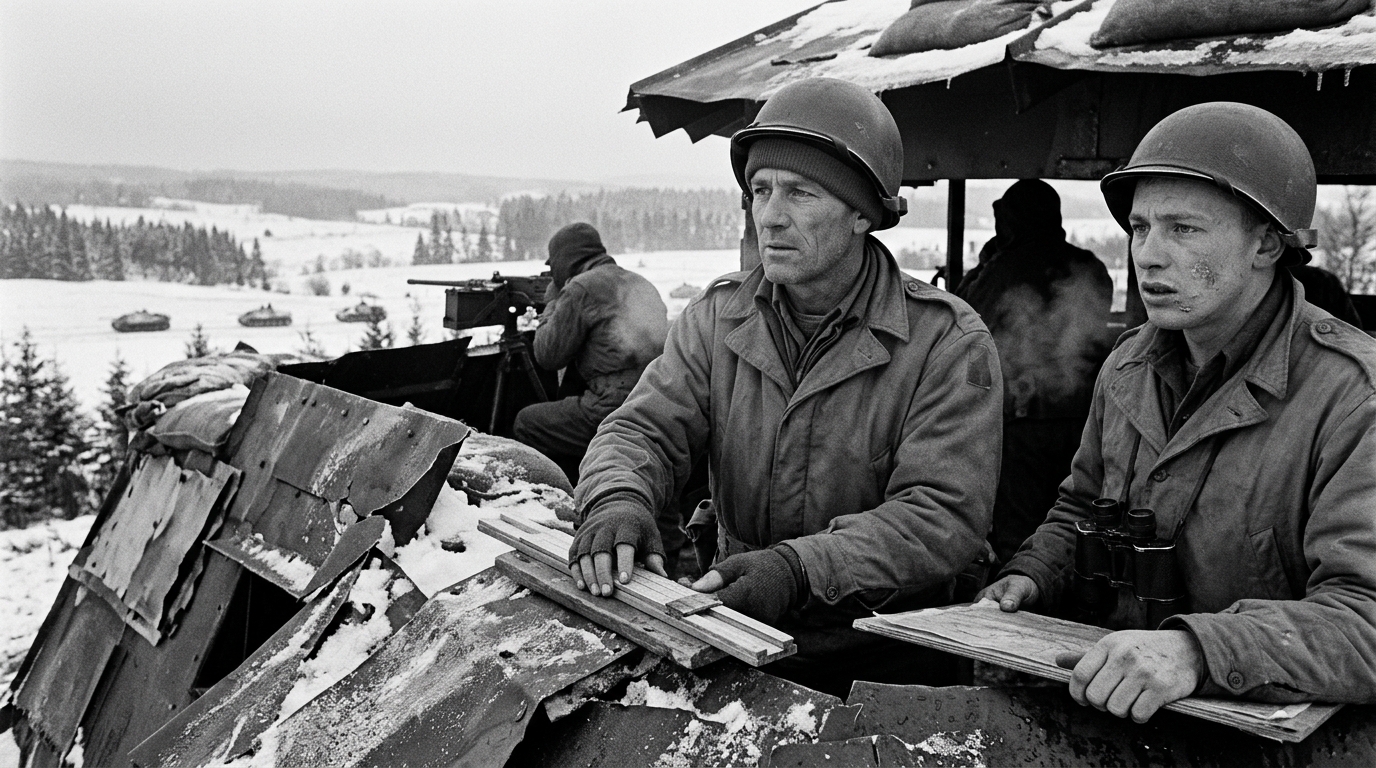
The frost bit hard into the canvas of the observation post roof. Staff Sergeant Irvin Schwarz rubbed his numb fingers together, blowing a plume of white breath over the scarred metal of his slide rule.
Down in the valley, the snow-covered evergreens stood dead still against the pale gray dawn. There was no wind to mask the sound, only the faint, rhythmic clank of heavy treads grinding against frozen earth.
Across the ridge, the first gray shapes of German armor detached themselves from the tree line. They moved with the confident, unhurried pace of veterans who had broken through better lines than this.
Irvin didn’t reach for a weapon or shout an order. He tapped the edge of the wooden slide rule against his knee, watching the distance markers shift in the dim morning light.
“They’re early,” muttered the gunner beside him, his voice scraping raw through a dry throat.
“They’re arrogant,” Irvin said, his eyes fixed on the leading Jagdpanzer crawling out into the open field. “Let’s see how much they like the math.”
CHAPTER 2: SEVERED LINES
Irvin didn’t look up when the field telephone on the reinforcement post let out a dry, rattling click and then died completely. The wire strung through the gully had taken a direct hit from a stray mortar round three minutes ago.
“Dead?” Corporal Miller asked, his breath pluming thick in the frozen trench.
“Completely,” Irvin said. His fingers were already tracing the precomputed grid coordinates on the damp greasepaper map. “We aren’t calling higher headquarters for a coordinated sweep today.”
Down the slope, the lead German tank pivoted its blunt snout toward the secondary road junction. Grenaders fanned out behind its steel skirts, boots splashing through the melting slush of the tree line.
They were expecting the usual automated response of a disciplined defense grid. They were expecting a quick adjustment from a central command post miles to the rear.
Instead, there was only silence over the wire. Irvin picked up a stubby wooden pencil, his knuckles gray with cold, and began scratching numbers onto the margin of the map board.
“Distance hasn’t changed,” Irvin muttered, keeping his voice flat to steady the younger men around him. “We calculate our own deflection. One gun at a time.”
“They’re inside six hundred yards,” Miller whispered, his grip tightening hard on the cold barrel of his rifle.
“Let them close the gap,” Irvin replied, tapping the wooden edge of his slide rule against the map. “Makes the math cleaner.”
CHAPTER 3: THE IRON ADVANCE
Panzer grenadiers surged out from the veil of evergreens, their long gray coats splashing through the melting slush of the open field.
They moved with an absolute, arrogant certainty, fully trusting that the downed telephone lines had left the ridge blind and helpless.
Miller wiped a streak of cold sweat from his forehead with the back of a stiff woolen glove, his breath coming in ragged gasps.
“They’re not even spreading out,” Miller hissed, locking his shoulder hard against the wooden parapet. “They think we’re just targets on a firing range.”
“Let them keep thinking that,” Irvin said without looking up from his calculations.
A sudden memory of the endless training rounds at Fort Sill flashed through Irvin’s mind, a stark contrast to the frozen mud beneath his boots.
He tapped the wooden slide rule against the map board once, twice, anchoring his nerves against the rising tide of mechanical noise outside.
“Adjust three degrees left of the gully,” Irvin commanded, his voice cutting cleanly through the mounting roar of armored engines. “And pray the wind holds steady for thirty seconds.”
CHAPTER 4: THE SILENT ADJUSTMENT
The wind whipped jagged shards of ice across the open parapet, stinging Irvin’s cheeks as he crouched beside the rough wooden aiming stakes.
Without the automated humming of the central switchboard, every angle had to be measured by hand, using a cracked protractor and sheer stubborn guesswork.
Miller cursed softly under his breath, sliding a heavy brass shell casing into position with a sharp, echoing metallic clang.
“The wind’s shifting north,” Miller warned, his eyes darting toward the gray smoke drifting across the lower ridge. “If we miss by a yard, we’re hitting our own front trench.”
“We aren’t missing,” Irvin replied, keeping his voice entirely level while his thumb dragged across the map scale.
He didn’t have the luxury of a secure command link or a pristine plotting room, only the freezing mud beneath his boots and the raw grit of men who refused to yield.
“Adjust two ticks back on the windage screw,” Irvin ordered, tapping his knuckles against the icy wood. “Then let them taste the iron.”
CHAPTER 5: THE CONVERGING STORM
The leading edge of the enemy formation didn’t slow down when they reached the open clearing. They pressed their steel forward, assuming the silent ridge meant total surrender.
Irvin didn’t blink against the biting wind as he scanned the grid numbers one last time.
“They’re bunching up by the tree line,” Miller snarled, his jaw locked tight against the mounting tension. “Now’s the time.”
“Not yet,” Irvin muttered, his pencil hovering over the final coordinate mark. “Let them commit every last squad to the open.”
The enemy commander stood upright in the turret cupola, gesturing aggressively toward the upper trench lines with unyielding arrogance.
Every battery across the frozen ridge waited in absolute silence for a signal that would never come over the dead wires.
Irvin slammed the edge of his slide rule down against the wooden table with a sharp crack—the signal for every gunner to release hell at once.
“Fire,” Irvin breathed.
CHAPTER 6: SILENCE ON THE RIDGE
The concussive shockwave rolled across the snow-covered valley, lifting a dense wall of white smoke and pulverized earth into the freezing air.
For a long moment, nobody in the forward trench moved, listening only to the ringing echo of the synchronized barrage settling over the shattered tree line.
Miller dropped his empty shell casing into the frozen mud, his shoulders sagging under the immense weight of the exhausted hours.
“They’re falling back,” Miller breathed, staring through the thinning haze at the deserted slope below. “They actually stopped.”
“They didn’t just stop,” Irvin said, his fingers carefully folding the grease-stained map along its worn creases. “They realized mathematics don’t care about their credentials.”
The heavy silence of the Ardennes settled back over the ridge, broken only by the soft drip of melting frost from the dugout timbers.
Irvin placed the wooden slide rule back into his pocket, wiping a smear of soot from his numb fingers without looking at the valley again.
The ridge held, the supply road remained open, and the common sense of manual precision had outlasted the arrogance of an elite division.