The Iron Weight of Mud And Metal: How One Forgotten Sergeant Rewrote the Rules of Survival in the Pacific Jungle
CHAPTER 1: DRAGGING IRON THROUGH HELL
The mud didn’t care about rank or requisition forms.
It coated the cuffs of my fatigues in a thick, gray paste that smelled of stagnant water and rotting vegetation. My shoulder muscles burned with a dull, rhythmic throb every time I heaved against the hemp rope tied to the carriage.
We had abandoned the path a mile back when the muck became too deep for wheels.
Henderson was swearing under his breath behind me, his palms raw where the canvas gloves had worn through. Neither of us spoke because wasting breath meant losing the cadence.
“Keep the tension,” I muttered, my voice raspy from the heavy, wet air.
General Morrison could sit back at the beach perimeter with his hot coffee and his ledgers all he wanted. He wasn’t the one listening to the radio traffic from the ridge.
Seventeen men were dead. Twenty-three were bleeding out in the roots of a banyan tree that had swallowed half a platoon.
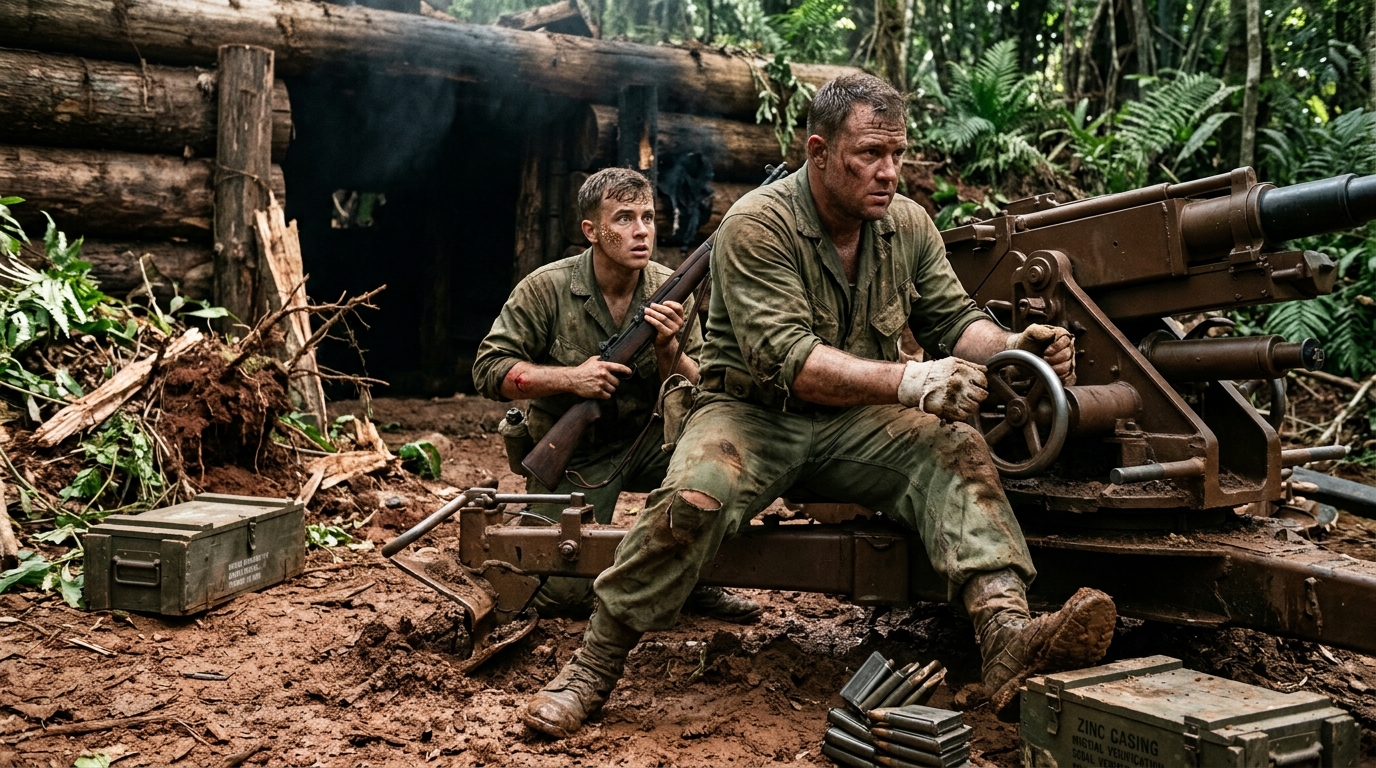
The Bofors forty-millimeter sat behind us on its iron carriage, a five-thousand-pound anchor of precision Swedish steel that was never built for this green hell.
A sharp crack echoed through the canopy far ahead, followed by the dry, stuttering rattle of a Japanese heavy machine gun chewing up another patch of cover.
Henderson spat a mouthful of grit into the ferns and heaved his weight forward against the tow-bar.
“If we make it to that ridge, Sergeant,” he grunted, his boots slipping in the red clay, “the court-martial’s going to be the least of our worries.”
“We only have to worry about what’s in front of us,” I said, locking my boots into the slick earth and pulling until my chest felt like it was caving in.
CHAPTER 2: POINT BLANK RANGE
The jungle didn’t offer breathing room.
We had wrestled the five-thousand-pound iron carriage through three miles of sucking mud only to drop it two hundred yards from a reinforced timber nest that had chewed up a full infantry company.
Henderson wiped sweat and gray clay from his forehead with the back of a raw, bleeding forearm.
“Sergeant, the firing slits are too narrow,” he muttered, ducking as a machine gun burst chewed the ferns three feet to our left. “We can’t elevate this thing high enough to clear the ridge line.”
“We aren’t shooting over the ridge,” I said, my fingers locking around the traverse wheel while the metal burned my palms through the torn canvas gloves. “We’re shooting straight through the front door.”
The Bofors was designed for high-altitude skies, not point-blank duels with entrenched infantry.
Its thin gun shield offered about as much protection as a wet bedsheet against direct horizontal fire.
A fresh round of dirt kicked up from the carriage wheel, stinging my cheek with sharp grit.
I checked the ammunition clips stacked in the mud beside the breach, my eyes catching a strange omission stamped onto the zinc casing crate—a missing serial verification block that should have been signed off at the rear echelon supply depot weeks ago.
General Morrison’s inventory clerks had been so busy hoarding these rounds behind barbed wire at the beach that they hadn’t even bothered to log half the shipment coming inland.
They wanted pristine ledgers while Lieutenant Coleman’s boys bled out in the roots of the banyan tree.
“Load the first clip,” I ordered, ignoring the whistle of incoming small-arms fire.
Henderson slammed the strip into the receiver with a sharp metallic snap, his eyes wild and fixed on the dark, smoking aperture of the Japanese bunker ahead.
CHAPTER 3: THE WOOD SPLINTER EFFECT
The forty-millimeter shell didn’t bore a neat hole through the timber fortification.
It met the two-foot-thick saturated logs and detonated instantly on the surface, converting the Swedish-engineered high-explosive round into a violent shockwave.
The heavy wood walls didn’t simply crack—they blew outward in a massive fan of razor-sharp splinters.
A muffled cry echoed from inside the dark fortification as the enemy machine gun abruptly choked into silence.
Henderson scrambled back against the carriage wheel, wiping a spray of fine sawdust from his sweat-streaked eyes.
“It’s tearing their own cover apart,” he yelled over the ringing in our ears, his chest heaving with raw adrenaline.
“Keep feeding the breech,” I shouted back, my shoulder throbbing from the violent recoil of the gun.
There was no time to celebrate a clean hit or admire the tactical math.
The rear echelon ledgers back at the beach headquarters didn’t account for this kind of brutal, improvised physics, and General Morrison certainly never planned for his pristine ordinance to be used as a close-quarters demolition hammer.
Every shell we fired was an unauthorized expenditure that threatened a court-martial, but every second we delayed meant another infantryman bled out in the mud.
I gripped the traverse wheel, shifted our angle slightly toward the secondary firing slit, and slammed my foot onto the pedal once more.
CHAPTER 4: THE GLOWING BARREL
The air around the breach smelled of scorched oil and heated zinc.
Henderson pulled his fingers back from the magazine with a sharp hiss of pain, staring at the raw blisters forming across his palms.
“Sergeant, the metal’s warping,” he warned, his voice cracking as he slammed another clip into place. “If we push another round through this chamber without cooling, it’s going to detonate right in our faces.”
“We stop now, the infantry dies in the mud,” I said, my grip tightening on the traverse wheel as the heated steel scorched through my glove.
The rear echelon commanders back at headquarters were never going to understand the math of survival under fire.
General Morrison’s ledgers treated every piece of equipment as a sacred artifact to be hoarded in pristine condition, completely divorced from the grim reality of boys bleeding out two hundred yards away.
The missing requisition stamp from the supply crate flashed in my mind—a silent symbol of an institutional machine designed to protect paperwork rather than human lives.
A loud ping echoed from the weapon as the barrel expanded under extreme thermal pressure.
“Keep feeding it,” I ordered, my eyes locked on the smoking timbers of the collapsing fortification ahead.
CHAPTER 5: THE JUNGLE CHARGE
The enemy didn’t wait for the bunker to finish collapsing.
A dozen figures broke through the tangled green curtain to our east, sprinting directly toward the gun carriage with desperate momentum.
Henderson scrambled back, his boots slipping on the spent brass casings scattered across the red clay.
“Sergeant, they’re on us!” he yelled, his fingers fumbling with the heavy bolt of his sidearm.
There was no time to turn the massive carriage around or crank the elevation gears for distant targets.
I grabbed the heavy traverse wheel and jerked it violently to the side, swinging the smoking muzzle straight toward the oncoming wave.
The Swedish-engineered barrel was glowing a bright, angry orange, radiating heat that scorched the skin on my face from three feet away.
I slammed my boot down on the firing pedal without hesitation.
The forty-millimeter rounds tore through the charging line at point-blank range, turning the dense vegetation into a chaotic wall of shattered wood and blinding concussive force.
General Morrison’s precious inventory ledgers and court-martial threats vanished from my mind, replaced entirely by the immediate friction of survival and the grim duty of keeping my men alive.
The charge faltered, broken not by tactical brilliance or official doctrine, but by raw, stubborn defiance in the face of impossible odds.
CHAPTER 6: THE VANISHING PAPERWORK
The silence that followed was heavy, broken only by the distant crackle of burning timbers and the ragged breathing of our crew.
Lieutenant Coleman stepped through the shredded vegetation, his boots crunching on the scorched earth as he stared at the smoking ruin of what had been an impenetrable stronghold.
“You just destroyed a five-thousand-dollar piece of government artillery,” Coleman said, his voice dropping into a flat, exhausted disbelief.
“I just saved your platoon,” I replied, wiping a mixture of soot and sweat from my brow with the back of a scarred hand.
General Morrison’s disciplinary machine moved with predictable malice over the following days, generating stacks of crisp court-martial paperwork detailing every unauthorized shell and destroyed gear component.
The charges were severe, carrying a sentence of up to ten years in a military prison for willful destruction of property and direct insubordination.
Yet, when those files traveled upward through the regimental chain of command toward the divisional judge advocate, they simply vanished into the bureaucratic ether.
The officers who had been so certain of the violations suddenly developed a convenient amnesia, unable to locate the missing requisition stamps or witness statements.
What remained in circulation were the casualty reports from the ridge—numbers that proved infantry units supported by improvised artillery fire suffered a fraction of the losses of those abandoned by rigid doctrine.
Within months, the tactical manuals rewritten in blood and common sense became standard operating procedure across the Pacific.
I finished the war as a technical sergeant, keeping a single warped piece of steel from that ruined Bofors barrel on my desk as a quiet reminder of what happens when you care more about human lives than a pristine ledger.