Iron on the Trail: How One Commander’s Defiance Shattered the Myth of Invincibility in the Bataan Jungle
CHAPTER 1: DAWN ON THE TRAIL
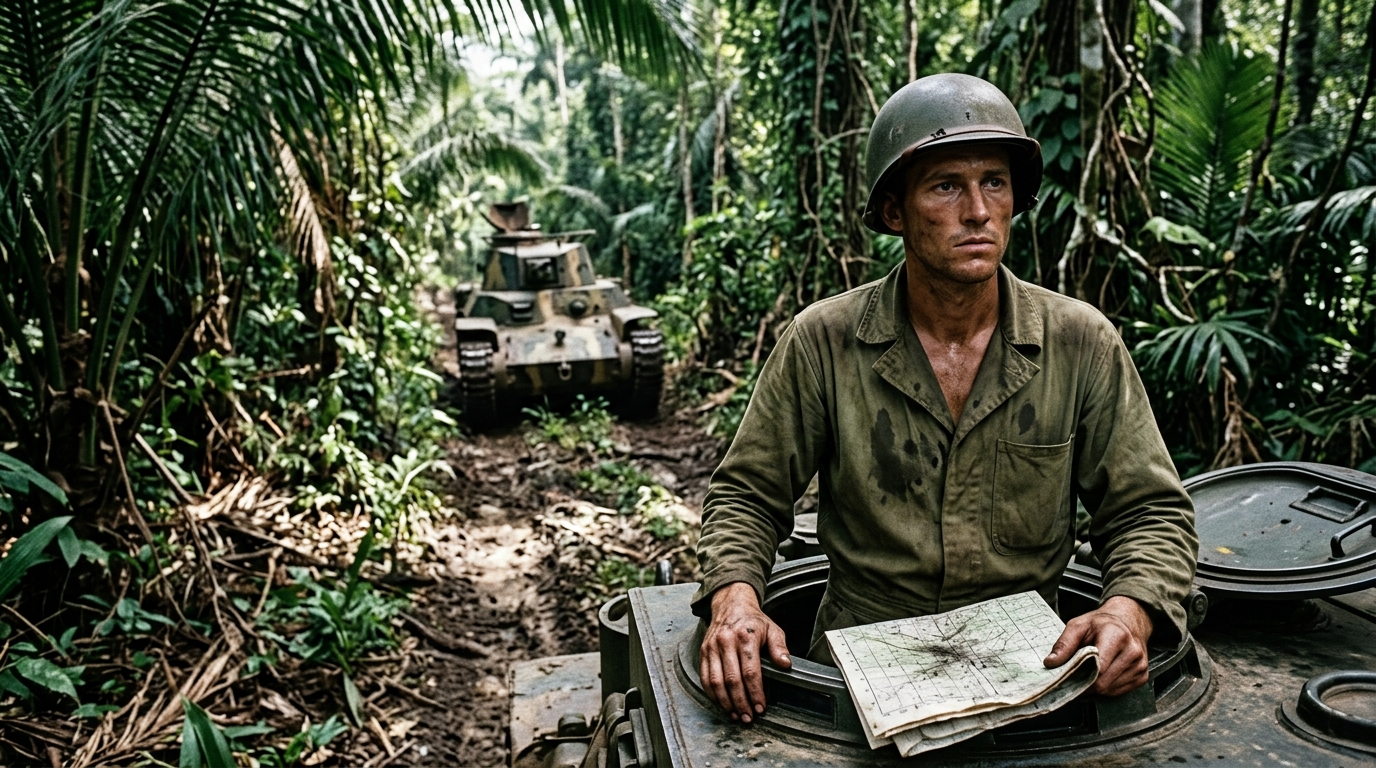
The diesel engine of the M3 Stuart idled with a heavy, rhythmic thrum that vibrated right through the steel deck into the soles of Benjamin Morett’s boots.
He kept his weight planted against the commander’s seat, his fingers braced on the rim of the cupola as his eyes swept the dense green wall of the Bataan jungle.
Three weeks of continuous withdrawal had taught him the smell of retreat—wet wool, stagnant sweat, and the sour copper tang of exhausted men who had stopped believing in their own weapons.
The standing orders from higher command were taped inside the hull in clear, unyielding black ink: preserve the armor, avoid engagement with superior forces, and pull back when outnumbered.
Outnumbered nearly three to one against eight Japanese Type 97 Chiha tanks, the textbook choice was simple and cowardly.
Morett felt the familiar knot of frustration tighten in his chest, his thumb rhythmically rubbing the edge of a folded, oil-stained topographic map tucked into his breast pocket.
Down in the turret below, Corporal Mitchell shifted his weight, the scrape of his boots against the ammunition racks carrying clearly through the intercom static.
“Sergeant,” Mitchell’s voice came up through the line, tight and low, “column’s moving past the bend at four hundred yards.”
Morett raised his binoculars, the rubber eye-cups pressing hard against skin slick with humidity as the lead enemy silhouette broke through the palm fronds.
The intelligence briefings whispered in the back of his mind—stories of battle-tested steel that had steamrolled armies across Asia and left American crews convinced their own 37mm pop-guns were useless.
The jungle around them offered no safety net, no friendly infantry line to fall back on, and no permission from headquarters to stand their ground.
He stared down the barrel of the approaching enemy column, his jaw hardening as the absurd weight of three weeks of running pressed down on his shoulders.
“Mitchell,” Morett said, his voice flat and steady against the roar of the idling engine, “load armor-piercing.”
CHAPTER 2: FIRST BLOOD IN THE BRUSH
The recoil from the 37mm gun hit the steel frame like a sledgehammer, sending a violent shudder through Morett’s boots.
He didn’t blink, keeping his eyes glued to the optical sights as the smoke cleared across the six-hundred-yard stretch of damp jungle trail.
The lead Type 97 Chiha hadn’t exploded like the training manuals predicted; instead, it simply lost all forward momentum, rolling sluggishly twenty yards off the path with greasy black smoke vomiting from its commander’s hatch.
Mitchell’s hands shook for a fraction of a second against the traversing controls before the raw discipline of six months at Fort Knox took over.
“Target two,” Mitchell muttered, his voice cracking slightly under the sudden weight of realized capability.
Morett didn’t answer with words; he simply shifted his weight against the iron rim of the cupola, his fingers tracing the torn edge of the topographic map in his pocket.
The remaining Japanese tanks in the column were scrambling now, their turrets swinging wildly as they tried to deploy from a tight column into a firing line.
They were operating on the assumption that American armor was a ghost—something to be brushed aside or avoided, not something that could punch clean through twenty-five millimeters of imperial steel.
A stray 57mm round from the second enemy tank hissed overhead, snapping a palm frond in half before detonating harmlessly against a wet dirt bank fifty yards behind them.
The enemy’s guns were built for infantry support, not for cracking armor, and every second they wasted trying to find a target played directly into the harsh logic of the Bataan trail.
“Load solid shot,” Morett barked, his eyes tracking the second Chiha as it fumbled to pivot its narrow chassis.
Mitchell slammed another round home, the metallic clack echoing off the steel walls like a hammer blow.
CHAPTER 3: THE JUNGLE KILL ZONE
The optical reticle framed the moving metal silhouette as the second Chiha fought to pivot its narrow tracks.
A memory of three weeks of endless, humiliating retreat flashed across the back of Morett’s mind—the infantry cursing the empty skies and the silent iron sitting useless in the rear.
The absurdity of that fear burned hotter than the tropical humidity clinging to his collar.
“Fire,” Morett muttered, his hand dropping sharply against the intercom switch.
The 37mm gun bucked with a vicious, deafening roar, sending a fresh wave of acrid smoke washing back over the turret ring.
Across the six-hundred-yard clearing, the solid steel round slammed directly into the enemy vehicle’s turret mantlet, punching straight through the housing with a sharp, echoing snap.
The machine didn’t return fire; it simply ground to an immediate halt as secondary explosions began cooking off the internal ammunition racks.
Remaining enemy vehicles scrambled in desperate confusion, their columns breaking apart against the dense walls of palm and vine.
Morett watched them flounder through the vision blocks, his thumb rubbing the frayed edge of the map in his pocket as the cold reality set in.
They weren’t fighting an unstoppable titan; they were fighting a ghost built entirely out of rumor and unverified caution.
“Keep the traverse steady,” Morett warned, his voice flat and hard against the metallic groans of the retreating column.
CHAPTER 4: THE POINT BLANK CHARGE
Morett’s fingers tightened around the cold steel cupola edge as a third enemy vehicle abruptly shifted out of the smoke, its tracks clawing at the muddy incline with desperate speed.
The machine was accelerating right down the center of the trail, closing the gap from four hundred yards down to two hundred in a matter of seconds.
“They’re coming straight in,” Mitchell called out from the darkness of the turret, his breath hitching over the internal wire as the diesel whine outside spiked into a frantic pitch.
The opposing commander wasn’t trying to maneuver or deploy anymore; unearned audacity had turned into a reckless, headlong rush to close the distance before their own low-velocity guns became completely useless.
Morett watched the rising sun insignia painted on the enemy turret loom larger in his vision blocks, his thumb unconsciously rubbing the torn seam of the map in his pocket.
“Hold until a hundred,” Morett ordered, his voice dropping into that flat, unyielding register that left no room for panic.
The ground beneath the tracks vibrated with a heavy, rhythmic pounding as the charging steel closed the remaining gap.
Mitchell’s boots braced hard against the floor plates, his eyes locked on the optical crosshairs while the distance counter ticked down in his head.
“Now,” Morett snapped.
The 37mm gun erupted with a sharp, blinding crack that slammed the heavy breach back against the stops and filled the compartment with a stinging wave of cordite.
CHAPTER 5: IRON AND SHRAPNEL
Mitchell’s hand flew back to the reloading lever while the smell of hot sulfur filled the cramped turret, his knuckles barking hard against the steel bulkhead.
Outside the armor plate, a dull concussive thud rattled the hull as an infantry rifle grenade detonated squarely against the commander’s cupola.
A stinging shower of hot iron fragments whipped across Morett’s face, instantly blinding his left eye with a warm, metallic rush of blood.
“Sergeant!” Mitchell shouted up through the wire, his voice cracking with sudden panic as the intercom hissed. “Are you hit? Do we bail?”
Morett gripped the bloody rim of the hatch, his jaw locking against the searing pain tearing through his shoulder and jaw.
The enemy infantry was swarming the flanks now, trying to salvage a desperate counter-move as their armored line disintegrated into burning scrap.
“Keep loading,” Morett rasped, his voice cutting through the ringing in his ears with brutal, unyielding common sense.
He blinked the blood away from his remaining sight, his eyes scanning through the smeared glass for the next moving silhouette.
CHAPTER 6: THE NEW DOCTRINE
Morett wiped the smeared blood from his vision block with a heavy, calloused thumb, his breath coming in slow, ragged hitches as the diesel engine settled back into a low idle.
Colonel Miller stepped up beside the scarred steel track, his boots crushing dry twigs as he leaned in to inspect the ragged entry hole punched straight through the ruined enemy chassis.
The battalion commander didn’t offer praise or elaborate speeches; he simply measured the thin plate with a small metal scale, his face hardening as the undeniable truth of the physical evidence settled between them.
“The books were wrong,” Miller said, his voice carrying the flat weight of an officer forced to confront his own mistakes.
“They weren’t wrong, sir,” Morett replied, his grip tightening instinctively on the torn map in his breast pocket. “We just never bothered to check.”
Miller nodded once, the old preservation doctrine dying right there in the damp heat of the jungle trail without a single word of mourning.
The orders were rewritten on the spot, junking months of paralyzed caution in favor of the raw, common-sense reality that steel built on fear could not stand against men willing to hold their ground.
Morett let out a long, shuddering breath, his eyes drifting over the silent tree line where the acrid smell of burnt rubber finally began to fade into the morning mist.