The Silent Footsteps of the Delta: How a Handful of Outcast Rangers Vanished Into the Enemy’s Footwear
CHAPTER 1: THE MUDDY LEDGER
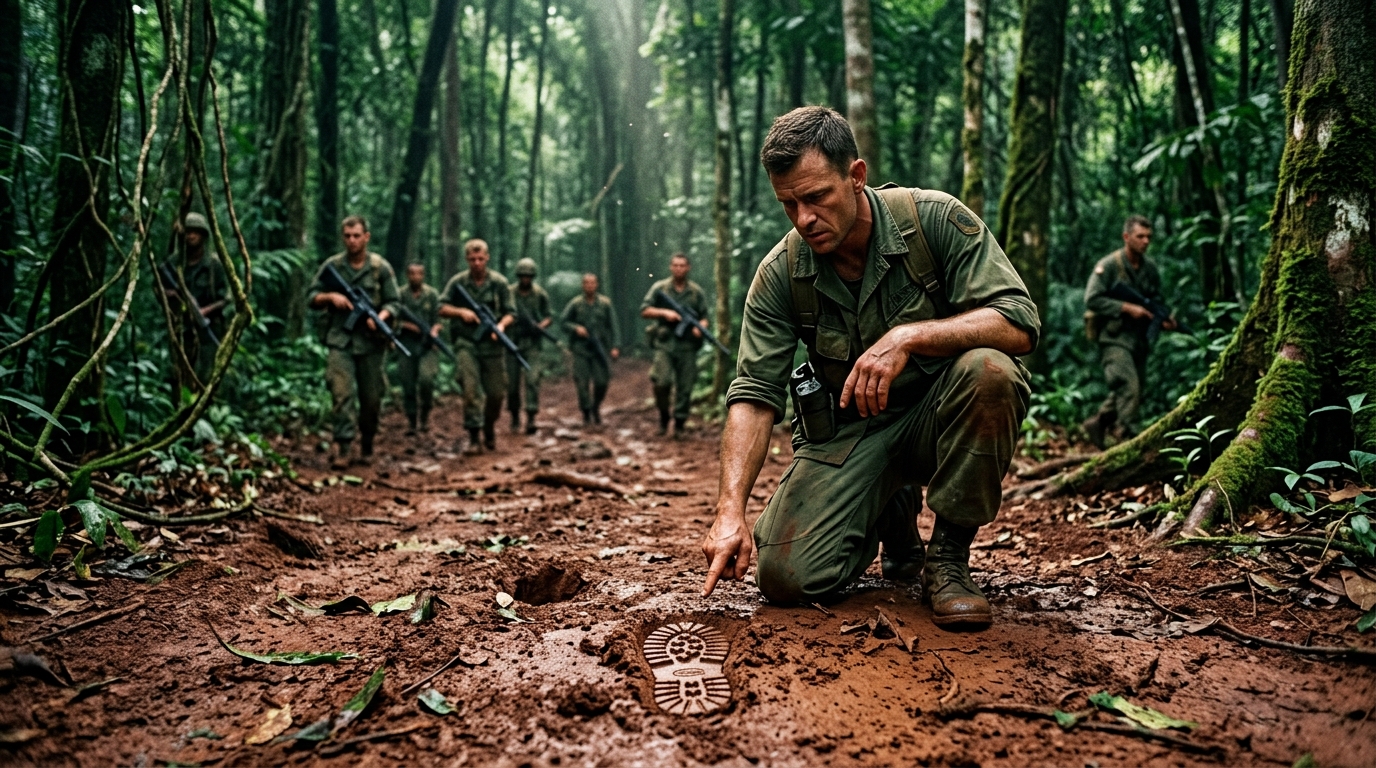
The American sergeant dropped to one knee and reached out with a scarred thumb to test the moisture of the soil.
The impression in the laterite clay was crisp, fresh, and unmistakably distinct.
A standard Vibram lug sole with a Panama tread pattern.
He looked up through the tangled canopy, his radio handset dead against his belt due to the heavy canopy and dead batteries, muttering a silent calculation to his men spread out in a loose wedge behind him.
They had been humping through the lowlands south of Nui Dat for three hours, chasing a trail that felt too easy, too textbook, too accommodating.
Every stride forward required a deliberate push against the sticky, choking humidity that soaked through their canvas uniforms and turned their boots into lead weights.
The sergeant spat a bitter taste of copper and stale canteen water onto a fern frond, his eyes scanning the dense wall of green for any shift in light or shadow.
The tracks pointed northwest, following the dry bed of a seasonal creek toward the river system, exactly where an inexperienced enemy would run when pushed.
Behind him, a private shifted his weight, the metal buckle of a rucksack clinking softly against a canteen cup.
The sergeant raised a single gloved hand, holding the entire platoon frozen in the suffocating stillness of the jungle.
He didn’t know that the prints beneath his knees had been made four hours earlier by an entirely different set of boots, left behind deliberately to draw his platoon away from a ridge they had no business climbing.
The earth beneath them was acting as a ledger, recording every misstep, every heavy breath, every ounce of arrogant American hardware hauled through the brush.
He motioned two men forward with a sharp chop of his hand, whispering an order to keep the spacing tight and the safety catches off.
The jungle did not answer back, offering only the heavy, dripping drone of insects and the distant, mocking call of a hornbill.
He hauled himself up by a moss-covered root, ignoring the throbbing ache in his lower back, and stepped directly into the next set of identical tracks.
CHAPTER 2: THE WEIGHT OF STEEL
The coarse grit of the sandpaper tore against the vulcanized rubber with a rhythmic, grating rasp that masked the distant mortar thuds rolling over the southern ridge.
Dennis didn’t look up when the heavy canvas partition rattled, his thumb pressing hard against the rough edge of the freshly cut sole to smooth away a ragged burr.
Standard-issue canvas and leather boots sat in a neat, neglected row beneath the cot, their thick Vibram Panama treads caked in dry laterite clay that no amount of base soap could ever truly scrub away.
Those boots were heavy, engineered by committees thousands of miles away to fight a war on maps, shouting out their nationality with every heavy, unyielding step they took through the lowlands.
He picked up a section of inner tube, stretching the tough black band between his calloused hands to test its elasticity before feeding it through the narrow slots carved into the tire scrap.
“The quartermaster won’t like seeing those racks empty,” a low voice murmured from the shadows near the entrance, belonging to a veteran corporal leaning against the center pole with a half-empty mug of lukewarm tea.
“The quartermaster isn’t the one walking forty clicks through the Soi Da Bang swamps next Tuesday,” Dennis replied without slowing his pace, the rasp of rubber drowning out the rising wind outside.
He didn’t bother explaining the arithmetic of survival to a man who still believed a clean uniform and a polished brass buckle kept you safe in triple-canopy jungle.
The transition wasn’t about looking the part or playing dress-up; it was a brutal, physical recalibration of the feet that had to be hammered into the skin weeks before stepping outside the wire.
He reached for a block of coarse gritstone, dragging the rubber edge across it until the scent of sulfur and old road tar filled the cramped, dim interior of the tent.
Outside, the base generators hummed their steady, mechanical drone, but inside, the only sound was the deliberate, quiet friction of men shedding their civilized skin to become something the jungle wouldn’t immediately hunt.
CHAPTER 3: THE HUNDREDMETER HOUR
The transition from the gravel path to the saturated lowland soil was entirely silent.
Dennis adjusted the weight of his rucksack, feeling the straps bite into his shoulders with a familiar, abrasive friction that demanded total concentration.
Beside him, Miller checked the toggle of his webbing without a single metal click, his eyes fixed on the impenetrable wall of dripping green foliage ahead.
“Move,” Miller muttered under his breath, the word little more than a shift in the heavy air.
They stepped forward into the triple-canopy darkness at a pace so agonizingly restrained it felt like standing still.
One hundred meters an hour.
Every single step required a conscious calculation of weight distribution, shifting balance away from dry twigs and decaying leaves that could snap like a pistol shot.
Dennis lowered his foot onto a mossy log, testing the surface for give before committing his full weight to the rubber tread beneath his toes.
The jungle around them breathed with a heavy, ancient rhythm, masking their movement behind the drone of cicadas and the constant drip of condensation from the canopy.
A sudden shift in the wind brought a faint, stale odor of tobacco smoke from a ridge three hundred meters to their left.
Dennis froze instantly, locking every muscle in his body into absolute stillness to let the environment recover its baseline soundscape.
The birds resumed their calls after a long, agonizing pause, confirming that their passage had gone completely undetected by whatever waited in the mist.
He didn’t need a radio or a command structure to tell him the game had changed; the mud beneath his feet was already telling a story that belonged to someone else entirely.
CHAPTER 4: THE STREAM CROSSING
The water ran fast and cold over the jagged stones, cutting a deep trench through the lower valley where the vegetation thinned into slick gray rock.
Dennis didn’t hesitate, stepping deliberately into the current to wash away the sticky muck of the inland trail.
Miller dropped down beside him, his rifle held high above the surface, his breathing sharp and shallow against the rushing sound of the water.
“Cut left,” Dennis muttered, gesturing toward a jagged limestone outcrop that jutted out over the stream like a broken tooth.
They waded upstream for fifty meters against the biting drag of the current, deliberately scrubbing out every trace of their footprint from the muddy banks.
A tracker arriving at their entry point would find the trail terminating at the water’s edge, forced to guess whether the ghosts had vanished upstream, downstream, or dissolved into the limestone itself.
Dennis hauled himself up onto a dry boulder, water dripping in heavy sheets from the crude rubber straps of his sandals.
Across the creek, the jungle wall remained silent, hiding whatever scouts might be combing the banks for a clean trail.
There were no fresh boot prints here, only the ambiguous, overlapping prints of rubber soles that matched the very people doing the hunting.
He wrung out the hem of his trousers with slow, mechanical efficiency, his eyes locked on the dark line where the water disappeared around a sharp bend.
The trap was tightening, but the tracks were leading everyone in circles.
CHAPTER 5: THE PHANTOM ENCOUNTER
Dennis froze mid-stride, his palm flat against the damp bark of a teak tree as a distant shadow flickered through the thick bamboo screen ahead.
Miller dropped to one knee behind a rotting log, his fingers tightening around the stock of his rifle without making a sound.
A lone scout from the local battalion stepped out onto the game trail twenty yards away, his eyes scanning the mud with practiced, casual confidence.
The scout paused, staring down at a set of crude rubber impressions left in the path just minutes before.
A heavy, suffocating silence descended over the ridge as the tracker’s brow furrowed in sudden, visible confusion.
“They’re ours,” Miller whispered, his voice barely disturbing the humid air.
“That’s the point,” Dennis replied, his thumb sliding slowly across the checkered grip of his knife.
The scout crouched lower, running a brown finger along the edge of the sandal print, searching for the familiar lugs of an American boot and finding only the flat, irregular signature of his own people.
Uncertainty rippled across the tracker’s face, a sudden paralyzing hesitation that broke the rhythm of the patrol’s routine.
Instead of raising an alarm or calling for an ambush team, the scout stood up slowly, muttered a curse under his breath, and backed away into the vegetation.
The trap had closed on empty air, leaving the tracker stranded in a web of his own assumptions.
CHAPTER 6: THE GHOST WALK HOME
Dennis unbuckled his web gear and dropped the heavy canvas bag onto the cot with a dull, wooden thud that kicked up a faint cloud of dust.
Outside, the base was waking up to another humid morning of roaring generators and clinking mess kits, business as usual for an army that measured progress in kilometers and body counts.
Miller leaned his rifle against the center tent pole, his hands gray with dried laterite mud that cracked across his knuckles as he curled his fingers.
“Any word from command?” Miller asked, his voice flat with exhaustion.
“Just the usual,” Dennis replied, sliding the crude tire-rubber sandals off his aching feet and dropping them beneath the cot.
They had left no trail, broken no rules of the jungle, and brought back intelligence that the high-ups would file away under anonymous patrol reports.
The boots they had left behind in the mud were gone now, washed away by the afternoon rain or buried under the endless rot of the lowlands.
No one back at headquarters would ever understand why a strip of truck tire worked better than a billion dollars of engineered leather.
Dennis reached down to massage a raw blister on his heel, feeling the thick, hard-won calluses that proved he was no longer just a visitor in this lethal green hell.
The trail outside was quiet, completely empty of footprints, and the ghosts had finally come home.