The Lone Farmer Who Broke the War Manual to Save His Crew
CHAPTER 1: THE STATIONARY TRAP
The iron hull of the Sherman didn’t hold heat. Cold seeped straight through three inches of rolled homogeneous steel, biting through my canvas trousers and settling deep in my kneecaps.
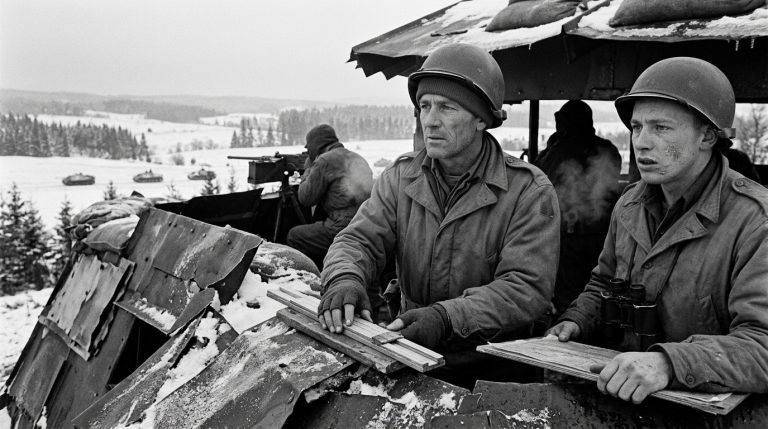
Outside, the Ardennes pine branches sagged under three inches of gray snow. Inside, the only sound was Wilbert Richards scraping grease off the driver’s hatch latch with an old pocketknife.
“Captain says we wait here,” Wilbert muttered, not looking up. “Says a stationary tank is an accurate tank.”
“A stationary tank is a campfire,” I said. I spat a brown stream of tobacco juice onto the cold floorboards near my boots.
I rolled a heavy, grease-stained brass calibration wrench between my palms. The steel felt like ice, but the weight kept my hands steady.
“Engine’s cooling down, Sarge,” Richards said, his knuckles red and raw against the levers. “If we idle much longer, the oil turns to molasses.”
“Keep her primed,” I said. “We aren’t sitting duck for anybody’s textbook.”
The radio sitting on the side shelf gave a wet, metallic pop. Sparks hissed from the housing before the vacuum tube inside cracked with a dull snap. A thin wisp of acrid white smoke curled out of the vent holes, dying instantly in the freezing air.
Richards turned his head slowly, his eyes wide in the gloom of the turret. “That was our last relay tube.”
I didn’t answer. I just squeezed the brass wrench until the metal edges bit into my calluses. We were clean off the net, completely alone on a frozen ridge with nine miles of dark timber behind us.
The treeline two hundred yards out suddenly shuddered. A thick shower of dry snow cascaded off the lower pine limbs, followed by the low, gut-rumbling clatter of heavy steel tracks grinding over frozen soil.
“Panzer,” Richards whispered, his boot already hovering over the clutch. “Sounds heavy.”
“Don’t touch that ignition until I give the word,” I said, leaning my forehead against the rubber cup of the periscope sight. “And whatever you do, don’t you dare hit the brake.”
CHAPTER 2: FRICTION AT THE RIDGE
The shadow in the treeline didn’t move like a tank. It moved like a man who had never spent a night in the cold.
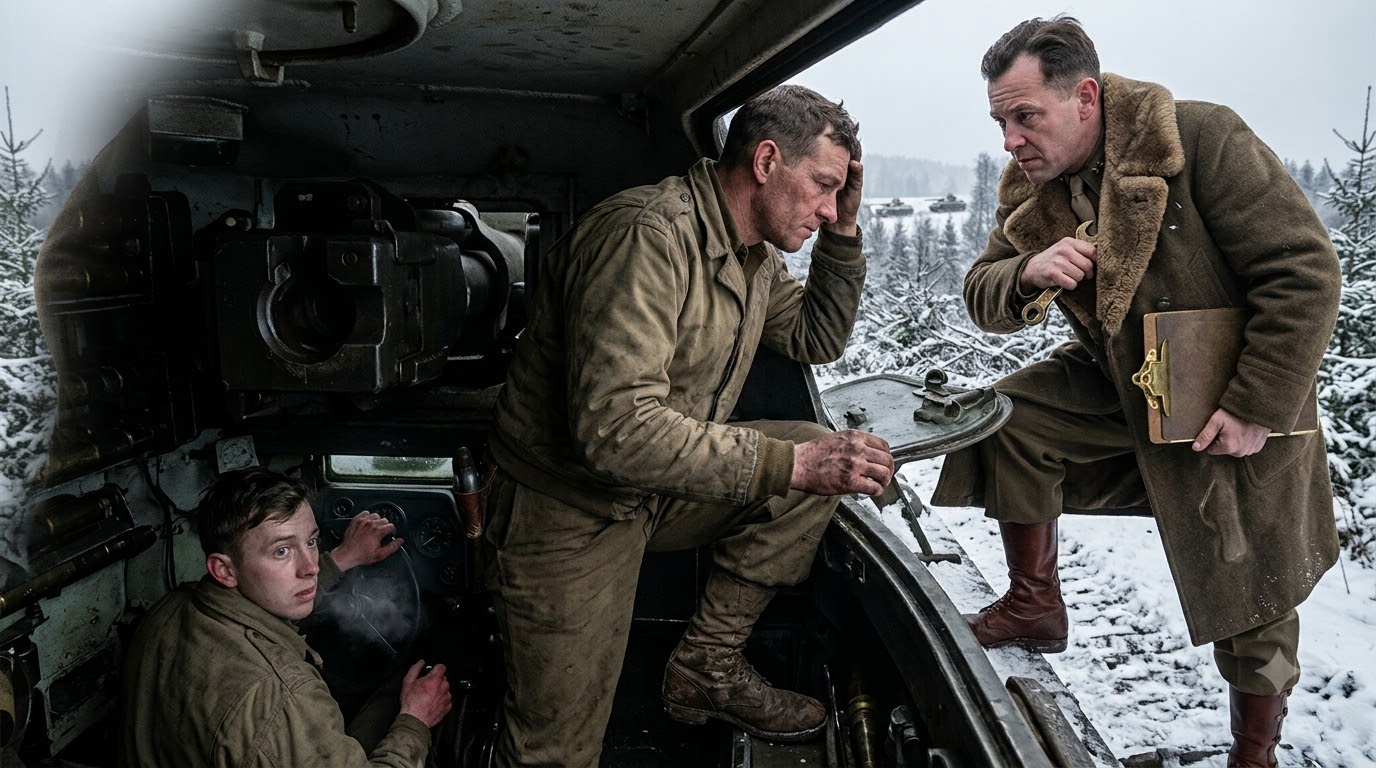
A heavy, fur-collared wool coat emerged through the snow-laden pines, followed by two staff guards carrying long-barreled carbines. Captain Vance walked with his chin shoved deep into his scarf, his polished leather boots crunching through the crust of the snow with total disregard for the noise.
Wilbert let out a long, slow breath through his nose, his hands staying flat against the steering levers. “Company commander. He’s supposed to be two miles back at the command tent.”
I didn’t lift my face from the periscope. “He’s lost, or he’s bringing bad news. Vance doesn’t walk in the snow unless somebody forces him.”
The heavy iron commander’s hatch above my head rattled as Vance banged the butt of his sidearm against the rim. The sound cracked inside the cold turret like a pistol shot.
“Pool,” Vance’s voice dropped down through the iron ring, muffled by his scarf. “Pop the hatch. Now.”
I set the brass wrench carefully on the gun-breech housing, climbed the short internal ladder, and pushed the heavy iron lid open three inches. Cold wind instantly whipped across my ears.
“You’re running your engine, Sergeant,” Vance said, his eyes watering in the biting wind. He held a brass-trimmed clipboard tucked under his arm, covered in a sheet of clear oilcloth to keep the snow off the paper. “Command orders strictly prohibit idling in forward observation sectors. Acoustic signature.”
“Engine turns over cold, Captain,” I said, keeping my hands on the lip of the hatch. “If a Panther rolls out of that tree line right now, we need three minutes just to warm the oil enough to turn the turret.”
“Doctrine dictates stationary firing positions for maximum optics accuracy,” Vance snapped, pulling a red grease pencil from his coat pocket and making a sharp tick on his board. “You don’t need to turn the vehicle. You lay the gun down the road, you wait for target acquisition, and you fire from a stabilized rest.”
“A stabilized rest just makes us a bigger headstone,” I said. My voice was flat, carrying no more emotion than the frozen mud beneath his boots. “The German optics can spot a motionless hull at twelve hundred yards. Moving fire is the only reason this crew is breathing.”
Vance leaned over the hatch, his breath smelling faintly of warm coffee and sugar. “Your job isn’t to redesign Armored Force doctrine, Sergeant. Your job is to hold this intersection until four-hundred hours.”
He reached over the coaming, his gloved hand dipping down into the crew area. He grabbed the brass calibration wrench resting on the breech and pulled it out.
“Non-standard modification gear,” Vance said, holding the heavy metal tool up to the gray light. “And where are your high-velocity solid-shot rounds? The rack behind your loader is half empty.”
“Supply depot didn’t issue them,” I said, watching his knuckles tighten around my wrench. “They handed us high-explosive shells meant for soft infantry targets.”
“Supply issues what doctrine specifies for holding actions,” Vance replied coldly. He dropped the wrench into his deep coat pocket. “You stay parked. You wait for the line to stabilize.”
He turned on his heel, stepping back toward his guards without another word. I watched his pristine wool coat disappear back into the gray timber, the cold air settling back over the hatch like lead.
I dropped back inside the turret and pulled the heavy lid shut, sliding the iron latch into place.
Wilbert looked back over his shoulder, his face pale in the faint green glow of the instrument panel. “He took the wrench, Sarge.”
“He took the wrench,” I said, reaching down to tap the side of the cold gun casing with my fingernails. “Which means he didn’t check the lower ammunition well.”
I kicked the wooden storage crate beneath my seat. The latch popped open. Tucked under a grease-soaked rag sat a stack of red-stamped supply manifests, completely fresh, unissued, and marked with a crisp red block letter stamp: DO NOT DISTRIBUTE – STANDSTILL HOLD.
Wilbert stared at the red ink. “What’s a standstill hold?”
“It means they knew the high-velocity shells were in the rear depot,” I said, my voice quiet in the tight steel space. “And they left them there on purpose.”
CHAPTER 3: THE BROKEN LINE
The vibration wasn’t a single machine. It was a rhythmic, heavy thudding that rattled the spare oil cans in their brackets.
Wilbert’s hands twitched on the steering clutch levers, his knuckles white under the engine grease. “Sarge—that ain’t one. That’s a full column.”
“Keep your boots off the gas till I tell you,” I said, leaning hard against the periscope cup.
Through the frosted optics, the pine treeline two hundred yards out dissolved into a spray of snapping timber. A gray bow plate tore through the brush, long-barreled gun muzzle leading the way, followed immediately by three more iron hulls churning up the deep drift. Nine of them rolled into the shallow valley road, exhaust smoking thick against the white slope.
They were moving in a tight road line, bold as brass, operating under the assumption that whatever stood in front of them was already dead or running.
“They’re taking the road,” Wilbert rasped, his breath fogging the lower dash. “If we stay parked like Vance said, their lead gun covers the turn before we can swing the barrel.”
“Vance isn’t sitting in this iron box,” I said.
I shoved the wooden crate lid down with my heel, locking the red supply manifests out of sight, and reached for the gear selector. “We sit here like a pillar, we die like a pillar. Kick the starter, Wilbert.”
“Sarge, Captain said—”
“I don’t care if the President said it,” I barked, grabbing the turret traverse handwheel with both hands. “Fire up the engine!”
The Ford V8 roared to life with a thick, throaty cough that shook the entire hull. Blue smoke billowed from the rear vents, catching the gray afternoon light.
On the road below, the lead German tank’s turret jerked sharply to the left. Their commander had spotted our exhaust plume.
“They’re traversing!” Wilbert yelled over the engine whine.
“Then don’t give ’em a clear line,” I shouted, slapping the back of his seat. “Hard right off the rise! Drive straight into ’em!”
Wilbert slammed the clutch and pulled the right lever. The Sherman lurched sideways off the snowbank, nose diving straight down the slope, tracks throwing chunks of frozen earth into the air as we charged directly at nine heavy guns.
CHAPTER 4: THE MOVING FIRE
The first German shell split the air overhead with a sound like tearing canvas, detonating in the pine canopy behind us and showering the engine deck with frozen splinters.
“Don’t touch that brake, Wilbert!” I roared over the screaming Ford engine. “We zig left, then sweep behind the lead wreck!”
“I’m keeping her wide, Sarge!” Wilbert yelled back, his elbows straining against the steering levers as the tracks bit into the rutted mud below.
The lead enemy hull loomed through the scope, its long barrel swinging hard to intercept our downhill run. They expected us to stop, anchor our tracks, and take aim according to the manual.
Instead, Wilbert yanked the right clutch, throwing our tail out in a forty-degree drift just as another heavy shell skipped off the ice fifty yards ahead.
“Now!” I hit the foot treadle.
The 75mm main gun kicked back into the recooling springs with a deafening crack, filling the turret with the acrid stench of cordite. Through the periscope smoke, I watched our round smash directly into the lead tank’s turret ring while we were still moving at twenty miles an hour.
The heavy steel hatch popped off the target as dark smoke erupted from its engine deck, blocking the narrow valley road completely.
“Keep rolling!” I slammed a fresh casing into the hot breech. “We don’t pause for photos!”
Behind the burning wreck, the second and third German hulls bunched up, their drivers slamming on their brakes to avoid a pileup in the tight ditch. Their turrets were traversing slowly, their gunners struggling to track a target that refused to follow a straight line.
Wilbert carved a tight, grinding circle around the burning lead armor, keeping our flank protected by the thick black smoke pouring into the freezing wind.
“Two more swinging wide on the left flank!” Wilbert shouted, his voice hoarse from grit and oil fumes. “They’re trying to set a trap!”
“They can’t set a trap on something they can’t hit!” I turned the handwheel violently, keeping the muzzle aligned with the second hull through the drift. “Drive her right up their seam!”
CHAPTER 5: THE TRAP UNRAVELED
The valley road had turned into a burning bottleneck. Nine heavy German hulls lay disabled, smoking, or abandoned along the frozen pass, their defensive line completely shattered by our constant movement.
Wilbert eased the throttle back, the Sherman’s engine dropping to a heavy, shuddering idle near the edge of the rise. “That’s nine, Sarge,” he panted, wiping grease-stained sweat from his forehead with his sleeve. “Nine out of nine.”
“Hold us here,” I said.
Through the rear view optic, three figures stepped out of the pine treeline behind us. Captain Vance walked in front, his pristine wool coat now speckled with snow, his face pale and furious. His two armed guards trailed behind, their eyes wide as they stared at the burning steel strewn across the road below.
I popped the hatch latch and climbed out onto the icy turret deck, the biting mountain air instantly cooling my face.
Vance marched up to the side of the track, his boots sliding on the frozen mud. He held my brass calibration wrench clutched in one gloved fist like a weapon, his red grease pencil sticking out of his breast pocket.
“Sergeant Pool!” Vance roared, his voice cracking against the quiet trees. “You violated direct standing operational orders! You abandoned a designated stationary defense sector!”
“The sector’s clear, Captain,” I said, leaning my forearms on the turret rim. “And my crew is alive.”
“That is irrelevant!” Vance shouted, stepping onto the track housing, his brass-trimmed clipboard trembling in his other hand. “You broke formation! I will have you court-martialed for insubordination before the sun goes down!”
“You won’t court-martial anybody,” I said softly.
I reached inside the hatch, pulled out the wooden crate lid, and tossed the red-stamped supply manifest onto the snow at his boots. The oil-stained paper fluttered against his leather heel, the bold red lettering stark against the white drift: DO NOT DISTRIBUTE – STANDSTILL HOLD.
Vance’s gaze dropped to the paper. His jaw worked silently, his fingers tightening so hard around my brass wrench that his leather glove squeaked.
“You knew the high-velocity shells were sitting back at the depot,” I said, looking down at him from the turret. “You kept us parked here with soft infantry shells, waiting for nine Panther tanks to roll over this ridge.”
“That was a high-command logistics distribution strategy!” Vance sputtered, his face flushing dark red as he tried to kick the paper into the slush. “You don’t understand grand theater operational priorities, Sergeant! You’re a cotton farmer!”
“I know when a man is setting a lamb out for slaughter to cover his own exit,” I said.
Vance raised his clipboard, his voice rising in an enraged, desperate shriek. “I am your commanding officer! You take your orders from me, or I’ll have these guards put you in irons right now!”
The two guards didn’t move. They looked at the burning German armor, then down at the red manifest in the slush, and slowly lowered the muzzles of their carbines toward the frozen ground.
CHAPTER 6: THE DUSTY STEEL
Vance’s chest heaved as he stared at the two guards who refused to raise their weapons. His face turned from crimson to a pale, mottled gray.
“You’re making a catastrophic mistake,” Vance whispered, his voice shaking as he pointed a gloved finger at me. “The division command will review this log! I will make sure you never command so much as a supply wagon again!”
“The division command can read the manifest,” I said, my voice quiet against the cold pine timber. “And they can count nine wrecks on the road behind you.”
Vance snatched his clipboard, spun on his heel, and stumbled back into the snowdrifts toward the rear trail, his shiny leather boots sliding in the mud. He left the brass calibration wrench lying in the slush where he dropped it.
I dropped down from the track housing, picked the cold brass wrench out of the snow, and wiped the slush off against my canvas trousers.
The two guards watched me silently before turning around to follow the captain’s retreating footprints back down the mountain path.
Wilbert poked his head out of the driver’s hatch, breathing out a thick cloud of vapor into the afternoon air. “He’s gonna write us up, Sarge.”
“Let him write,” I said. I climbed back up the front glacis plate and dropped into the commander’s seat. “He writes on paper. We write on steel.”
The valley below had gone quiet. The dark plumes of smoke from the disabled German column drifted straight up into the gray sky, dissolving over the snow-covered ridge.
There was no radio call to confirm the kill, no officers coming down the hill with medals, and no reinforcements marching up the pass to pat us on the back. Just a quiet wind blowing through the pine needles and the steady, warm thrum of the Ford V8 idling beneath our feet.
I pulled the brass wrench from my pocket and set it back on the gun-breech housing where it belonged.
I picked up an old cotton rag, sat down on the loader’s stool, and began slowly wiping the black grease off my fingers, one knuckle at a time.