The Ledger of Broken Angels: A Story of 47 Days, 103 Bikes, and the Grace of the Unbroken
CHAPTER 1: THE WEIGHT OF THE COUNT
The radiator in Room 214 always hissed at the end of the afternoon, a thin, metallic wheeze that smelled of rusted iron and old water. Jennifer Walsh didn’t move from her knees. The linoleum floor was cold beneath her slacks, the surface scuffed by a hundred small shoes, but her focus was locked on the frayed gray hem of the sleeve Ethan Cooper held between his thumb and forefinger.
The fabric was worn to the threads at the wrist. For forty-seven days, she had noted the same salt-stains on the pocket, the same loose stitch dangling from the hood like a broken web. She had counted them in her small green ledger, an unblinking ledger of sequential numbers that she kept hidden beneath her lesson plans. But tracking a pattern was a cold, academic exercise. Touching it was different.
“Slowly, Ethan,” she murmured. Her voice was soft, pitched low to prevent it from bouncing off the high, empty blackboards. “Just the left one first.”
The boy didn’t look at her. His eyes remained fixed on the small wooden grain of his desk, his jaw locked so tightly the pale skin over his cheekbones looked translucent. He pulled the sleeve back. The cotton was stiff, resisting the movement as if it wanted to keep its secrets buried in the dark weave.
When the skin was bare, the pale afternoon light filtering through the smudged windows caught the surface. Jennifer’s breath caught in her throat, a sharp, dry sensation like swallowing sand.
Four distinct ovals, the deep indigo of a late-stage plum, pressed into the thin muscle of his forearm. Above them, where the skin met the elbow, the colors shifted—mottled shades of yellow and a sickly, olive green. Fingerprints. The unmistakable geometry of an adult hand wrapping around a ten-year-old’s bone and squeezing until the vessels beneath shattered.
Jennifer didn’t flinch. She knew that if her hand shook, if her eyes widened by even a fraction, the boy would pull the cotton down and vanish back into the silence that had protected him since January.
“The nurse is going to look at this, Ethan,” she said, her fingers remaining two inches away from the skin, respecting the boundary of his fear. “But I need to know. Did you fall?”
A tiny, involuntary tremor ran through the boy’s shoulder. He gripped his desk with his other hand, his knuckles turning the color of chalk. “I fell,” he whispered. The words were automatic, a rhythmic chant learned under pressure, delivered without any expectation of belief. “The stairs in the back. I’m clumsy, Ms. Walsh.”
“Ethan.” She reached out, letting her palm settle near his hand on the wood, offering warmth without forcing contact. “Those are finger marks. Someone held you down.”
A tear broke from his lashes, cutting a clean path through the gray smudge of dust on his cheek. He looked toward the heavy oak door of the classroom, his gaze darting to the shadow cast by the hallway locker. “Please don’t call them,” he breathed, the sound barely clearing his lips. “Please. If you call, they’ll know I told. They’ll put us back in the dark.”
Jennifer stood up slowly, her knees cracking in the quiet room. She looked at the empty desks, the brightly colored alphabet banners hanging from the ceiling, the safety of a world that stopped at the threshold of her door. Beyond that door lay a system that had already stamped “resolved” on Ethan’s file four times.
She reached into her pocket and pulled out her phone. Her thumb flipped past the school directory, past the principal’s office, straight to a number she hadn’t dialed during school hours in three years.
The phone didn’t ring twice.
“David,” she said, her back to the window, her body forming a solid shield between the hallway and the boy at the desk. “It’s Jenny. I need the club. I need them now.”
CHAPTER 2: THE SECOND RING
The line went dead with a dry, mechanical click that felt heavy in the silence of Room 214. Jennifer Walsh lowered the phone slowly, her thumb still resting against the smooth, smudged glass of the screen where her brother’s name, David, had just vanished. The radiator gave another thin, rusty wheeze, sending a faint puff of dry, metallic-tasting air across her face.
She turned back to Ethan. At the sound of the line disconnecting, the boy had already pulled his sleeve down. The frayed gray cotton of the hoodie swallowed the purple and green marks on his forearm, returning him to the shape of an ordinary, quiet fourth-grader sitting beneath the faded construction-paper self-portraits taped to the wall. But the transformation wasn’t perfect. As he pulled the hem tight against his wrist, a sharp twist of his torso caused the worn collar to shift, revealing a tiny, millimeter-wide tear near the seam of his shoulder blade. Beneath that loose white thread, Jennifer caught a fleeting glimpse of a different color—a pale, sickening mustard-yellow that extended upward toward his neck. Another bruise, older, deeper, hidden beneath the thickest part of the fleece.
“Ms. Walsh?” Ethan’s voice was small, dry as chalk dust. His hands were tucked completely into his pockets now, pulling the oversized fabric forward like a shield. “Is… is someone coming?”
“My brother is coming, Ethan,” she said softly, keeping her movements deliberate as she walked to her desk. She didn’t want to pace; the room was too small, and any sudden vibration on the floorboards might shatter the fragile trust holding him in his seat. She picked up a yellow legal pad, her pencil stub scraping quietly against the top sheet as she turned to a fresh page. “His name is David. But people call him Reaper. I know that sounds like a frightening name, but he used to be a Marine. He looks after people who cannot protect themselves.”
Ethan didn’t look up, but his shoulders dropped a fraction of an inch, the heavy fabric of the hoodie sagging against his collarbones. “The case worker before… she had a blue folder,” he whispered, his finger tracing a small groove in the old wood of his desk. “She sat right there. Karen gave her tea with the little sugar cubes. The lady wrote in her folder and said I was having an episode. That’s what Karen calls it when I cry. An episode.”
Jennifer’s grip tightened on the pencil until the wood compressed against her finger. She could picture it perfectly—the polished performance of Karen Mitchell, the clean, sunlit living room on Maple Ridge Drive, the scent of lavender and lemon oil masking the damp rot underneath. It was a dynamic built on smooth surfaces. The system loved a smooth surface; it was easy to file away, easy to sign off on.
“We are not using folders today, Ethan,” Jennifer said, her voice steady despite the thin, cold current of rage circulating through her chest. “And you are not having an episode. We are going to wait right here.”
She turned to the window, looking past the smudged glass down into the school parking lot. The afternoon was dying, the sun dipping below the line of gray sycamore trees at the edge of the property, casting long, pale shadows across the asphalt. A single yellow school bus sat idling by the cafeteria doors, its exhaust pipe coughing white plumes into the cold air. Everything looked normal. It was the terrifying regularity of a small town operating on its default setting while a three-minute drive away, three children were kept locked behind a deadbolt on a basement stairwell.
A sharp tap at the classroom door made Ethan flinch, his entire body jumping back an inch against the wooden backrest of his chair.
Jennifer turned instantly, placing herself between the door and the boy. The heavy oak panel swung open, and Linda Morrison, the school nurse, stepped into the room. Linda was sixty-one, her gray hair pulled back in a practical, silver clip that matched the wire rims of her glasses. She carried a small, black leather medical kit by the strap, her boots clicking softly against the linoleum with the measured, unhurried cadence of someone who had spent thirty years identifying the subtle boundary between a playground scrape and something intentional.
“Jenny,” Linda said, her eyes scanning the empty desks before settling on Jennifer’s face. She didn’t look at Ethan directly yet—a veteran choice, giving the child space to adjust to her presence. “The office said you were keeping a student late for a mandatory report.”
“Room 214,” Jennifer replied, her hand reaching out to touch the corner of Ethan’s desk, anchoring herself. “Thank you for coming up, Linda. We need a physical assessment. Documentation. For the state record, but… also for our own.”
Linda set her black kit on an empty desk two rows away, the metal clasps undoing with a sharp clack. She pulled out a small, flexible plastic ruler—the kind used for measuring surgical scars or skin discrepancies—and a small digital camera with a faded black wrist strap.
“Ethan,” Linda said, her voice dropping into a rhythmic, warm register that smelled faintly of peppermints and isopropyl alcohol. “Do you remember me from the health checks in September?”
The boy gave a single, microscopic nod.
“I need to look at your arms, buddy,” Linda said, moving closer but staying at a slight angle, never crowding him. “Just like Ms. Walsh did. We’re going to take some measurements. It’s going to be very quiet, and nobody is going to pull or push. Okay?”
Ethan looked at Jennifer. Jennifer nodded, a slow, single movement of her chin.
Slowly, with the agonizing hesitation of a creature accustomed to the trap, Ethan pulled his hands out of his pockets. He began to work the gray cotton sleeves upward, the fabric bunching around his thin elbows like old bandages. The dark ovals emerged once more into the stark light of Room 214, their margins even clearer now against the pale skin.
Linda knelt, her silver hair catching the fluorescent glare from the ceiling. She didn’t speak. She didn’t gasps. She simply laid the edge of the plastic ruler against the widest bruise on his left arm, her thumb holding the zero-mark steady against the purple center.
“Three point five centimeters,” Linda murmured to herself, her pencil moving across her pad with a dry, scratching efficiency. “Spacing between center marks is exactly two centimeters. Consistent with adult digital compression.”
Jennifer watched from the side, her eyes tracking the movement of Linda’s camera as the small flash flickered against the boy’s skin. Each click of the shutter felt like a heavy, permanent nail being driven into the Mitchells’ polished front door. But as Linda moved the ruler toward the boy’s shoulder, her fingers brushed the small tear Jennifer had noticed earlier near the collar.
“Wait,” Linda whispered, her tone shifting from clinical to a deep, heavy quiet. “Ethan, lean forward for me. Just a little bit.”
The boy complied, his spine curving into a sharp, thin line where each vertebra showed clearly beneath his shirt like a row of small stones. Linda gently moved the frayed cotton of the collar aside.
The yellow bruise Jennifer had seen was only the tail end of a larger pattern. Spreading down across his left shoulder blade, trailing toward his lower ribs, was an entire grid of thin, horizontal marks—pale green at the edges, dark brown at the center, the unmistakable texture of old leather or heavy canvas applied with deliberate, repeated force. It was an entire history written on skin, a hidden layer that the gray hoodie had kept safe from the eyes of the world for forty-seven days.
“This isn’t from a fall, Jenny,” Linda said without looking up, her voice dropping into a hard, brittle whisper that seemed to chill the small room. “The stages of healing… these are weeks apart. Some are months old.”
Before Jennifer could answer, a low, vibration began to hum through the floorboards. It wasn’t the radiator. It was a deep, rhythmic thrumming that started at the edge of the valley, a distant roar that sounded like summer thunder rolling across the river basin. The glass panes in the classroom windows began to rattle within their old wooden frames, a steady, synchronized chatter that grew louder with every second.
Ethan’s head lifted, his eyes widening as the sound swelled into a massive, iron weight that seemed to press down on the roof of the school. “What is that?” he whispered.
Jennifer walked back to the window, her hand pressing against the vibrating glass. Down below, turning past the brick entry gates of Riverside Elementary, a line of dark shapes was spilling into the asphalt lot. Chrome bars caught the final rays of the sun, flashing like signals in the gray dusk. One after another, the heavy, leather-clad silhouettes of a hundred motorcycles entered the circle, their engines roaring in a massive, unified chorus that drowned out the hiss of the radiator, the ticking of the clock, and the silent failure of the town around them.
“That’s the backup, Ethan,” Jennifer said, her reflection in the glass showing a pale, unyielding smile. “That is my brother.”
CHAPTER 3: THE IRON HORIZON
The vibration didn’t stop at the window frames. It ran up through the soles of Jennifer’s shoes, a deep, tectonic frequency that seemed to shake the very chalk dust from the grooves of the chalkboards. Down in the parking lot, the rows of yellow lines were swallowed by an oncoming wave of dark iron and leather. One by one, the riders cut their ignitions. The sudden transition from an earth-shattering roar to absolute, heavy silence was almost physical, leaving only the thin, high whistle of the wind through the sycamore trees.
Jennifer turned from the glass. Ethan hadn’t moved, but his chin was tucked so deeply into the collar of his hoodie that only his eyes were visible—wide, wet reflections of the fading sky outside. Beside his desk, Linda Morrison stood with her small digital camera hanging from her wrist, her thumb resting on the power switch, her clinical composure hardening into something defensive as the heavy double doors of the school’s main entrance slammed open down the hall.
The footsteps approaching Room 214 weren’t the hurried, light taps of school administrators. They were slow, weighted by the heavy click of steel-toed leather and the rhythmic jingle of utility keys.
When the doorway filled, the light from the corridor was blocked entirely. David “Reaper” Walsh stood in the frame, his six-foot-one frame nearly brushing the top molding. He didn’t step inside immediately. His brown eyes, identical to Jennifer’s but lined with the sharp, permanent creases of someone who spent his days looking into the wind on open highways, scanned the room. His heavy leather vest bore the faded, oil-stained patches of the Columbus chapter, the stitching frayed at the edges from years of road grit.
Behind his left shoulder stood an older man. Victor “Priest” Dalton moved with a calculated, unhurried grace that made his massive frame seem quiet. His beard was a thick thatch of silver and iron-gray, masking a jawline that looked as though it had been chiseled out of river stone. He wore the president’s rocker on his chest, the leather broken-in, soft with age, and showing the salt-lines of winter storms.
“Jenny,” David said. His voice was low, a gravelly baritone that seemed to absorb the small echoes of the classroom. He didn’t look at the child yet; his attention remained locked on his sister’s face, reading the faint, white line of strain around her mouth. “You’re still here.”
“I told you I wouldn’t leave the room, David,” Jennifer said. She moved two steps toward them, her hand remaining on the corner of Ethan’s desk, an anchor for the boy behind her. “The nurse has already documented the marks. They aren’t from a fall. There are old ones on his back. Horizontal lines. Like a heavy strap.”
David’s jaw didn’t tighten; it went perfectly still, his eyes shifting over Jennifer’s shoulder to fix on the small figure in the gray hoodie. The look that passed into his face wasn’t anger—it was the cold, hollow neutrality of a soldier shifting into a familiar baseline.
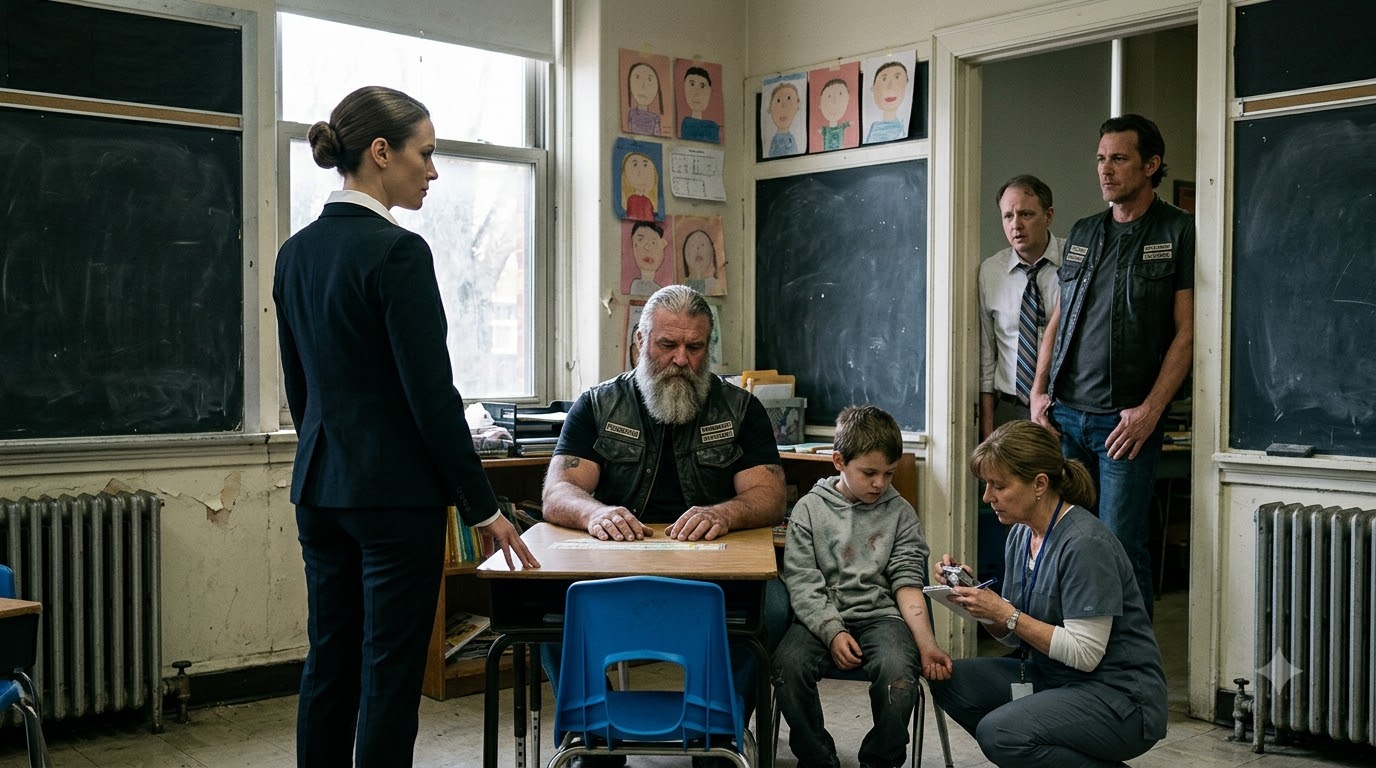
Priest stepped into the room, his heavy boots making no sound against the linoleum. He unclipped his thick leather gloves from his belt, tucking them into his pocket with a slow, deliberate motion. When he reached the row of desks, he looked down at the plastic third-grade chairs, then carefully pulled one out. The metal legs scraped softly, a small, domestic sound that seemed to break the freezing tension in the air. He sat down. His knees rose high against the low frame of the desk, his massive leather-clad torso leaning forward so his face was level with Ethan’s.
“Son,” Priest said. The voice was surprisingly gentle, a deep, resonant rumble that sounded like a furnace kicking on in an old house. “My name is Victor. Most people call me Priest. I know I look like the bad guy in a comic book, but you don’t have to worry about that. My wife used to tell me that the Lord made me this big so children wouldn’t have to look hard to find someone to hide behind. You think she was right?”
Ethan stared at the silver patch on Priest’s vest, his small fingers twitching within his pockets. He didn’t answer, but his breathing, which had been shallow and ragged since Linda began her examination, slowed into a rhythmic, steady pattern.
“Your sister says there are two more at the house, Reaper,” Priest said, his eyes never leaving Ethan’s face. He reached out, his thick, scarred fingers resting flat on the wood of the desk, keeping his hands entirely visible, completely still. “Two girls. Sibling group.”
“Sophia and Isabella,” Jennifer supplied, stepping closer to Linda’s side. “Eight and six. Ethan told me they’re all scared. He’s been wearing this hoodie for forty-seven days because it’s the only thing that covers what they’re doing to him. The foster parents are Karen and David Mitchell. They took them in seven months ago.”
“Seven months,” David repeated from the doorway. He was looking out toward the hallway now, his hand resting on the frame, his ears tuning to the sound of an approaching set of footsteps—sharper, frantic ones this time. “That’s long enough to clear a lot of tracks.”
“We aren’t letting them clear anything,” Priest murmured. He looked down at the frayed hem of Ethan’s sleeve, noticing the small, white loose thread Jennifer had discovered earlier. His large hand remained still on the desk, a massive, unyielding wall between the boy and the rest of the world. “Wire is already in the lot. He’s pulling the state databases from his truck. If there’s ink on a page showing where the money went, he’ll have the first string before the sun is completely under.”
The frantic footsteps in the hallway grew louder, accompanied by the distinct, high-pitched protest of leather dress shoes squeaking against the floor wax. Principal Anderson appeared in the doorway, his tie slightly askew, his face the color of dry parchment. He stopped dead when his eyes hit David’s vest, his gaze darting between the two massive men in the room and the rows of motorcycles visible through the windows behind them.
“Ms. Walsh,” Anderson stammered, his hand adjusting his glasses twice in rapid succession. “There are… there are over a hundred men outside. The superintendent has already called my office. This is a school property. You cannot have these vehicles blocking the bus lanes.”
Jennifer didn’t look at the principal. She looked at Ethan, whose head had dropped again at the sound of an authority figure’s sharp voice.
“The vehicles are legally parked in the overflow lot, Mr. Anderson,” Jennifer said, her voice dropping into the cool, professional register she used during parent-teacher conferences. “And I have filed a mandatory child endangerment report under Ohio law. The student is a victim of non-accidental trauma. He stays with me until a county representative arrives to take emergency custody. If you want the lot cleared, you can call Children’s Services and tell them to expedite the investigator.”
“This is highly irregular,” Anderson whispered, his eyes sliding toward Priest, who remained seated on the tiny plastic chair, an iron monument that refused to acknowledge the principal’s presence. “The optics, Jenny… if the local press sees this—”
“The optics,” David interrupted, stepping forward just enough to force Anderson to look up at him, “are that my sister did your job for forty-seven days while you were looking at the test scores. Now step back out to the hall. We’re busy.”
CHAPTER 4: THE INHALE OF THE RIGHTEOUS
Principal Anderson didn’t argue. The sheer physical density of David standing in the doorway, framed by the long, shadow-drenched hallway, seemed to drain the remaining color from his face. He let his hand drop from his glasses, gave a stiff, jerky nod that looked entirely automatic, and backed out into the corridor. The heavy oak door didn’t close entirely; it remained ajar by three inches, letting in the faint, distant rattle of the school’s central ventilation system and the quiet, persistent idling of the yellow bus outside.
Inside Room 214, the world contracted back to the perimeter of the low wooden desk. Victor “Priest” Dalton remained seated on the small plastic chair. The blue plastic frame groaned slightly under his weight, but his posture didn’t shift. His large, weathered hands were spread flat against his denim-clad thighs, the skin scarred across the knuckles by decades of hot oil and heavy wrenches.
He didn’t press the boy. Instead, his gaze wandered briefly to the bulletin board behind Ethan’s head, where a line of faded construction-paper drawings hung from silver pushpins. One of them—a house drawn in thick, blunt yellow crayon with a lopsided chimney—had a small smudge of dried glue near the corner, holding a tiny piece of frayed pink yarn.
For a single micro-second, the deep lines around Priest’s eyes tightened. A psychological phantom, heavy and cold, settled into the room. Twenty-six years of distance didn’t soften the texture of a memory; it only turned it into granite. He could still see the small, white-painted room in Columbus where Katie’s blue folder had sat on a polished laminate table, identical to the ones the county caseworkers used now. The system had standard forms for grief, just as it had standard forms for neglect. It used the same smooth, bureaucratized vocabulary to bury a child as it did to assign them to a licensed cage.
Priest cleared his throat, the sound like gravel shifting under a boot, breaking the internal silence before it could show on his face. He looked back at Ethan.
“The lady with the blue folder,” Priest said, his voice dropping into that low, warm furnace register that seemed to absorb the room’s chill. “When she sat at your kitchen table, Ethan… did Karen tell her about the doctors?”
Ethan’s thumb twitched inside his pocket, a small ripple against the frayed gray cotton. He kept his chin down, his eyes tracking the silver skull ring on Priest’s left hand. “Karen told her I hear things,” he whispered. The admission came with a visible drop in his chest, an exhaustion so heavy it seemed to shrink his small frame even further. “She said that’s why I don’t eat. She said the food has bad words in it. That’s what she wrote in the blue folder. The caseworker nodded her head and gave me a little white pill. But I hid it under my tongue. I spit it into the register behind the couch.”
Jennifer stepped closer, her hand tightening on the edge of the desk until her knuckles turned a flat, bloodless white. “They were setting up a baseline,” she whispered to Linda Morrison, her voice barely carrying across the rows of empty chairs. “A behavioral manipulation defense. If anyone noticed the weight loss or the marks, they could claim he was unmanageable. Self-harming.”
“They always build the wall before they dig the hole,” Priest said, his tone entirely free of anger, carrying only the flat, terrifying certainty of a judge delivering a routine sentence. He didn’t look at Jennifer; his focus remained locked on the boy’s small face. “They tell the county the kid is broken so the county stops looking close when the pieces start falling off. It’s a good script, Ethan. It works on people who only read the summaries.”
He slowly lifted his right hand from his thigh, placing it on the edge of the desk. The thick leather cuff of his jacket was scuffed at the wrist, the black dye worn down to the pale gray suede underneath—a faded texture of thousands of miles spent on the asphalt.
“But here’s the thing about scripts, son,” Priest continued softly. “They only work if everybody plays their part. Your teacher didn’t stay on the page. She started counting. And once someone starts counting the days, the whole wall starts to slide.”
A soft rustle came from the back of the room. Linda Morrison had set her digital camera down on a stack of arithmetic textbooks. She held her flexible plastic ruler between her fingers, her eyes fixed on the vertical horizontal lines on Ethan’s back that were still partially visible where the collar of the hoodie remained displaced.
“The documentation is clear, Victor,” Linda said, her clinical tone carrying a slight tremor that she couldn’t quite mask. “The marks on the scapula… those aren’t behavioral. You can’t reach that part of your own spine with that kind of leverage. Not at ten years old. Not with that depth.”
“I know,” Priest murmured. He looked at Ethan. “You’ve been being brave for a long time, haven’t you?”
Ethan didn’t answer with words. A slow, shuddering breath rattled through his chest—the long, delayed inhale of a child who had spent seven months holding his breath, waiting for the blow that always followed the silence. His small, dirt-caked fingers came out of his pockets, just an inch, resting on the worn lip of the desk near Priest’s massive hand. They looked impossibly small against the dark denim and old leather, like pale twigs dropped against the root of an old oak tree.
In the doorway, David turned his head slightly, his ear catching a new sound from the lower levels of the building. The heavy thud of the school’s double entry doors echoed up the stairwell again—not frantic this time, but measured, accompanied by the distinct, metallic click of a heavy laptop case bouncing against a metal zipper.
“Wire’s coming up the east stairs,” David said, his voice level. “He’s got the preliminary sheets from the Department of Job and Family Services. The state ink is starting to run.”
Priest didn’t look back. He kept his eyes on Ethan, his hand remaining perfectly still on the wood, an unyielding gray anchor in the middle of Room 214. “Let him in,” he said. “Let’s see how much they thought three children were worth.”
CHAPTER 5: THE FORENSIC GRID
The heavy leather folder Wire slipped out from beneath his vest didn’t look like state documentation. Its edges were bound in reinforced black canvas, scarred by deep, oily grease stains from years of being tossed onto garage workbenches and the steel floorboards of a custom truck. He stepped fully into Room 214, his wire-rimmed glasses sliding a millimeter down his nose as he caught the clinical scent of Linda Morrison’s kit. He didn’t acknowledge Principal Anderson’s shadow retreating down the terrazzo; his eyes were already searching the surface of Jennifer’s desk for a clear space to unroll his printouts.
“The digital registry is only the first layer, Priest,” Wire said, his voice carrying the flat, nasal monotone of a veteran forensic accountant. He placed the heavy folder down onto a neat stack of graded spelling tests, the weight causing the papers to compress with a soft whoosh. “The state portal shows they’ve been receiving the specialized medical allowance since January—the maximum tier for three non-related dependents under twelve. That’s nine thousand two hundred and fifty dollars every thirty days, deposited straight into a regional trust account at Federal Commerce.”
He flipped the canvas binder open. Inside, clipped over the standard state-issued placement logs, was a thick, older ledger with a scarred gray leather cover. It was an out-of-system record, its pages filled with neat, handwritten columns in fading purple ink.
Jennifer leaned over the desk, her finger tracing the edge of the gray leather. “This isn’t a county form, Marcus. Where did this come from?”
“It’s an internal routing book from the local auxiliary clinic,” Wire muttered, tapping a blunt, ink-stained thumb against the bottom entry. “I have an old contact from the revenue division who still answers the phone when the office line rings late. Look at the balance lines. The Mitchells haven’t submitted a single voucher for pediatric maintenance since October. But the state system automatically flags the care as ‘fully verified’ on the twenty-fourth of every month. Someone is manually overriding the verification protocols at the county portal level.”
The room went cold, the silence thick and heavy as the implication settled into the worn floorboards. This wasn’t a case of a broken bureaucracy dropping a file; it was a systematic ledger of deliberate concealment.
Priest didn’t move from his position on the low blue plastic chair. His hand remained flat on the wooden desk, an inch from Ethan’s pale fingers. “They aren’t just hiding the money, Wire. They’re hiding the children from the medical tracking logs. If the kid doesn’t go to the clinic, the clinic doesn’t write down the dimensions of the skin.”
“Exactly,” Wire said, pulling out a loose leaf of matte, heat-sensitive thermal paper that uncurled across the desk with a dry crackle. “The behavior manipulation notes that Karen Mitchell submitted to the caseworker—the ones describing Ethan’s ‘hallucinations’ about food—were filed three days before the child was even processed through the entry clinic in October. They didn’t build the wall after they noticed he was thin. They built the defense before they ever pulled him out of the vehicle.”
Ethan’s small head turned toward the desk at the sound of his name, his eyes tracking the curling edge of the thermal paper. He didn’t understand the numbers, but his shoulders tightened beneath the heavy gray cotton of his hoodie, his small frame instinctively shrinking away from the documentation that had defined his life for seven months.
“The lady… she didn’t look at my arms,” Ethan whispered, his gaze dropping back to the silver skull ring on Priest’s thumb. “She just looked at the paper on the kitchen table. Karen had a little gold pen. She let the lady use it because the lady’s pen was dry.”
Jennifer felt the breath leave her lungs in a short, sharp line. The image was vivid, terrifyingly domestic—the shared pen, the warm kitchen, the small white sugar cubes Linda had mentioned, while beneath the floorboards, the true weight of the house was locked away in the dark.
Linda Morrison stepped forward from the corner, her fingers still holding the clear plastic ruler. She laid it down on top of Wire’s thermal sheet, the straight edge alignment crossing directly through the column marked Independent Placement Allowance.
“The measurements I took from his back, Marcus,” Linda said, her voice dropping into a hard, rhythmic clinical register. “The depth of the bruising on the shoulder blade matches a standard utility belt—the heavy leather kind worn by industrial technicians. David Mitchell works the night shift at the engine facility down by the rail yards, doesn’t he?”
“Maintenance supervisor,” Wire said, his eyes scanning the gray ledger’s manual entries without a trace of emotion. “He signs for the tool cages every Monday at six in the evening. He has access to the full inventory of non-serialized leather straps used for the heavy conveyor lines.”
David moved away from the doorway then, his shadow sliding along the blackboard as he walked toward the window. He looked out at the parking lot where the hundred and three motorcycles sat in perfect, silent alignment, their chrome pipes cooling in the damp river air. “The caseworker won’t come alone when she sees the lot, Priest. She’s going to bring the local unit. They’re going to try to turn this into a boundary dispute between the school and the family.”
“Let them bring whoever has the signature,” Priest murmured, his large hand finally turning over on the desk, palm up, offering a thick, solid surface of scarred skin for Ethan to look at. “We have the measurements, we have the ledger, and we have forty-seven days of gray cotton that says the system didn’t notice a child disappearing in the middle of Room 214. The ink is dry, Wire. Close the folder.”
Wire snapped the black canvas binder shut, the sharp pop of the metal rings echoing off the high ceiling like a small caliber shot. “The portal is locked down for the night, but the paper trail is planted. Once the county investigator puts her feet on this floor, she either signs the removal order or she explains to the regional director why her manual override code is on the same line as the Mitchells’ deposits.”
Jennifer walked back to Ethan’s side, her hand settling gently on the top of his chair. The radiator gave one last, long hiss before going cold, leaving only the sound of the wind rising against the heavy brick corners of the building, carrying the cold promise of rain across the valley.
CHAPTER 6: THE SILENT INVOICE
The echo of the metal rings snapping shut lingered in the high corners of Room 214 like a low hum. Jennifer Walsh didn’t move her hand from the edge of Ethan’s desk. The wood was cold under her palm, its varnish worn smooth by decades of leaning children, but her focus remained fixed on the scarred gray leather binder Wire had placed on her desk. A faint, sharp scent rose from the yellowed edges of the manual registry logs—not the standard chemical tang of school ink, but something damp and heavy, a smell like stagnant water trapped in an unheated cellar.
She leaned slightly closer, her eyes tracking a darkened water-stain on the inner canvas lining. It was a subtle, physical discrepancy, a localized dampness that didn’t belong on records pulled from a clean state building.
“The county office didn’t have these files in the central archives, Marcus,” Jennifer said, her voice dropping lower as she glanced toward Ethan. The boy’s fingers were still resting on the lip of his desk, mere inches from Priest’s leather sleeve, his breathing a small, dry rustle against the collar of his hoodie. “If they manually overrode the system, where did this paper log stay?”
Wire adjusted his wire-rimmed glasses, his blunt fingers tracing the faded purple ink lines of the clinic receipts. “It didn’t stay in Columbus, Jenny. It stayed in the regional field unit’s storage locker down by the old freight yards. The local caseworker didn’t use the standard portal because she wasn’t filing standard reviews. She was keeping a secondary ledger—a shadow account that allowed the payments to clear without triggering the automatic home-visit flags.”
He lifted a single sheet of the heat-sensitive paper, its surface curling into a tight cylinder as the cold air from the window caught the thermal coating.
“The Mitchells have had eleven placements in five years,” Wire continued, his nasal voice stripped of any inflection, sounding like a machine reading data lines. “The longest placement lasted exactly eight months. Every single child was removed under an ‘administrative reclassification’—a procedural loophole where the foster parents request a transfer due to behavioral incompatibility. The state doesn’t audit a closed file if the child stays inside the system. They just open a new ledger line for the next placement.”
Priest didn’t lift his hand from the wood. His massive knuckles were perfectly still, his eyes fixed on the small white loose thread dangling from Ethan’s shoulder blade. “Eleven kids,” he murmured, his rumble vibrating through the hollow legs of the low desk. “Eleven sets of footprints through that house, and the county never checked the floorboards. They just kept printing the vouchers.”
“They were running a laundry,” Wire said simply. “The state pays a premium for sibling groups and special-needs reclassifications. If you keep the children long enough to clear the winter clothing allowance and the diagnostic grants, then cycle them out before the six-month medical review, you never have to present them to an independent physician. The paper stays clean because the ink never has time to dry.”
Ethan’s small voice cut through the administrative calculation, a tiny, fractured sound that seemed to stop the wind outside. “Sophia didn’t get the yellow shoes,” he whispered. His eyes were still fixed on the silver skull ring on Priest’s thumb, his thumb nervously smoothing the frayed gray cotton of his own pocket. “The lady in the car brought them in a big box with a ribbon. But Karen put them in the high closet. She said special shoes are for children who know how to keep their mouths shut.”
Jennifer felt a cold, hard knot tighten in her throat. The tactical layout of the Mitchells’ operation was becoming clear—it wasn’t an explosive explosion of violence; it was a slow, deliberate erosion, a calculated baseline of deprivation designed to turn children into silent sources of revenue. They didn’t just hide the bruises; they hid the ordinary markers of childhood, hoarding the small gifts of the state like inventory in a locked storeroom.
Linda Morrison moved back to her black medical kit, her movements deliberate as she tucked the plastic ruler back into its leather loop. “The nutritional deficit alone is enough for emergency intervention, Jenny. A ten-year-old boy shouldn’t show this level of bone prominence under a standard winter fleece. If the investigator doesn’t sign the emergency custody forms within the hour, the school nurse’s log is going straight to the state board with my signature on the header.”
David turned back from the window then, his leather vest creaking against his shoulders as he shifted his weight. The long shadows of the sycamore trees outside had crossed the asphalt completely, swallowing the first row of motorcycles in a uniform, dark blue dusk. “The caseworker’s car just turned into the lower gate, Priest. She’s got a local cruiser trailing her. No lights, but they’re moving up the bus ramp.”
Priest slowly stood up from the blue plastic chair. The low frame rose an inch with him before dropping back to the floorboards with a dull, hollow thud. He didn’t look toward the door; he looked down at Ethan, his large hand turning slightly to expose the thick, silver band of his ring to the pale light of the room.
“You stayed alive for seven months, son,” Priest said softly, his voice filling the space between the rows of desks like a heavy blanket. “That’s a long time to keep your head down. But the paperwork is on the desk now. Your teacher did the counting, and Wire found the invoice. The system is coming up the stairs, but they aren’t the ones writing the ending today.”
Jennifer walked back to the front of the desk, her green ledger held tight against her ribs. The footsteps down in the stairwell were clear now—the steady, heavy boots of an officer and the hurried, light rustle of a county coat. The context zone was closing; the physical evidence was pinned to the laminate, and the first line of the defense was about to hit the floor.
CHAPTER 7: THE COLD WARRANT
The click of the door handle was mechanical, small, yet it cut through the room like a physical blade. Jennifer Walsh did not step away from Ethan’s side. Her fingers remained lightly brushed against the worn wooden lip of his desk, sensing the tiny, rhythmic vibration of the boy’s shallow breathing. The corridor light bulb, yellowed and clouded by insects from summers past, cast a long, narrow shadow into Room 214 as the door swung back completely.
Michelle Garrett stepped through first. The county investigator looked exactly like the weight of her caseload—her beige trench coat was damp from the mist rising off the river, the bottom hem slightly frayed from years of dragging across gravel driveways and courthouse steps. Under her left arm, she carried a thick plastic file folder clutched against her ribs like a small piece of shields. Trailing an exact half-step behind her was a local uniform officer, his heavy black duty belt jingling with a dry, metallic rattle that made Ethan instinctively draw his knees tighter together within the gray fleece of his hoodie.
“Ms. Walsh,” Michelle said, her voice dry, paper-thin, carrying the automatic exhaustion of a bureaucrat who had spent ten hours in a state-issued sedan. She stopped three feet inside the threshold, her eyes dropping to Jennifer’s green notebook before swinging toward the rows of low desks. “The administrative office relayed a priority report. We were told there was an irregular situation regarding a mandatory custody hold.”
She paused, her eyes finally registering the presence of the figures in the room. Her gaze skittered from Linda Morrison’s clinical stance to the massive leather vest worn by David near the window, finally stopping on the silver-bearded monument of Priest sitting on the third-grade plastic chair.
“This is an assessment zone, Miss Garrett,” Jennifer said, her voice remaining low, balanced, stripping away any emotional peaks that might startle the boy behind her. She reached out, her hand resting flat on the stack of thermal printouts Wire had left spread across the laminate desk. “The child is Ethan Cooper. The marks are documented. The school nurse has already verified non-accidental trauma, and the timeline does not match the file your field unit closed three weeks ago.”
Michelle’s face tightened, a professional mask of defensive neutrality settling over her features as she unclipped the plastic latch of her folder. “The Mitchell home was inspected on April twenty-sixth by an accredited representative of this division, Ms. Walsh. The report indicated adequate conditions, compliant behavior tracking, and no visible evidence of physical variance. We operate under established administrative protocols.”
“Your protocols allowed an override,” Wire said from the dark corner by the blackboard. He didn’t rise from his seat, but his wire-rimmed glasses caught the pale yellow light from the hallway as he reached into his binder. He pulled a single, thick page of the auxiliary clinic ledger and slid it across the desk, the paper making a dry, whispering drag against the wood. “Look at the verification line for January twenty-fourth, investigator. The electronic verification code belongs to Sarah Rodriguez, but the physical ledger signatures are written in a different hand entirely. The state was paying for a pediatric assessment that never hit the portal.”
Michelle Garrett didn’t pick up the page immediately. She stared at the manual entry lines, her fingers tightening on the plastic edge of her folder until the vinyl creaked. The officer behind her shifted his weight, his hand resting naturally near the top of his holster, his eyes tracking David’s stillness by the window.
“This is a county record,” Michelle whispered, her tone losing its bureaucratic edge, dropping into a cold, flat register as she recognized the specific formatting of the internal revenue tracking sheets. “Where did you extract this?”
“From the place your division leaves the things they don’t want to audit,” Priest said from his low seat. He had not taken his eyes off Ethan’s small, dirt-caked fingers. His voice was a heavy, tectonic rumble that seemed to fill the lower half of the room, grounding the high tension between the desk and the door. “Eleven children in five years, Miss Garrett. All of them moved before the ninety-day medical tracking flag could trigger an independent review. You didn’t look at the child because the paper told you the house was clean. But paper doesn’t bleed.”
He reached out slowly, his large, scarred hand turning over on the desk, palm up, exposing the faded, white texture of an old mechanic’s scar across his thumb.
“Ethan,” Priest said softly. “Show her the sleeve, son.”
The boy didn’t move for three long seconds. The room held its breath, the only sound the thin, distant rattle of the yellow bus idling in the lower lot. Then, with a slow, mechanical hesitation, Ethan pulled his left arm out from the pocket of the hoodie. He worked the gray cotton back, wrinkle by wrinkle, exposing the deep, plum-colored ovals that Linda Morrison had measured with her plastic ruler.
Michelle Garrett took a half-step forward, her plastic folder dropping an inch as her eyes locked on the fingerprint shadow pressed into the thin muscle of the boy’s forearm. The professional distance on her face shattered, leaving only the hollow, gray look of someone who had realized the machine they served had been grinding down lives in the dark.
“The younger ones are still at the house, investigator,” Jennifer said, her voice cutting through the silence of the room like a cold iron nail. “Sophia and Isabella. They are eight and six years old. If you don’t sign the emergency removal order right here on this desk, my brother’s people aren’t leaving the lot, and this ledger goes straight to the district prosecutor’s evening desk. The ink is already dry.”
Michelle Garrett looked at the boy, then at the gray ledger, and finally at Priest’s unblinking, silver-stubbled face. Her hand went into her trench coat pocket, her fingers emerging with a simple, state-issued black ballpoint pen that looked impossibly fragile against the weight of the leather surrounding her.
“Give me the custody header,” she said quietly.
CHAPTER 8: THE RUSTED SIDE OF THE PORCH
The scratch of the pen was a small, dry sound, like a mouse scratching at the baseboards. Michelle Garrett’s signature was jagged, missing the smooth, rounded curves of her typical administrative sign-off. She didn’t look up as she pressed the carbon copy down, tearing the yellow sheet from the file with a sharp, paper-thin rip that sounded too loud in the classroom. She handed the page directly to Jennifer, her eyes carefully avoiding the thin boy sitting three feet away.
“This is the emergency authorization,” Michelle said, her voice dropping into a flat, toneless murmur that seemed to freeze as soon as it cleared her lips. “It grants forty-eight hours of provisional custody to the state based on verified medical evidence of immediate danger. The officer and I will proceed to the residence now to secure the other two placements.”
“You aren’t going to that porch alone, investigator,” David said from the window. He didn’t look back at her; his fingers were already hooked into the pocket of his leather vest, his shoulders squared against the dark blue dusk outside. “The Mitchells have had forty-seven days to watch my sister watch their boy. They know the fence is down. When they see a county cruiser pull up without a siren, they aren’t going to open the screen door to ask for a folder.”
“We have a standard protocol for residential extraction, Mr. Walsh,” the officer said, his hand rising to rest flat against the heavy plastic grip of his utility belt. The silver snaps of his holster caught the yellow glow of the corridor bulb, flashing like a warning sign. “The department handles domestic disputes within city boundaries without civilian assistance.”
Before David could answer, a massive, explosive crack shattered the rhythm of the wind outside. A heavy sycamore branch, brittle from the early spring frost and weighted by the freezing mist rising off the river, snapped completely from the trunk. It dropped ten feet, striking the copper flashing of the school roof directly above Room 214 with a violent, metallic thud that vibrated down through the old plaster walls.
The sound hit the room like an iron bar.
Ethan didn’t scream. He didn’t make a sound at all. But his entire body reacted with the instantaneous, mechanical velocity of a spring under immense pressure. He bolted from the low wooden desk, his small shoes slipping against the slick floor wax as he threw himself backward into the narrow gap between the radiator and the blackboard. The gray fleece of his oversized hoodie caught on the rusty metal valve of the heating unit, tearing with a sharp, dry sound that exposed the pale, thin skin of his ribcage beneath the fabric. He curled into a tight ball, his knees tucked against his chin, his hands white-knuckled as they clamped over his ears.
Jennifer was on her knees before the echo of the impact had even cleared the ceiling. “Ethan,” she said, her voice coming out in a fast, low whisper that stayed entirely beneath the level of the wind. She didn’t reach into the dark gap behind the radiator; she kept her hands spread flat on the linoleum, showing him her open palms in the dim light. “It was just the tree, sweetheart. It was just a branch on the roof. Look at me. Look at my face.”
The boy didn’t move. His chest was heaving in short, shallow gasps that smelled faintly of dry chalk and old wool. His eyes were wide, rolled back until the whites showed clearly against the gray smudge of dust on his cheeks. He was completely gone from Room 214, locked back inside the heavy, 55-degree dark of the house on Maple Ridge Drive where every loud thud meant the deadbolt was sliding into place at the top of the stairs.
Priest didn’t rise from his seat this time. He slowly leaned sideways from his plastic chair, his massive leather-clad torso casting a long, protective shadow over the opening where the child was hidden. He didn’t look down at the boy; he looked across the room at Michelle Garrett, his blue eyes turning into two pieces of cracked glass.
“That’s the baseline, investigator,” Priest said, his rumble so low it made the loose papers on Wire’s ledger vibrate against the laminate. “That’s what seven months of ‘adequate conditions’ looks like when the wind blows too hard. You think that child is going to wait forty-eight hours for an administrative review?”
Michelle Garrett didn’t answer. She stood frozen by the doorway, her trench coat hanging loose around her frame, her fingers still holding the fragile black ballpoint pen as if she had forgotten it was there. The officer beside her had taken a full step back into the corridor, his eyes tracking the sudden, dark movement of David’s shadow as the brother moved toward the door.
“The lot is moving, Priest,” David said, his hand already on the brass handle of the classroom door. “Reaper’s calling the line. We’ll be at the curb before her sedan hits the main road.”
“Wire,” Priest murmured, his hand remaining flat on the wood of the front desk, his voice steady as granite. “Stay with the ledger. Keep the school nurse’s camera in the folder. Nobody touches the digital sheets until the district unit has the ink.”
He slowly turned his head toward the dark gap behind the radiator, his silver-and-iron beard catching the faint gold light from the hallway. “Jenny,” he said softly. “Keep him here until the rumble starts again. When he hears the engines, he’ll know the fence is up.”
Jennifer didn’t look back as the heavy boots of the three men clicked down the terrazzo hallway, their rhythmic, weighted cadence fading into the lower stairwell. She stayed on the cold linoleum, her breath forming tiny, pale plumes in the drafty air as she watched the small gray shape of the boy tremble against the rusted iron of the wall.
CHAPTER 9: THE UNOPENED CELLAR
The silence that rushed into the classroom after the departure of the men felt thick, heavy with the sharp scent of old rainwater and freezing mud that leaked through the window seals. Jennifer Walsh didn’t change her posture. She remained on her knees on the scuffed linoleum, her weight balanced on her shins, keeping her palms pressed flat against the floor. Beside her, Wire sat motionless at the edge of the desk, his pencil tip hovering exactly one millimeter above the manual verification log, his wire-rimmed glasses slipping slightly in the cold, damp air.
“Ethan,” Jennifer said, her voice remaining a soft, level thread that stayed strictly beneath the sound of the wind. “They are gone to the house now. My brother is with them. No one is coming into this room.”
The boy didn’t lower his hands from his ears. He was squeezed so tightly into the narrow gap behind the radiator that the rusty metal coils dug deep into the oversized fleece of his gray sleeve. A tiny trail of loose thread from his torn cuff hung down, vibrating slightly against the floorboards with the force of his shallow, ragged gasps. He didn’t look at her; his eyes were fixed on a small, dark knot in the baseboard, his jaw clenched until the muscle beneath his cheek looked like a knot of wire.
“The white room… it has the dust,” Ethan whispered, the words barely clearing his teeth. He wasn’t talking to her; he was reading the dark knot in the wood, his mind locked completely inside the perimeter of the 55-degree basement on Maple Ridge Drive. “If you make a noise when the train passes, David brings the strap from the tool drawer. Sophia tried to climb the water pipe because she wanted to see the light under the door. But the lock is on the outside. It always stays on the outside.”
Jennifer felt a cold, static hum rise through her chest. She didn’t press forward into his space. She knew that to touch him now would be like striking a cold piece of glass—it would only cause him to shatter deeper into the dark.
“The lock is off the door here, Ethan,” she said, her voice anchoring the empty space between them. “The investigator signed the paper. Marcus has the ledger right on the desk. Nobody is going back to that house.”
Wire slowly lowered his hand, the tip of his pencil finally touching the matte thermal paper with a soft, scratchy friction. “The manual override logs show something else, Jenny,” he said, his nasal baritone dropping into a hard, clinical monotone that didn’t rise or fall by a single decibel. “Look at the routing columns from 2021. The two placements before Ethan—the sibling group from Dayton. They didn’t get reclassified due to behavioral incompatibility. The ledger entries just stop on a Tuesday in November. There’s no transfer signature from the central registry. No routing code to a secondary home.”
Jennifer shifted her gaze from the boy to the desk, her fingers tightening against the linoleum. “What does that mean, Marcus?”
“It means the paper trail goes cold inside the house,” Wire muttered, his eyes tracking a faint, purple ink notation written in the margin of the gray leather binder. “The state kept depositing the specialized allowance for sixty days after the file stopped updating. They were collecting on names that weren’t being processed through any regional field clinic. It’s not just a revenue laundry, Jenny. They were running a dead ledger.”
A sharp, thin draft rattled the window glass behind Jennifer’s back, carrying the first heavy drops of freezing rain that drummed against the copper flashing above. The texture of the room felt brittle, stripped of any warmth as the administrative reality of the Mitchells’ operation began to bleed through the margins of the state printouts. They hadn’t just built a wall to hide the deprivation; they had engineered a structural dead zone where a child could cease to exist on paper while the trust account at Federal Commerce continued to clear the manual overrides.
Ethan’s shoulders caught a fresh tremor, the frayed wool of his hoodie scraping quietly against the concrete wall behind the heating unit. “The little box under the porch has the pictures,” he murmured, his gaze never drifting from the knot in the wood. “Karen tells the church people they went back to their mother in Kentucky. But Isabella found the little blue hair clip in the gravel behind the dryer. It had the white flower on it. The one the girl in the picture wore.”
The air in Room 214 seemed to drop five degrees in an instant. Jennifer looked up at Wire, her face pale, the white lines around her mouth tightening until her lips were a thin, hard seam. The double-layer mystery was beginning to crack at the bottom—the decoy secret of financial fraud and behavioral manipulation was shifting, revealing a heavier, darker foundation beneath the floorboards.
“Marcus,” Jennifer said, her whisper going perfectly flat, perfectly dangerous. “The deaths… the accidental rulings from three years ago. Were those files in the regional archive?”
“They were ruled closed by the field unit before the digital transition,” Wire said, his blunt thumb holding the gray binder’s margin steady against the wind. “The local coroner signed off on a non-suspicious cardiac anomaly for the 2021 placement. But the manual check logs don’t show any disbursement for medical transport. The Mitchells didn’t call the emergency line until four hours after the log went dark.”
In the corner, Ethan slowly let his hands drop from his ears, his small head tilting upward just enough to let the pale yellow light from the corridor catch the wet tracks on his cheeks. He wasn’t looking at the dark knot anymore; he was listening to the distant, rhythmic rumble that was starting to rise from the lower valley once more—the synchronized roar of a hundred and three engines cutting through the sound of the rain, moving toward the target on Maple Ridge Drive.
“They’re at the gate,” Ethan breathed, his small fingers hooking into the torn edge of his gray fleece pocket. “The scary men. They’re at the fence.”
Jennifer stood up slowly, her knees cracking in the cold room as she walked to the desk to stand beside Wire. She looked down at the jagged signature Michelle Garrett had left on the carbon paper, her hand settling over the ledger with the unyielding weight of an educator who had spent forty-seven days preparing for the extraction.
“Let the engines run, Marcus,” she said, her eyes locked on the gray leather binder. “We’re going to keep counting until the whole house is down.”
CHAPTER 10: THE UNTOUCHED PAPERS
The vibration from the valley floor was a continuous, rhythmic thrumming that made the pencils in Jennifer’s desk drawer roll toward the front divider with a tiny, synchronized rattle. She didn’t look up from the sheet Wire had spread across the laminate. The paper felt brittle under her fingers, its texture dry and dusty, smelling faintly of the underground basement vault where it had been quarantined from the light of the state database for five long years.
As she adjusted her weight against the edge of the desk, the yellow glare from the corridor bulb hit the back of the manual clinic log at a sharp angle. A faint, indented circle appeared through the fiber—a purple municipal seal from the county coroner’s division, stamped over with a heavy black line that bore a handwritten notation: File restricted under non-indexed quarantine. The date beneath the ink was November twelfth, 2021. The signature matched a name she had seen in the old directories—an inspector who had passed away three winters ago.
“Marcus,” Jennifer said, her voice remaining low, a tight whisper that stayed entirely beneath the hum of the cooling radiator. “This seal on the reverse… this wasn’t an administrative override. Someone intentionally stamped the tracking records out of circulation. They didn’t just hide the children; they locked the file in a dead cabinet before the digital system was ever turned on.”
Wire didn’t take his eyes from the handwritten ledger rows. His thumb was pressed flat against the margin, his wire-rimmed glasses catching a twin reflection of the yellow hallway light as he reached into his leather bag for a separate sheet of thermal printouts. “The caseworker wasn’t operating on her own authority, Jenny. A field agent can’t pull an entire entry block from the regional archives without an internal signature from the budget division. The money was being routed through a municipal insurance trust that didn’t report to the state child-welfare board. They were paying for the placements using specialized grant lines that stayed off the digital ledger.”
He slid his finger down to the final entry line from 2021—the names of the sibling group that had vanished from the field unit’s tracking system on a Tuesday afternoon.
“The children weren’t transferred, Jenny,” Wire muttered, his monotone voice stripped of any rising inflection, carrying only the hard, mechanical weight of a ledger calculation. “The Mitchells filed an insurance claim for an accidental residential event three days before they notified the emergency line that the placement had ended. The state kept processing the manual maintenance checks because the trust account was programmed to clear the numbers automatically until a death certificate hit the digital portal. But the certificate was never uploaded. It stayed in the physical drawer with this purple seal.”
The room seemed to shrink, the damp air from the cracked glass behind Jennifer’s back smelling more intensely of stagnant cellar floorboards and wet gravel. The geometry of the Mitchells’ operation was shifting again, dropping past the layer of state fraud into the cold, gray foundation of a long-term laundering scheme where children were kept as non-registered inventory until their insurance lines could be liquidated in the dark.
From the dark corner by the heating unit, Ethan slowly shifted his weight. The gray cotton of his oversized fleece scraped quietly against the concrete wall as he pulled his knees down from his chin, his small shoes making a soft, sticky sound against the old floor wax. He wasn’t tracking the numbers on the desk; his head was tilted toward the open window pane, his eyes wide and dark as he listened to the low, rhythmic roar of the hundred and three engines that had just reached the outer curb of Maple Ridge Drive.
“The screen door doesn’t have the latch,” Ethan whispered, his small voice carrying a dry, hollow vibration that sounded older than ten years. He was staring at the small loose thread dangling from his torn cuff, his small fingers unmoving within his pockets. “If you stand on the top step when the cars go by, David tells you to go down into the dark. But Karen stays in the kitchen with the gold pen. She writes the names on the white envelopes and puts them in the little iron box behind the dryer. The ones with the blue flower pictures.”
Jennifer felt the blood go cold in her forearms, the skin beneath her sleeves tightening as the child’s detail locked perfectly with the manual entries Wire had extracted from the gray binder. The little hair clip with the white flower Isabella had found behind the dryer wasn’t a forgotten toy; it was a physical marker left at the mouth of the dead zone, a piece of evidence that had remained untouched by the caseworkers who had signed the blue folders at the kitchen table.
“The police unit won’t find the box if they only look at the bedrooms, Marcus,” Jennifer said, her whisper going flat and dangerous as she reached for her coat. “They’re going to search the closets and the kitchen cabinets because that’s what the administrative manual tells them to do. They don’t know about the iron box behind the dryer.”
“They won’t have to look for it,” Wire said simply, his hand snapping the black canvas binder shut with a sharp clack that sounded like a small hammer hitting iron. “Priest is already on the curb. He doesn’t read the manual. He knows exactly how much a basement smells like old paper when the lock stays on the outside.”
Jennifer walked back to the window, her palm pressing flat against the vibrating glass to steady her reflection against the dark night. The yellow bus had finally left the lower lot, its tail lights two small red signals vanishing into the mist by the river basin, leaving only the unblinking line of headlights waiting on the main road to bridge the gap into the climax.
CHAPTER 11: THE ARREST ON MAPLE RIDGE
The white light of the patrol car’s spotlight split the mist, turning the manicured lawn of the Mitchell residence into a stark, desaturated stage. From her vantage point back at the school, Jennifer could only trace the shape of the deployment by the static hum of Wire’s radio unit, its frequencies catching the sharp, click-clack chatter of the scene as it unfolded three miles away. The real-time transit had been unbroken—a straight, unyielding line of steel moving from the school parking lot to the heart of the suburban development.
David stood at the base of the porch steps, his leather jacket darkened by the driving rain, his boots planted firmly in the wet gravel. Behind him, the crescent formation of a hundred bikes completely bracketed the property line, their idling engines creating a low wall of dense, mechanical sound that prevented any entry or exit.
The front door of the house swung back slowly, the bright brass latch gleaming beneath a festive porch light. Karen Mitchell stepped out first, her pearl necklace catching the blue strobe of the cruiser. She had a soft gray cardigan folded across her chest, her posture perfectly aligned with the image of a bewildered, upper-middle-class homeowner caught in an administrative error. Behind her, David Mitchell stood in a clean polo shirt, his face an unblinking mask of localized authority as he held his phone up to his ear.
“This is private property,” Karen said, her voice rising over the whistle of the wind, thin and reedy but perfectly clear. She pointed a manicured finger toward Michelle Garrett, who was ascending the wooden steps with the custody header held tight against her ribs. “We have an approved administrative status. We have been vetted by the regional board. Officer, remove these people from our curb immediately.”
The investigator didn’t look at Karen’s hand. She reached the top landing, the damp hem of her trench coat brushing the white vinyl railing. “Mr. and Mrs. Mitchell, I am executing an emergency removal order under Ohio Revised Code,” Michelle Garrett said, her voice entirely stripped of its earlier bureaucratic hesitation, carrying only the hard weight of the documented marks Wire had pulled from the dead file. “We are here to secure the physical persons of Sophia and Isabella Martinez. Step away from the interior threshold.”
“You don’t have the authority to break a placement line based on a single malicious report,” David Mitchell barked from behind his wife, his hand dropping from his phone as his eyes tracked the arrival of Detective Sarah Ramirez from the Columbus Fraud Unit. “Our file was signed off three weeks ago. The child Ethan is medically unstable. He has a history of self-inflicted—”
“The override codes are frozen, Mr. Mitchell,” Ramirez interrupted, her heavy boots clicking up the steps as she pulled a leather wallet from her pocket, exposing the gold shield of the municipal fraud division to the glare of the spotlight. “The regional trust account at Federal Commerce was locked down by a state directive twenty minutes ago. We aren’t here for a review. We have a felony warrant for child endangerment, grand embezzlement, and systematic fraud.”
A sudden, sharp movement caught the edge of the spotlight. Karen Mitchell’s face didn’t crumple into fear; it tightened into a predatory, calculating baseline as she realized the smooth surfaces she had maintained for five years had completely lost their friction. She turned her torso by a fraction, her eyes darting toward the narrow side alley that led to the utility entrance behind the garage—the exact location where the un-indexed iron box sat behind the dryer.
But the lane was already closed. Reaper’s shadow moved across the vinyl siding, his massive frame blocking the escape path before her foot could hit the first step of the side stairs.
“The box is out of the wall, Karen,” David Walsh said, his voice a flat, gravelly ultimatum that stayed entirely beneath the roar of the perimeter engines. “Bones is already in the cellar with the medic kit. The small girls are out of the dark.”
The steel cuffs clicked home with a sharp, double-notched clack around Karen Mitchell’s wrists, the metal biting into the soft skin beneath her cardigan sleeve. She twisted once, her pearl necklace catching on the officer’s brass button and snapping with a dry, rapid sequence of small drops that scattered across the porch boards like rain.
David Mitchell was forced down onto his knees on the wet wood, his face pressed flat against the white vinyl grain as the second set of irons locked behind his back. He didn’t speak, his jaw clamped shut as the system he had manipulated for half a million dollars finally closed around his ankles.
From the lower level of the house, the narrow basement door swung back with a long, rusty screech that carried through the open radio receiver back in Room 214. Bones emerged first into the porch light, his combat-medic vest bulky against his frame as he carried a bundle of heavy wool blankets in his arms. Within the fabric, two small, pale faces were visible—Sophia and Isabella, their dark eyes wide, unblinking, reflecting the flashing blue indicators of the cruisers without a single sound. They didn’t cry. They held onto the thick leather straps of his vest with the tiny, white-knuckled grip of children who had finally been lifted out of the concrete floorboards.
Priest stood at the curb, his arms crossed over his chest, his silver-and-iron beard catching the damp mist as the two separate patrol cars backed down the driveway, their rear doors slamming shut with a heavy, permanent finality that signaled the close of the long laundry. He looked up at the empty porch, his hand settling over the silver ring on his thumb as the rumble of a hundred and three bikes began to shift into a rhythmic, synchronized vanguard, ready to clear the road back to the center.
CHAPTER 12: THE TABLE SPREAD WITH LIGHT
The final echo of the bikes left the valley, leaving only the soft, continuous patter of the evening rain against the windowpane. Jennifer Walsh stood very still by her desk. The stack of thermal printouts and the gray canvas binder remained precisely where Wire had left them, but their weight had shifted; they were no longer a layout of active threats, but a quiet record of an infrastructure that had been completely dismantled.
She turned slowly back to the corner of the room. Ethan had crawled out from the narrow gap behind the iron radiator. He was sitting cross-legged on the floor, his thin fingers resting on his knees, his eyes wide and dark as he watched the small, yellowed light from the corridor reflect off the wet linoleum. The gray fleece of his hoodie was torn at the shoulder blade, exposing the pale skin where Linda Morrison’s camera had fixed the geometry of his survival into permanent evidence. But he wasn’t trembling anymore.
“Ms. Walsh?” the boy whispered, his voice small, but completely free of the dry, chalky panic that had choked his words at 3:52 PM. “Are the girls out now?”
“They are safe, Ethan,” Jennifer said, kneeling down beside him, her hands resting flat on her apron, keeping her movements slow, open, and deliberate. “James and Rita Chen are waiting at the regional clinic. They have real beds with thick wool blankets, and the doors do not have locks on the outside. Sophia and Isabella are going to stay with them tonight. And so are you.”
The journey from Room 214 to the permanent placement house on the south side of the river was unhurried, zero-skipped, and real-time. Jennifer did not summarize the transition. She walked with the boy down the wide terrazzo stairs, past the empty trophy cases and the quiet administrative office where Principal Anderson’s door remained locked and dark. They stepped through the main entrance into the cool, damp night air. The hundred and three motorcycles were gone from the overflow lot, but their presence remained carved into the wet gravel, a line of deep, synchronized tire tracks that ran all the way to the boundary gate.
David’s truck was waiting by the curb, its old diesel engine idling with a soft, steady hum that sounded like a heavy iron furnace ticking over in winter. He didn’t speak as Jennifer helped Ethan into the cab, his leather sleeve creaking softly against the steering wheel as he turned the vehicle toward the bridge. The river below was black, its surface catching the faded red signals of the distant rail yard where David Mitchell had once signed for the heavy leather conveyor straps. That registry was closed now. The state prosecutor had already added the 2021 dead-ledger data to the evening file; by morning, the frozen vaults at Federal Commerce would be converted into an airtight restitution fund for the three survivors.
When the truck pulled into the driveway of the Chen household, the sun was completely under the horizon, leaving only a long, thin ribbon of warm, melancholic amber across the Western edge of the valley. The house was old, built of red river brick with a wide wooden porch that had faded to a soft, weathered gray. Through the wavy glass of the dining room window, a single yellow lamp threw a long, pale gold rectangle across the damp lawn.
James Chen opened the screen door before David could cut the ignition. He was a retired high school teacher, his silver hair cropped neat and close, his soft flannel shirt smelling faintly of cinnamon and old cedar wood. He didn’t call out; he didn’t reach for the boy with the urgent, heavy hands of a state worker. He simply held the door back, his eyes reading the faded texture of Ethan’s gray sleeve with an immediate, deep understanding.
“The bread is on the wood, son,” James said softly, his voice a low, level baritone that seemed to absorb the remaining chill of the river road. “Rita just took the loaf out of the stone oven. It’s uncounted. You take whatever piece fits your hand.”
The kitchen was small, clean, and filled with the thick, sweet density of baking yeast and melted butter. At the center of the room sat a massive oak table, its surface scarred by decades of domestic use, showing the deep, dark rings of hot iron pans and old water cups. In the center of the wood lay three massive loaves of crusty, un-sliced bread, sitting on a clean linen cloth beside a wide stoneware bowl filled with fresh honey.
Sophia and Isabella were already seated on the low benches, their small frames wrapped in thick, green wool blankets that Bones had verified as clinically clean. They didn’t look up when Ethan entered, but their movements adjusted instantly, their shoulders dropping two inches as their brother took his place between them.
Ethan slowly reached out his right hand from the pocket of his hoodie. His fingers were still marked by the dry gray dust of the classroom blackboard, but they didn’t shake as he took a piece of the warm loaf. He didn’t tuck a crumb into his pocket. He didn’t look toward the kitchen register or the high closet to see if a hand was coming to claim the margin. He simply laid the bread on his lap, his thumb smoothing the soft, white inner fiber of the crust as he watched the gold light from the lamp settle across his sisters’ hair.
On the porch outside, Priest stood in the shadow of the overhanging roof, his massive leather vest unbuttoned, his silver-and-iron beard catching the soft mist from the lawn. He reached down into his pocket, his blunt fingers emerging with a small, silver utility wrench he had carried in his tool kit since the winter he lost Katie. He laid the metal piece down on the weathered wood of the railing, his thumb smoothing a small scratch on the chrome handle before he let his hand drop completely.
“The fence is up, Jenny,” Priest murmured, his voice a low, rolling rumble that stayed entirely beneath the quiet patter of the rain on the shingles. “The papers are in the file, and the children are inside the house. We’re done with the counting.”
Jennifer walked to the edge of the steps, her hand settling over her green notebook one last time before she slipped it deep into her coat pocket, burying the sequential numbers beneath the heavy weave of her scarf. She looked back through the wavy glass of the window, watching the thin boy in the gray hoodie take his second un-permitted bite of the warm bread while the world outside settled into an atmospheric, enduring peace.