Dust on the Wind: How One Quiet Mechanic Halted an Armed Overreach With Five Calming Words
CHAPTER 1: THE WRONG ADDRESS
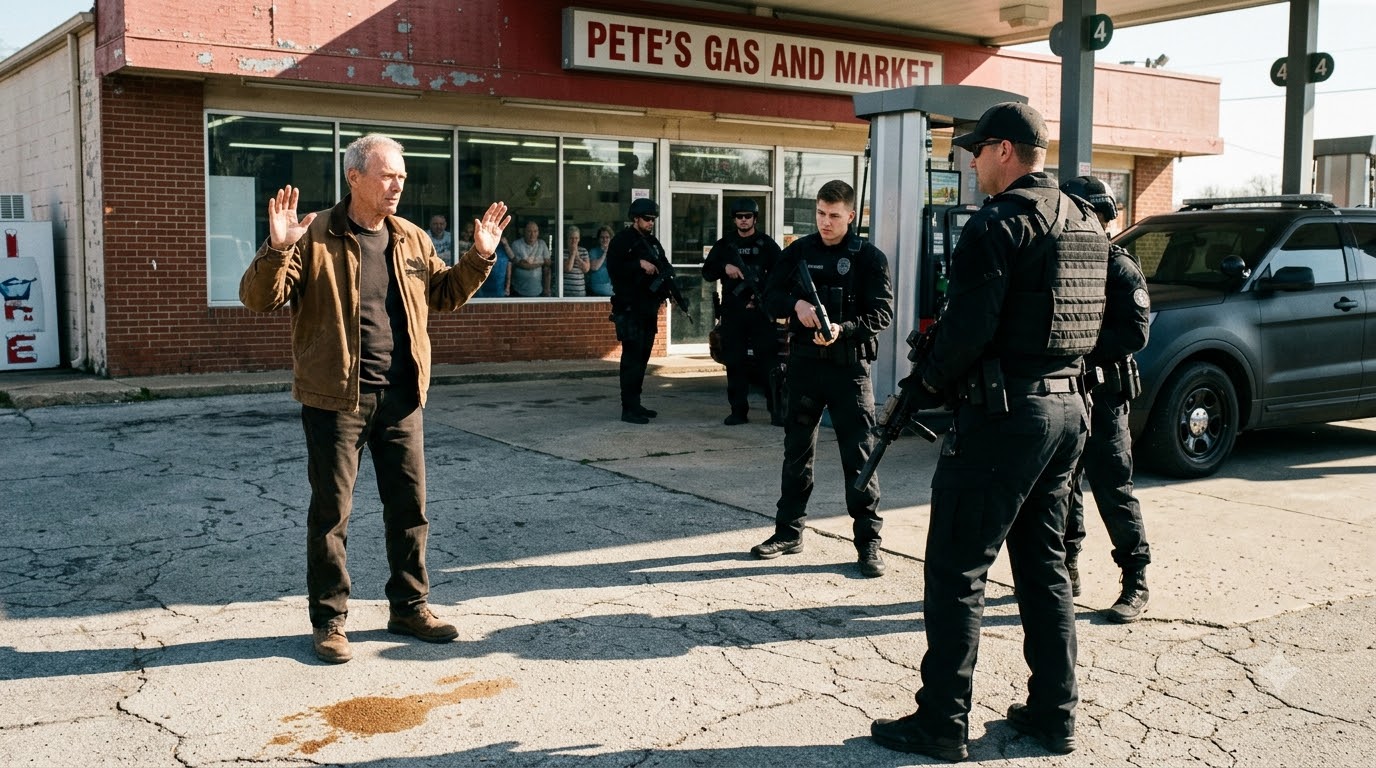
The morning air smelled of burnt gasoline and sun-baked dust. Nora stood near pump four, her fingers clutching a paper receipt that fluttered against the wind like a wounded moth. Three matte black vehicles blocked the perimeter of Pete’s Gas and Market, their tires hissing against the cracked asphalt. An officer in full tactical gear stood atop a cruiser, sweeping the horizon with binoculars. Another shouted unintelligible commands into a shoulder mic.
Nora did not raise her voice. She had lived seventy-four years without ever needing to shout at anyone. She simply lifted her left hand, palm open and empty, to show she was holding nothing more dangerous than a paper cup. The youngest officer, his helmet strapped too tight across a sweat-slicked jaw, flinched backward. His finger twitched against the grip of his taser holster.
“Non-compliant,” the officer barked, his voice cracking with unearned adrenaline. “Step away from the pump now.”
Across the street, Ellis Monroe paused. He slid the red shop rag deep into the pocket of his worn brown jacket, his thumb rubbing the rough cotton seam. His boots crunched against the gravel as he left the shelter of the sidewalk, moving with the slow, deliberate stride of a man who had measured every step he took for decades. He did not run. Running invited panic, and panic made mistakes fatal.
The distance between the sidewalk and pump four was barely forty paces, but every single yard was thick with the electric hum of forced authority. Before Ellis could reach the edge of the asphalt, the sharp, dry crackle of a discharged taser ripped through the morning silence. The sound hit the brick walls of the market and bounced back.
Nora did not scream. Her knees simply buckled, her body dropping limp onto the gritty pavement as the barbs found their mark. The paper coffee cup exploded in a brown splash across the concrete. Her glasses skidded beneath the base of the fuel pump, the lenses catching the glare of the morning sun. Her fingers twitched once against the dirt, then went still.
The tactical team spun instantly toward the motion on the street, three rifle barrels snapping upward to form a jagged, threatening wall of steel.
“Step back, old man!” the team leader roared, his face hidden behind a dark visor. “Active perimeter! You’re next!”
Ellis froze mid-step. His hands went up automatically, palms flat and facing outward, fingers relaxed. He did not look at the rifles aimed at his chest. His eyes bypassed the steel, the ceramic vests, and the shaking hands of the men behind them, locking entirely onto the still form of his wife lying against the gray concrete.
CHAPTER 2: THE RED RAG
The dust kicked up by the idling tactical vehicles hung suspended in the harsh morning glare. Ellis did not look away from the pavement where Nora lay motionless. Her fingers remained curled against the grit, mirroring the stubborn stillness of a woman who had weathered decades of quiet storms without ever breaking her stride.
The team leader stepped closer, his heavy combat boots grinding against spilled gravel. He reached out and shoved Ellis hard against the side of the nearest cruiser. The hot metal pressed through the thin cotton of Ellis’s shirt, radiating the dry heat of the mid-morning sun.
“I said hands on the vehicle, old man,” the leader snapped, his voice tight with defensive arrogance. “You interfere with an active zone again, and you’ll find yourself sharing those cuffs with your wife.”
Ellis breathed out slowly through his nose. He could feel the coarse fibers of the red shop rag hidden deep inside his coat pocket, pressing against his thigh like a steady, silent anchor. He did not pull it out. He did not give them the satisfaction of a panicked flinch or a useless threat.
Across the asphalt, the youngest officer kept his taser pointed rigidly at the ground, his chest rising and falling in rapid, uneven gasps. The indicator light on the side of the weapon blinked a dull, steady amber. A half-empty paper coffee cup drifted lazily across the curb on a sudden gust of wind, leaking dark drops into the dust.
“She has a heart condition,” Ellis said, his voice flat, dangerously quiet against the roar of the idling engines.
“She should have thought of that before she reached for her purse during a high-risk perimeter lockdown,” the team leader shot back, refusing to yield an inch of his manufactured authority.
Ellis didn’t blink. He kept his eyes locked on the way Nora’s shoulder rose in a shallow, uncertain breath. The system these men wore, the matte black vehicles, the unearned swagger—it was all built on a foundation of noise and borrowed power.
“You’re standing on the wrong block,” Ellis said.
The leader stiffened, his hand hovering inches from his radio clip. “Watch your mouth, old man. We have our coordinates.”
Ellis let the silence stretch out, heavy and suffocating, until the team leader’s posture twitched with sudden, reluctant doubt.
CHAPTER 3: THE GRAVEL ROAD
The weight of the team leader’s forearm pressed heavier against Ellis’s shoulder blade, trying to force a compliance that the old mechanic’s bones refused to grant.
“I’ve warned you twice, old man,” the leader muttered, his breath smelling of stale coffee and hot tactical nylon. “Keep your face against the cruiser and don’t turn around.”
Ellis did not turn. His cheek rested against the sun-warmed paint of the vehicle panel, feeling the dull vibration of the idling engine beneath the metal. He could still see the edge of Nora’s shoe from the corner of his eye, unmoving beside the pump island.
“You’re thirty blocks off,” Ellis said, his voice dropping an octave, steady as a falling plumb line. “The dispatch order lists North Maple. This is South.”
The pressure on his shoulder hesitated for a fraction of a second. A bead of sweat rolled down the temple of the young officer standing nearby, dropping dark onto the dusty toe of his combat boot.
“Shut your mouth,” the leader snapped, though the absolute certainty in his tone had begun to fray at the edges. “We secure the perimeter as ordered.”
Ellis shifted his weight slightly, testing the friction of his boots against the gravel. The plastic zip ties groaned under the slight movement of his wrists, biting into his skin with sharp, unyielding friction.
“You didn’t verify the grid,” Ellis murmured, letting the cold logic of a man who had built field protocols hang heavy in the air. “You didn’t check the cross street. And you deployed heavy containment on a civilian retail pump.”
A radio clipped to the leader’s vest crackled with static, spitting out a garbled update from the perimeter guard that nobody could decipher over the engine hum. The younger officer swallowed hard, his fingers twitching nervously against the strap of his tactical vest.
“Boss,” the younger man muttered, his voice cracking slightly. “The cross street… is that right?”
“Quiet,” the leader hissed back, tightening his grip on Ellis’s jacket.
Ellis kept his eyes fixed on the cracked asphalt beneath the cruiser bumper, waiting for the exact moment the false authority would buckle under the simple weight of an unaddressed fact.
CHAPTER 4: THE FIVE WORDS
The team leader pressed his weight harder against the cruiser panel, his breath coming in short, heated gasps.
“I’ve had enough of your stalling, old man,” the leader snapped, his hand tightening around his radio mic. “Secure him in the back of the transport unit right now.”
Ellis did not flinch. He did not pull away. He simply rotated his head an inch against the sun-baked metal, keeping his eyes fixed on the distant edge of the asphalt where Nora still sat under the market awning.
“You’re thirty blocks off,” Ellis repeated, his voice dropping into that deep, level register that carried no anger, only absolute, crushing weight. “And you didn’t check the grid.”
The young officer standing nearby froze mid-step, his boot hovering half an inch above the grit. A cold bead of sweat tracked down his jawline, catching the morning light before falling into the dirt.
“Boss,” the younger man muttered, his fingers loosening on his holster strap. “He… he said the address. We cleared North Maple.”
“Shut it,” the leader hissed, though his own thumb hesitated over the toggle switch of his radio.
Ellis didn’t raise his voice. He didn’t need to shout over the rumble of the idling armored engines. He let the silence stretch until the absurdity of their unearned authority began to crack wide open under the simplest common-sense boundary.
“Call Admiral Ren right now,” Ellis said.
The five words dropped onto the pavement like a lead weight. No threat, no plea, just a cold instruction delivered with the absolute certainty of a man who had written the rules these officers were currently breaking.
The team leader stopped dead. His radio sputtered with static, but nobody moved to answer it.
CHAPTER 5: THE BADGE EMERGES
The tactical team leader stared down at Ellis with eyes narrowed behind polarized visors, trying to reassert a dominance that had just evaporated into the morning air.
“You’re playing a dangerous game, old man,” the leader hissed, his fingers finally dropping away from the radio. “Interfering with a federal perimeter carries heavy consequences.”
Ellis didn’t blink. He kept his palms flat against the sun-baked metal of the cruiser hood, feeling the engine heat radiate into his knuckles.
“Left pocket, inside lining,” Ellis said, his voice entirely devoid of fear or anger. “Look. Don’t touch.”
The older officer standing nearest to the vehicle hesitated, glancing sideways at his commander for permission. The leader gave a stiff, reluctant nod, his jaw clenched tight with wounded pride.
Two gloved fingers slid cautiously inside the worn brown jacket lining. They hooked the edge of a heavy, dull piece of metal and drew it out into the open light.
It wasn’t a police star. It wasn’t a standard military tag. It was a black metallic badge, dulled by decades of service and bearing clearance markers that most tactical officers only heard about in rumors.
The older officer’s breath caught audibly in his throat. He stared at the engravings for three long seconds before slowly stepping back, holding the metal out toward the commander like it might burn his palm.
“Boss,” the officer whispered, his voice trembling slightly. “Look at the clearance code. This isn’t local.”
The commander snatched the badge from his subordinate’s hand, his eyes scanning the lettering line by line. The arrogant color drained completely from his face, leaving him staring dumbly at a piece of hardware that completely dismantled every single order he had barked that morning.
CHAPTER 6: THE QUIET NORMAL
The commander dropped his arm, the metal card slipping slightly against his damp glove. He looked from the engraved serial numbers up to Ellis’s weathered face, his mouth opening and closing once without sound.
“We—we received coordinates for a high-risk interdiction,” the commander stammered, his earlier arrogance dissolving into thin, frantic air. “The manifest came straight down from regional command.”
“You didn’t verify the grid,” Ellis said, his voice entirely flat, carrying the cold weight of a man holding an immovable boundary. “And you didn’t check who was standing on it.”
Admiral Jonathan Ren’s charcoal gray SUV rolled silently to a stop behind the barricade, its tires crunching softly against the dust. The door clicked open, and Ren stepped out onto the pavement, his silver hair cropped razor straight. He bypassed the armored vehicles entirely, walking straight toward the center of the lot with a measured, crisp stride.
Ren stopped two feet from the commander, his eyes fixed cold and steady. “You didn’t secure a suspect,” Ren said, his voice carrying cleanly across the quiet street. “You assaulted a former field director with command-level clearance over a clerical error.”
The young officer who had fired the taser dropped his head, his hands trembling as he unclipped his vest and let it hit the pavement with a dull thud. No one shouted. No one argued. The unearned authority of the perimeter collapsed under the sheer, crushing weight of reality.
Ren reached into his coat pocket and pulled out a sealed envelope, offering it forward. “We want you back, Ellis. The agency needs your clearance.”
Ellis did not look at the envelope. He turned his back on the command vehicle, walking past the silent officers toward the small market awning where Nora sat wrapped in a blanket.
“My clearance belongs to her now,” Ellis said softly, extending a calloused hand to help his wife to her feet.
Nora took his fingers, her grip firm and steady as she stood up straight against the morning wind. They walked together past the rows of matte black trucks, stepping past the discarded gear without a single backward glance.
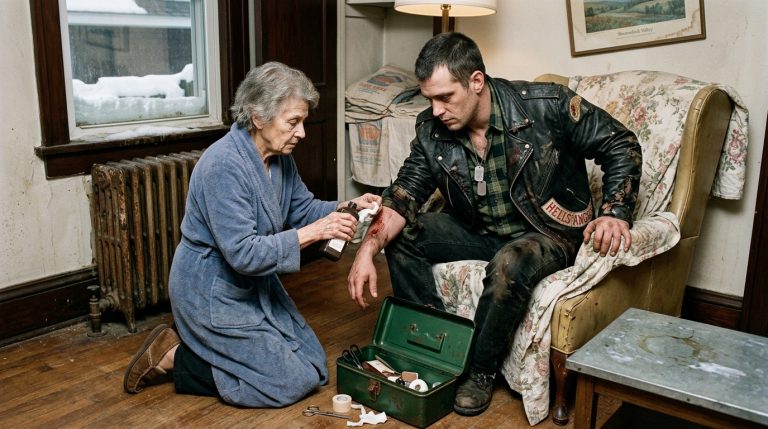
Later that afternoon, the dust on the porch settled back into the old floorboards of their weathered brick house. Ellis sat in his usual wooden chair, a small wrench in his hand, tightening a loose bolt on the wind chime above the front door.
The brass tubes chimed once in the breeze, clear and sweet, anchored safely in a quiet world that no amount of noise could ever touch again.