The Weight of Standing Water: A Rusted Tale of Loss, Legacy, and Long Memories
CHAPTER 1: THE FIRST CITATION
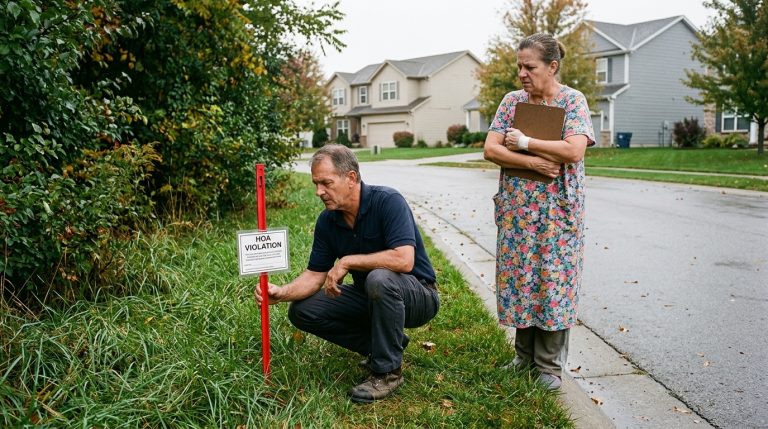
“Unauthorized,” she said. The word hit the damp morning air with the flat, mechanical click of a staple gun.
Bethany Cromwell didn’t step onto the cedar. She stayed where the gravel driveway dissolved into the marshy edge of the property, her designer heels sinking exactly half an inch into the gray, iron-heavy mud. Behind her, two men in identical polyester polo shirts held clipboards against their chests like small sheets of armor.
Daniel Morrison didn’t drop the rod. His hands were still slick with cold lake water and the rough, metallic texture of bass scales. The fish was small, breathing hard in the bucket at his feet, its gills working against the stagnant shallows.
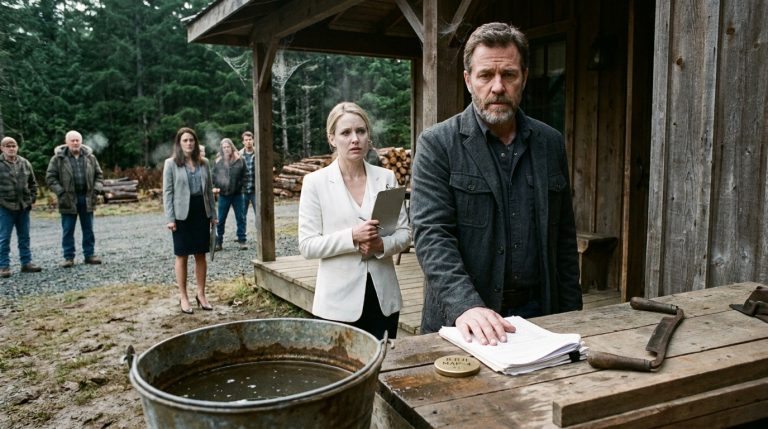
“Section 4.7b,” Bethany continued, her thumb running along the edge of a yellow carbon copy slip. Her designer sunglasses reflected the flat slate-gray of Lake Thornberry, obscuring her eyes behind two small, dark mirrors. “Recreational fishing from unapproved residential structures. The board voted on the amendment Tuesday night, Mr. Morrison. Six hundred dollars.”
A hundred yards out, the silence tore open. A two-stroke jet ski engine screamed, a rising, high-pitched wail that sounded like iron teeth grinding against a lathe. It was her boy, the teenager with the gold chain and the loose wrists, cutting a sharp, white crescent through the glassy surface of the water. The wake rolled inward, heavy and thick, slapping against the raw cedar pylons beneath Daniel’s boots. The smell followed a second later—unburned fuel, sharp and synthetic, cutting through the damp scent of rotting pine needles and wet earth.
“I have the deed,” Daniel said. His voice was low, dry from the morning’s first coffee, which was currently cooling in a tin mug on his tackle box. “The water rights go back to forty-three. Before the county put the blacktop down.”
“The lake is community property now, honey.” Bethany’s smile didn’t move the rest of her face. It stayed fixed, small and white, beneath the edge of her oversized straw hat. Her fake nails, clicked against the aluminum clip of her board. “Your quiet mornings? Done. The neighborhood is changing. We are establishing aesthetic uniformity.”
Daniel looked down at the cedar planks beneath his boots. He’d selected every board himself from the mill in Tomahawk, sorting through the knots until he found the ones that smelled most like clean resin. Sarah had sat in the hospital bed, her skin the color of skim milk, pointing at the Polaroid of the deep water drop-off where the shelf dipped forty feet into the dark. Two chairs, Danny, she’d whispered through the rubber tang of the oxygen mask. Make it strong enough for two chairs.
He looked back at the citation in Bethany’s hand. The paper was thin, trembling slightly in the damp breeze that always rolled off the spillway at dawn. He didn’t take it. Instead, his gaze drifted past her shoulder, toward the small white sticker affixed to the side of her assistant’s clipboard—a corporate logo for a regional development group out of northern Illinois.
“Thirty days to clear the dock of all non-standard gear,” Bethany said, dropping the yellow slip onto the lid of his tackle box. The wind immediately caught it, pinning it against the rusted latch. “We’ll be back for the structural inspection on the first.”
As her heels crunched back up the gravel toward her Mercedes, her assistant leaned in close to her ear. Daniel’s ears, trained to pick up the faint, rhythmic piston-knock of diesel engines across a crowded deck, caught the low murmur: “Think the old man’s going to fight it?”
Bethany didn’t look back. Her laugh was short, the sound of dry grass breaking under a heavy boot. “He’s a grieving widower on a fixed pension. He’ll pay, or he’ll sell. They always do.”
Daniel didn’t move until the sound of her tires faded into the main road. He reached down, picked up the yellow paper, and turned it over. On the back, in faint, purple ink from the carbon press, was a small, hand-drawn map of his shoreline with three red grease-pencil marks directly over the main support beams under his feet.
CHAPTER 2: THE RUSTING FRAMEWORK
“Riparian means nothing when the foundation is bleeding,” Jerome said through the phone speaker. His voice carried the faint, crackling hum of a small-town attorney’s landline, punctuated by the rhythmic tapping of a cheap keyboard. “I’m looking at the digital pull of the forty-three deed right now, Tank. The text is clean. But the county GIS mapping system has a gray overlay on your parcel. That doesn’t happen by accident.”
Daniel didn’t answer right away. He stood inside his dark garage, the air heavy with the sharp smell of penetrating oil, dry dirt, and old canvas tool bags. He had the heavy steel filing cabinet open, the green hanging folders slouched like tired soldiers. His rough fingers traced the edge of the original surveyor’s map from the house purchase. The paper was thick, aged to the color of wet sand, its margins stamped with faded purple ink that had begun to bleed into the fibers decades ago.
“What kind of overlay?” Daniel asked. He balanced the phone between his shoulder and ear, pulling a heavy brass compass from a velvet-lined case. The metal was dull, coated in a fine patina of green oxidation that rubbed off on his thumb like copper dust.
“A municipal zoning hold,” Jerome replied, a long breath escaping him, rattling the tiny microphone. “It’s usually reserved for properties under structural condemnation or environmental remediation. It overrides standard private water rights by putting the title into a state of civil escrow. If Bethany’s group flags your dock as an immediate public safety hazard, that escrow clause activates automatically. They don’t have to break your deed, Tank. They just have to freeze your ability to exercise it while they push the marina permits through the county board.”
Daniel set the compass down on the metal cabinet lid. The click of brass against steel was loud in the small space. “She had a red grease-pencil mark on the joists. Three of them.”
“She’s setting up the structural failure argument,” Jerome said. “Listen to me, brother. You’re an engineer, so you think about load-bearing capacities and physical evidence. But this isn’t an engineering problem. This is predatory title-washing. Over the last eighteen months, Cromwell’s corporate LLC has acquired four adjacent waterfront parcels. Every single one of them was flagged with minor zoning infractions first. Then the fines multiplied. Then the owners got tired of the friction and signed the quick-claim forms for pennies on the dollar.”
“They won’t get the cedar,” Daniel murmured. His voice was flat, devoid of anger, settled into the cold, calculated registry he used when calculating pipe-line pressures under fire in the dry heat of the oil-fields.
“Just don’t give them a reason to call the sheriff,” Jerome warned. “I’m pulling the corporate registration for that Illinois group. Every time I dig, the server down in Madison delays the request. Someone’s running interference on the public index. Keep your eyes open.”
The line went dead. Daniel didn’t put the phone away. He slipped it into his breast pocket and reached for his heavy flashlight, the aluminum casing cold and pitted with salt-scars from old coastal deployments. He walked out of the garage, his work boots grinding into the dry gravel of the driveway, heading toward the shoreline where the morning sun was just beginning to catch the rust on the old spillway mechanism half a mile down the bank.
The air by the water was different—colder, carrying the faint, metallic stink of old iron and wet weed. He walked out onto the dock, the cedar planks dry and grayed by two years of unshielded exposure to the Wisconsin winters. He dropped to his knees at the very edge where Bethany had stood, lowered himself over the side, and swung beneath the timber framework into the damp, shadowed space between the water and the joists.
Here, out of the direct glare of the sun, the world smelled of rot and river-silt. The water lapped rhythmically against his boots, dark and thick with tannin. He clicked the light on, washing the bright beam across the main carrying beam.
There were the red marks. Three neat, identical slashes of grease-wax, right over the heavy galvanized bolts he’d driven into the wood himself. But as he traced the beam back toward the stone retaining wall, his light caught something else—something that hadn’t been there when he finished the project.
A small, circular disc of rusted brass was pinned to the underside of the main joist by a heavy copper nail. It was stamped with a series of numbers: 1974-WD-08. The metal was deeply pitted, the edges eaten away by the dampness of the lake, but the lettering was deliberate, industrial. It wasn’t an HOA tag. It was an old state utility marker, buried deep within the structural wood of his land.
Daniel reached out, his thumb pressing against the rough surface of the disk. The metal didn’t budge, but as he applied pressure, a thin trickle of reddish-brown water squeezed out from behind the wood, staining his skin with the scent of iron-heavy rust. He pulled his hand back, his eyes narrowing as he noticed a faint, oily sheen slicking the surface of the lake directly beneath the tag, swirling in small, iridescent rings against the dark current.
Above him, on the main road, a heavy diesel engine shifted gears, the vibration rumbling through the timber frame of the dock. The sound was too deep for a residential delivery truck. It was the low, rhythmic thrum of commercial equipment moving toward the development line.
CHAPTER 3: MARKED WOOD
The impact driver bit into the rusted steel casing with a sound like bone cracking. Daniel didn’t lean away from the dust that blew out of the old screw threads; he kept his forearm locked against the grip, his weight driving directly through the stock to prevent the tool from slipping and stripping the head.
The security camera housings were industrial surplus, heavy zinc-coated alloy that smelled faintly of dry grease and old warehouse floors. He mounted the first one six inches below the roofline of the tool shed, angling the lens downward until the crosshairs on his handheld monitor sliced clean across the narrow path leading to the cedar dock. On the tiny screen, the digital night-vision feed gave the gray water out on the lake the flat, dead look of cooled lead.
By noon, the humidity had dropped, leaving the air thick with a fine, chalky silt that blew off the dry shoreline. Daniel wiped his palms on his canvas trousers and walked the length of the south baseline stake. The boundary marker was a length of iron rebar driven five feet into the earth back when the subdivision was still farmland. It was coated in thick, bubbling layers of rust that came away in dry flakes under his boot.
He knelt down in the scrub grass, his fingers checking the base of the iron pin. Someone had cleared away the dead brush around it within the last forty-eight hours. The dry dirt was turned over, leaving dark, clotted chunks exposed to the hot sun, and right beside the rebar sat a small, unlisted gray junction box, completely unmarred by time, wired directly into a thin conduit that vanished straight down into the hard soil toward the lake bed.
Daniel didn’t open it. He touched the plastic molding, noting the clean, soft gasket seal that hadn’t yet been degraded by the alkaline dirt. He took a single high-resolution photograph with his phone, the timestamp ticking past 13:15, then stood slowly, his knees grinding with the familiar stiffness of a man who spent twenty years working on steel deck plates.
The sound of an approaching vehicle cut through the dry rustle of the oak trees. It wasn’t the loud, high-performance growl of Bethany’s Mercedes. This was a heavy, commercial flatbed, the engine missing slightly on the third cylinder, its brakes squealing as it pulled onto the narrow gravel turnout outside his perimeter wire.
Two men in industrial canvas workwear climbed down from the cab. They didn’t look toward the house. Instead, they began unchaining a heavy spool of black polyethylene pipe from the bed, their movements methodical, unhurried. One of them carried a long, T-handled iron key used for turning municipal water mains.
Daniel walked toward the wire fence line, his hands resting loose at his sides, his gaze settled on the door logo of the truck: Thornberry Infrastructure Partners LLC. The paint was fresh, masking an older, scraped-away decal beneath it that still retained the faint outline of a corporate seal from Cook County, Illinois.
“You’re outside your utility easement,” Daniel said when he reached the gravel shoulder. His voice didn’t rise above the low idle of the flatbed’s engine, but it carried the dead-weight authority of an engineer who had spent half a lifetime reading property maps under high pressure.
The man with the iron key didn’t stop unrolling the pipe. He had a graying mustache and eyes that stayed fixed on the dirt near Daniel’s boots. “Emergency county bypass installation, sir. We’ve got an order from the district supervisor to drop a secondary pressure line along the riparian zone.”
“Show me the signed variance,” Daniel said. His hand went into his pocket, his fingers wrapping around the cold, textured barrel of his flashlight.
The driver of the truck, a younger man with a thick leather tool belt that looked brand new, stepped between Daniel and the flatbed’s cab. His fingers were tucked into his belt, hovering less than an inch from a heavy steel framing hammer. “The paperwork’s handled through the main office in Madison, friend. We just execute the work order. If you’ve got a dispute with the placement, you take it up with the association president during the scheduled session.”
“The association doesn’t hold an easement on this side of the ditch,” Daniel replied. He pointed his flashlight toward the ground, where a thin, bright line of fluorescent green spray paint had been freshly applied over the weeds, tracking a direct path toward the cedar dock pylons. “You cross that wire, you’re on private land covered by an active land grant from forty-three.”
The older worker finally stopped with the pipe. He looked up, his face dry and grayed by dust, his mouth tight. “The forty-three grant has an uncorrected tax assessment discrepancy from eighty-seven, Mr. Morrison. It’s listed on the public ledger as an unverified title. We’re legally cleared to access the watershed for public utility stabilization until that ledger is cleared by the court.”
Daniel didn’t answer. He watched the older man’s hand tighten on the iron key, the metal slick with oil. The detail about the 1987 ledger wasn’t something a field technician would know offhand; it was a specific legal counter-move, a scripted response designed to stall an owner while the physical hardware was forced into place. Bethany wasn’t just sending citation papers anymore; she was using the county infrastructure loop to physically isolate the parcel before the ownership petition could even reach a judge’s desk.
“Get the truck off the gravel,” Daniel said, his voice dropped an octave, the tone perfectly level. “The county didn’t pave this turnout. I did. And the load limit on this shoulder doesn’t support an eight-ton flatbed.”
The younger man took a half-step forward, his shoulder dropping slightly, his hand shifting toward the handle of the hammer. “And if we don’t?”
Behind them, deep within the interior of the tool shed, the small digital receiver Daniel had mounted to the wall gave a single, sharp beep. The infrared motion arrays on the dock had just registered a change in density beneath the main carrying joist.
CHAPTER 4: THE HALFCENTURY LEDGER
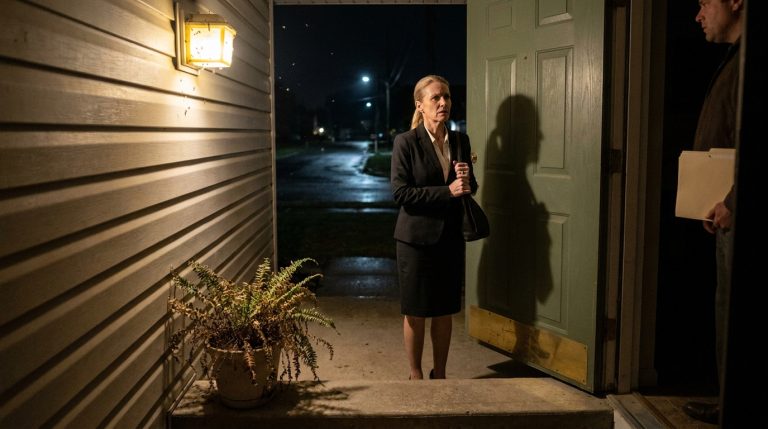
“Sign the acknowledgment of escrow, Daniel. It’s a matter of administrative cleanup, nothing more,” Bethany said. She did not open the front screen door. She stood on the concrete porch, her polished fingers resting on the cracked wooden frame, her voice cutting through the dry midday heat like a cold blade. Behind her, the blue lights of a county vehicle pulsed lazily against the dusty leaves of the old oak trees.
Daniel held the heavy iron latches of the screen door from the inside, his thumb tracing the rough, pitted metal. “A cleanup doesn’t require a sheriff’s deputy at the gate, Bethany.”
The man standing behind her wasn’t the regular county deputy who checked the boat landings. He wore a stiff, dark tan uniform that smelled of fresh starch and synthetic leather, his hands resting heavily on his utility belt near a matte-black folder. He didn’t look at Daniel; his eyes were fixed on the zinc-coated security cameras Daniel had mounted to the tool shed the afternoon before.
“Mr. Morrison,” the deputy said, his tone flat, bureaucratic, and entirely devoid of local inflection. “We’re here to serve an administrative summons from the county clerk’s office. The property description on your forty-three land grant contains an unresolved statutory cloud dating back to the winter of nineteen eighty-seven. Until the title-washing audit is complete, the watershed access is restricted under public utility code section twelve.”
Daniel pushed the door open an inch. The hinge gave a short, dry scream as iron ground against iron. “The eighty-seven ledger was settled before the power company turned the dam over to the trust. The records are in the Madison archive.”
“They were,” Bethany murmured, her small, white smile returning. She reached down, took the matte-black folder from the deputy, and slid a single sheet of heavy, textured paper through the crack in the door. “But the county clerk uncovered the original ledger during the routine pre-permitting review for the marina development. Your parcel failed to account for the nineteen eighty-seven special utility assessment. The back taxes, compounding at eight percent annually over forty years, exceed the assessed valuation of the entire lot.”
Daniel caught the edge of the paper. The texture was rough, dry, carrying the faint scent of old cellar dust and decomposing ink. It was a certified copy of a municipal ledger entry dated November 14, 1987. The lines were written in a thick, sloping cursive that had faded to the color of dried blood, listing his parcel number under a section marked Delinquent Corporate Utility Escrow. At the bottom of the page sat a heavy, purple stamp—a municipal seal from the Cook County clerk’s office, an extraction from an Illinois jurisdiction completely outside the state of Wisconsin.
“This is an out-of-state corporate lean,” Daniel said, his rough fingers pressing against the ink lines. The paper didn’t smudge; the copy was crisp, fresh from a modern digital laser press, but the artifacting around the purple stamp showed faint, jagged pixel edges where a physical seal had been digitally superimposed onto a public record.
“It’s an enforceable multi-state infrastructure claim, honey,” Bethany said, her voice dropping into a low, transactional rhythm. “The development group in Chicago bought the utility debt from the state trust last quarter. The hold on your banking assets is already filed under the emergency escrow provision. You can’t liquidate the savings to purchase the lake assets, Daniel. You don’t even own the wood you’re standing on.”
The deputy took a step forward, his boot heels clicking against the concrete porch. “The county code allows for immediate property seizure if the utility debt remains unaddressed forty-eight hours after formal notification. You have until Thursday evening to vacate the dock structure and permit the secondary infrastructure line to cross the baseline stake.”
Daniel looked past them, toward the main road where the gray flatbed truck was already idling by his fence line. The workers were lifting a heavy steel drilling rig from the bed, the metal clanking against the iron chains with a sharp, hollow sound that echoed across the flat water of the bay. They weren’t laying a simple water line; they were preparing to drop an industrial core-drill directly into the limestone shelf where the sacred springs broke through the lake bed.
“The ledger’s a dummy,” Daniel said, his voice dropping into the level, heavy registry of a veteran calculating structural load under artillery fire. He didn’t look at Bethany; his eyes were fixed on the small, purple stamp at the bottom of the sheet. “The Cook County clerk doesn’t hold jurisdiction over a public watershed in Tomahawk. Someone altered the database entry before the pre-permitting session.”
“Prove it in court on Monday, Mr. Morrison,” Bethany said, her fingers snapping the clip of her board shut with a loud, mechanical pop. “But by Monday, the concrete will already be poured over the south pylon shelf. Enjoy the view while it lasts.”
She turned, her designer shoes crunching over the dry gravel as she walked back toward her vehicle, the deputy following a step behind her. Daniel stayed at the door, the dry ledger sheet clutched in his hand, his thumb catching a tiny, raised texture on the reverse side of the page—a faint, indented watermark of a modern commercial paper mill that hadn’t existed in 1987.
CHAPTER 5: THE SACRED BED
The cold water of the inlet cut through Daniel’s canvas hip boots like a dull blade. He dug his fingers into the coarse river gravel along the south embankment, the small stones grinding under his nails as he cleared away thirty inches of packed clay and rotting leaf litter. Above him, the afternoon sun was a pale disk masked by the dust kicked up from the drilling rig down the lane, but down here in the shadow of the overhang, the world was a narrow strip of dark silt and cold iron.
His fingers hit a hard, geometric edge. It wasn’t the jagged limestone native to the Thornberry basin; it was a squared block of granite, the surface scarred by deep, old chisel marks that had been smoothed over by half a century of subsurface currents. Daniel hauled a heavy brush from his pack, scrubbing the slime off the stone face until his flashlight caught the deep, incised indentation of a tribal allotment boundary—the three-notch sign of the Menominee land surveys that predated the 1924 damming.
“The marker hasn’t moved,” a voice said from the brush above.
Elder Joseph Corn stood on the crumbling bank, his heavy wool jacket coated in a fine layer of gray dust from the development trucks. He didn’t offer a hand to pull Daniel up. He stood with his arms crossed, his old leather boots planted firmly on a exposed oak root that held the bank from sliding into the shallows. His face had the dry, weathered texture of winter timber, his eyes fixed on the green fluorescent paint line that stopped exactly three inches from the granite block.
“They’re drilling thirty yards from the alignment,” Daniel said, climbing out of the silt. His boots dripped heavy, dark water back into the pool, leaving a gray trail across the dry grass. “They’re not sampling for the marina foundation, Joseph. They’re going down past the bedrock shelf. They’re looking for the high-pressure aquifer.”
Joseph knelt down, picking up a handful of the gray mud Daniel had excavated from the marker’s base. He rubbed it between his palms, sniffing the residue before letting it drop back to the earth. “The water from these springs doesn’t belong to the county trust, Daniel. It never did. When the power company built the spillway in twenty-four, they buried the creek bed, but they couldn’t kill the flow. The old people call this place the breathing stone. If they plug it with concrete to build their docks, the pressure will blow out the hillsides five miles south.”
“The ledger Bethany produced says the allotment was dissolved during the eighty-seven assessment,” Daniel said, pulling the laser-copied document from his internal pocket. The paper was stiff, ruined by the humidity of his clothes, the purple ink stamp looking even more disjointed against the natural green shadow of the woods.
Joseph didn’t look at the paper. He spat into the dry dirt near his feet. “In nineteen eighty-seven, the county clerk was a man named Miller who took his retirement in a lakefront house down in Geneva. He didn’t clear the titles. He buried the tribal claims under the utility escrow clause so the state could lease the surface rights to the homeowners’ association. That paper is a shadow of an old lie, engineer. But Bethany’s people aren’t digging for a lie. They know what’s under the limestone.”
Daniel looked back toward the dock, where the zinc-coated cameras were still silently tracking the perimeter wire. Through the trees, the rhythmic thump-thump-thump of the core-drill was vibrating through the ground, a steady, low-frequency oscillation that made the tiny ripples in the shallows distort into concentric geometric rings. He walked toward the wire fence line, his fingers touching the rusted steel posts.
The conduit he’d discovered near the baseline stake wasn’t an electric line for the neighborhood utilities. He traced the trench line with his boots, noting how the earth had settled over the backfill. It led straight from the unlisted gray junction box directly toward the core-drilling platform. Bethany’s developers hadn’t just discovered an old tax loophole; they were trying to isolate the aquifer before the federal environmental surveyors could verify the deep-water chemistry of the basin.
“Jerome is filing the emergency stay at the courthouse in forty minutes,” Daniel said, his voice level, flat with the cold calculation of a man prepping an engine block for an overload run. “But the sheriff’s office is running their calls through the development liaison. They won’t serve the papers before the midnight shift changes.”
“Then the stay is just more dry paper,” Joseph said, his hand resting on the smooth handle of a weathered hickory walking stick. “A man who builds bridges under fire doesn’t wait for a clerk to sign a pass, Morrison. If that drill cuts through the lower shelf before you hold the deed, the state will condemn the entire watershed under the emergency conservation act. The lake will belong to the receivership by Friday morning.”
Daniel turned the heavy aluminum flashlight over in his palm, his thumb resting on the cold toggle switch. He could feel the vibration of the drill rising through the soles of his work boots, a deep, mechanical friction that felt like iron teeth chewing through the bone of the land. The decoy secret—the forged tax ledger Bethany had used to lock his bank accounts—had served its purpose; it had kept him looking at the county records while her syndicate brought the heavy hardware onto the bank to seal the real secret under ten tons of quick-setting industrial grout.
“They won’t drop the casing tonight,” Daniel murmured, his gaze settling on the flatbed truck’s hydraulic arms as they lifted another length of heavy zinc-coated drill rod into the derrick. “They’ve got three more lengths of pipe to thread before they hit the bedrock transition. That gives us exactly five hours before the midnight shift takes the site.”
Joseph looked at him, his mouth tightening into a thin line that looked like a scar in the dim light of the canopy. “The wood of your dock is marked, Daniel. But the water under it has a long memory. Don’t look at the paper. Watch the valves at the spillway.”