The Quiet Echo of Valor: A Veteran’s Silent Lesson in Grace and Unseen Humanity
CHAPTER 1: THE TARNISHED REFLECTION
The brass nameplate beneath Joseph’s fingers was cold, but the reflection it gave back was sharp enough to cut. He ignored the Captain. The man’s voice, sharp and thin as a razor blade, didn’t rattle him; Joseph had heard artillery fire that shook the very marrow of his bones, and a young officer’s insecurity was nothing compared to the thunder of an NVA mortar barrage.
“Did you hear me, old-timer?”
Hayes took a step closer, his boots clicking rhythmically against the marble floor. Behind him, the junior lieutenants shifted, their posture a performance of casual dominance. They were waiting for a reaction—a flinch, a stutter, an apology—to validate their afternoon of hollow status-building.
Joseph finished the stroke. The name on the plate—Specialist Greg Miller—glinted back at him, perfectly polished. He didn’t need to look up to know the Captain was red-faced and trembling with that specific, fragile brand of indignation reserved for those who had never been truly tested by fire.
“The brass was tarnished,” Joseph murmured. His voice was a dry, rustling sound, like leaves skittering over pavement. He kept his posture slightly stooped, a physical mask he wore to keep the world at an arm’s length. “It’s important to see their names clearly. Especially today.”
“Their names are for brothers-in-arms,” Hayes scoffed, his confidence swelling as the janitor remained passive. “Not for custodial staff to obsess over. Pack your cart and get out. You’re staining the atmosphere.”
Joseph reached for a fresh rag. His fingers were stiff, scarred by decades of labor that had replaced the weight of a rifle. He felt the familiar, grating squeak of his cart’s left wheel—a sound that usually acted as a signal to keep walking, to stay invisible. But today, the silence of the hall felt heavy, pregnant with the ghosts of men who had shared their last rations in the dark.
“I have my orders, Captain,” Joseph said, his tone devoid of challenge. He spoke with the quiet, devastating detachment of a man who had already seen the end of the world and survived it. “But the honor wall isn’t finished.”
Hayes exchanged a look with his lieutenants—a silent, cruel pact. The humiliation of simply dismissing the old man wasn’t enough; they wanted to see him broken. The Captain’s hand went to his breast pocket, pulling out a crisp, heavy-stock invitation. It was a golden ticket to a room of heroes, a place where he planned to turn this old, quiet shadow into a punchline for a room full of men who wore their valor on their chests like bright, colorful ribbons.
He shoved the card into Joseph’s rough hand, his fingers deliberately avoiding contact. “Fine. Stay. Be here at 1900. Wear your best rags, if you have them. I’m sure my men will find your presence… educational.”
Joseph looked down at the embossed crest of the 75th Ranger Regiment. He felt the raised texture of the gold leaf, a stark contrast to the grit of his work-stained skin. He felt a sudden, sharp ache in his lungs—the phantom sensation of jungle air and thick, choking cordite. He didn’t look up at the Captain. He simply nodded, a single, precise movement that Hayes mistook for submission.
As Joseph turned, his cart rattled across the floor. He didn’t see the smirk on Hayes’s face; he saw the brass nameplate of another boy who would never grow old. He pushed the cart toward the service exit, the squeaking wheel sounding like a lonely, rhythmic heartbeat in the vast, empty hall.
CHAPTER 2: THE WEIGHT OF THE INVITATION
The service corridor was dim, illuminated only by the flicker of a dying fluorescent tube that hummed in a frequency Joseph had long since learned to tune out. Every revolution of the janitor cart’s left wheel produced that specific, high-pitched protest—a sound that, in the silence of the back halls, felt louder than a gunshot.
Joseph didn’t rush. He never rushed. He walked with the measured, rolling gait of a man who had spent years balancing his life on the edge of a precipice, his spine straight despite the years of leaning into a mop handle. He could still feel the phantom heat of the Captain’s gaze on his back, a prickling sensation that usually signaled an incoming ambush. But here, in the bowels of the administrative wing, the only thing hunting him was the memory of the A Shau Valley.
He reached the janitor’s closet, a cramped space that smelled of lemon-scented industrial soap and damp concrete. He pushed the cart inside, the wheels catching on the threshold with a dull thud. He didn’t turn on the light. He didn’t need it. His hands moved with an economy of motion that would have looked alien to the young officers upstairs—men who defined movement by speed rather than necessity.
He reached into the pocket of his coveralls and withdrew the invitation. It was a crisp, heavy-stock rectangle of paper, embossed with the regimental crest that had once been the sole focus of his entire existence. In the dark, the gold leaf caught a stray sliver of light from the hallway, gleaming like a polished bayonet.
He closed his eyes. Instantly, the smell of the damp closet—the stale floor wax and cleaning chemicals—vanished. It was replaced by the cloying, suffocating scent of humid earth, wet jungle foliage, and the metallic tang of copper that hung in the air after a long firefight.
Thump. Thump. Thump.
The sound wasn’t the cart wheel anymore. It was the synchronized beat of Huey rotor blades, chopping the air into violent, frantic segments. He saw Corporal Peterson’s face, pale and blood-streaked against the churned-up mud of the perimeter. He felt the phantom pressure of the man’s dead weight on his shoulders, an agonizing burden that had carved a permanent stoop into his posture, even if he worked to hide it.
Joseph exhaled, a slow, rattling breath that served as his own personal anchor. He opened his eyes. The darkness of the closet returned, absolute and grounding. The ghosts were always there, waiting in the periphery, but he had learned how to keep them contained behind a wall of quiet, gray discipline.
He didn’t hate Captain Hayes. Hatred was a luxury he couldn’t afford; it burned too much energy, and he had learned that energy was the only currency that mattered when the perimeter was collapsing. Hayes was just a boy playing at war, someone who had never had to drag a brother through the mud to keep him from the darkness. He was a product of the polish, not the battle.
Joseph sat on the edge of his wooden stool, the wood groaning beneath him. He knew what tonight meant. It wasn’t just a banquet. It was a stage. He had seen the way the lieutenants had looked at him—like an object, a relic that they could drag into the light to make their own brightness seem more intense. They wanted a mascot of failure to stand in contrast to their pristine uniforms.
He looked at the invitation again. If he showed up, he would be the center of their joke. He would have to sit in the back, silent and stooped, while they toasted to a version of history that was sterilized and neat. But then, he remembered the brass plaque. He remembered the fallen whose names he kept clean, whose identities were slowly being eroded by the dust of neglect. They didn’t have voices anymore. They only had him.
If he went, he would be holding the space for the men who couldn’t be there. He would be the witness to their glory, even if the men in the room were too blinded by their own conceit to realize it.
He reached into a hidden compartment behind the locker, his fingers brushing against a small, velvet-lined box he hadn’t opened in years. He didn’t take it out. He didn’t need to. He just acknowledged its presence, a secret weight that balanced his soul.
He stood up, his joints protesting with a dull ache, and walked over to the small, cracked mirror above the sink. He leaned in, peering at his own reflection. He saw the wrinkles, the deep lines that time had etched into his skin, and the winter-sky clarity of his eyes. He wasn’t the janitor. He wasn’t the staff sergeant. He was just a man, holding a fragment of truth in a room full of noise.
He tucked the invitation into his inner pocket, right over his heart. He would go. Not for the Captain, and certainly not for the joke. He would go to ensure that when the lights were dimmed and the stories were told, there would be at least one person in that room who remembered what the cost of those stories actually was.
He turned toward the door, his hand resting on the latch. He could hear footsteps in the hallway—the heavy, purposeful tread of an enlisted man. It was Private Davis. Joseph recognized the cadence. He stood still, waiting, listening to the young man stop outside the closet door. He sensed the hesitation in the air, the way the private hovered, clearly wrestling with something he had seen earlier.
Joseph didn’t move. He let the silence stretch, the air in the narrow corridor growing thick with the weight of unspoken things. He wasn’t going to make it easy for the boy to speak, but he was prepared to listen.
CHAPTER 3: THE PREBANQUET STILLNESS
Joseph didn’t turn around. He kept his hand resting on the latch of the closet door, his posture relaxed, his breathing rhythmic. He felt the vibration of footsteps—hesitant, uneven, and far too loud—approaching down the linoleum corridor. Private Davis. The boy stopped three feet away, his breathing ragged, a clear sign of internal conflict.
“Sir?”
The word was barely a whisper, an accidental slip of the tongue that Davis immediately tried to swallow. Joseph turned slowly. He didn’t look like a staff sergeant. He looked like an old man in oil-stained coveralls, his skin like parchment, his frame frail. But when he met Davis’s eyes, the young private flinched, as if he’d been struck by a physical force.
“You’re a long way from the mess hall, Private,” Joseph said, his voice level. He didn’t offer an invitation to enter, nor did he close the door. He simply stood there, a quiet, stationary object in a world that was currently spiraling toward a manufactured disaster.
Davis looked at the janitor’s cart, then back at Joseph’s face. The boy’s hands were trembling at his sides. “I saw… I saw what happened, sir. With the Captain.”
“Captain Hayes is a young man with a lot of energy,” Joseph replied, his voice devoid of judgment. He leaned against the doorframe, his shoulders relaxing into the frame as if he were taking the weight off his legs. “He has a vision of how tonight should go. That’s his prerogative.”
“It’s a mockery,” Davis blurted out, the words bursting from him with a desperate, youthful intensity. “He thinks you’re… he thinks you’re just a joke. He’s going to bring you out there in front of the Colonel, in front of everyone. He’s going to make you stand at the back, like a prop. They don’t know. Any of them.”
Joseph watched the boy carefully. Davis was observant, far more than the lieutenants who walked the halls with their heads tilted toward their own reflections in the glass. The boy had been spending time in the archives—Joseph knew the smell of those old records, the way the paper dust clung to the uniform of anyone who spent long hours chasing ghosts in the basement.
“The truth is rarely as loud as the people who talk about it, Private,” Joseph said softly. He reached out, his hand steady as he adjusted the position of his cart. The squeaky wheel let out a soft, mournful protest. “Why are you here? You have work to do for the banquet.”
Davis shifted, his gaze flickering toward the end of the hall as if expecting a patrol to round the corner. “I don’t belong in there. Not tonight. Not when they’re planning to… to do this to you. I read the file, sir. The classified one. The A Shau Valley operations. They told us it was a legend, that it was a training exercise that got out of hand. But the dates… the unit… it matches.”
Joseph felt a phantom ache in his left shoulder, a familiar, deep-tissue throb that always surfaced when the air grew cold or the pressure mounted. He didn’t confirm the boy’s suspicion; he didn’t deny it. He simply adjusted his coveralls, hiding the faint, white line of a long-healed scar that traced the path of a jagged piece of shrapnel from 1968.
“The past is like the dust on these floors, Davis,” Joseph said, looking down at the pristine linoleum. “If you don’t sweep it, it builds up. If you sweep too hard, you just make a mess for everyone else to breathe. There’s a balance to it. A rhythm.”
“You shouldn’t go,” Davis insisted, his voice dropping lower. “I can help you get out the back way. There’s a service road behind the hangar. I can get you your coat, your things. You don’t have to be their entertainment.”
Joseph smiled, a slow, crinkling movement that reached his eyes and stayed there, cold and clear as a winter sky. “And what would that solve? If I leave, the Captain wins his game anyway. He’ll make up a story about how the old janitor was too scared to face the ‘heroes.’ The narrative would be written without me, and the nameplate on the wall would just be another piece of metal waiting for someone else to polish it.”
“But they’ll hurt you,” Davis whispered.
“They’ll try to offend me,” Joseph corrected, his tone gentle. “There is a difference. Hurt is what happens when you’re not prepared. Being offended is a choice. I’ve made my choice.”
He moved past the boy, his gait slow and deliberate, the janitor’s cart rolling smoothly now as if the squeaky wheel had finally been coaxed into obedience. Davis turned, watching him, his mouth open as if he wanted to scream, to warn the others, to stop the clock.
“Private,” Joseph said, stopping ten feet down the hall. He didn’t look back. “Whatever happens tonight, keep your eyes on the men at the head table. Not the Captain. Look at the ones who have been quiet all evening. Look at the ones who aren’t laughing.”
“Why?”
“Because,” Joseph said, his voice barely audible over the hum of the overhead lights, “they’re the ones who will understand why I’m there. And they’re the ones you’ll need to trust if you want to understand what this regiment really stands for when the cameras are off and the speeches are over.”
He continued walking, leaving the young private standing in the dim light of the corridor. Davis watched the old man move toward the entrance of the banquet hall, his heart hammering against his ribs like a trapped bird. The atmosphere in the building felt charged, the air growing thick and heavy, as if a storm were gathering just outside the doors.
Joseph pushed through the service entrance, stepping back into the vast, echoing space of the banquet hall. The room was being prepared, the tables set with white linens that looked like freshly fallen snow under the harsh, artificial lights. He began his work, his movements methodical, brushing away the invisible debris left behind by the hurried staff. He was a shadow moving through a house of mirrors, preparing the stage for a performance that would change everything, even if the actors didn’t know the script yet.
He picked up a stray fork that had fallen onto the carpet, his fingers tracing the cold metal. He placed it carefully back on the table, aligning it with the edge, his focus absolute. He could feel the eyes of the staff on him—a mix of pity, impatience, and annoyance—but he paid them no mind. He was not there to be noticed. He was there to be the witness. And as the clock ticked closer to 1900, the weight of the invitation in his pocket seemed to pulse with a low, insistent heat, reminding him that the time for silence was ending, and the time for truth was just beginning.
CHAPTER 4: THE ARRIVAL OF HISTORY
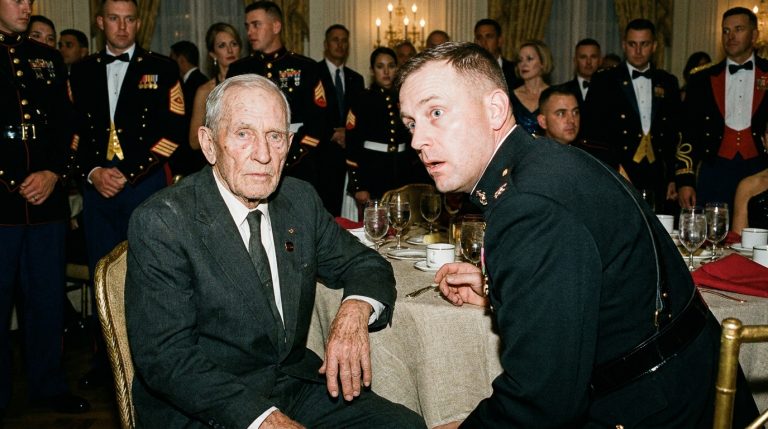
The banquet hall, which had been a buzzing hive of bravado and back-slapping a moment ago, transformed into a cavern of fragile silence. The string quartet, mid-note, faltered as if the conductor had been struck dead. Captain Hayes, standing near the head table with his chest puffed out like a peacock, froze, his smirk curdling into something sharp and anxious as the main doors groaned open.
Joseph stood his ground. He didn’t look back at the room of staring men. He kept his shoulders squared in that unnatural, soldierly set he usually kept buried under his janitor’s slouch. He wore the suit he had retrieved from the back of his closet—an antique, charcoal-gray wool that had survived decades of mothballs and memory. It was threadbare at the cuffs and too large in the shoulders, yet it possessed a geometric perfection that the modern, tailored dress uniforms of the officers lacked.
But the silence wasn’t for the suit.
It was for the star.
Hanging from a pale, fraying ribbon against his chest, the five-pointed golden star caught the light of the chandeliers. It didn’t sparkle with the synthetic, factory-new shine of the medals pinned to the younger men’s chests. It had a dull, heavy luster—a look of ancient, forged iron, as if it had been beaten out of the very earth of the valley he still walked through in his dreams.
A ripple of confusion—a physical tremor—ran through the room. Some of the lieutenants leaned in, their eyes narrowed, trying to compute the impossibility of what they were seeing. They were programmed to recognize rank, to respect the geometry of ribbons and the hierarchy of gold, but this… this was an anomaly. It was a piece of history that had been scrubbed from the brochures.
Hayes took a step forward, his face a mask of mounting, frantic indignation. “Who the hell told him he could wear that?” he hissed to the officer beside him, his voice carrying too far in the tomb-like quiet. “That’s a replica. It’s a disgrace. It’s theft.”
Joseph heard him. He didn’t need to turn. He could smell the desperation on the man—the sour, metallic scent of a coward realizing he had overplayed his hand. Joseph felt the weight of the medal against his sternum, a cold, grounding pressure. It wasn’t a costume piece. It was a gravestone. Each point of that star represented a man he had pulled from the mud, a brother who would never attend a reunion, never wear a uniform again, never see the sunset.
The air in the room grew heavy, the scent of roasted duck and expensive wine being replaced by the phantom, visceral odor of ozone and wet jungle rot. For Joseph, the chandeliers overhead ceased to be crystal; they became the canopy of the A Shau, shaking violently under the downwash of an incoming chopper.
“Get him out of here,” Hayes commanded, his voice gaining its thin, sharp edge again as he regained his footing. He stepped forward, his knuckles turning white as he reached out, fingers hooked like claws, intending to snatch the ribbon from the old man’s neck. “You think you can just walk in here with that? You have any idea what that represents? You’re a janitor. You’re—”
The doors boomed open once more, a violent, kinetic interruption that stopped Hayes mid-stride.
General Wallace stepped into the hall.
The four-star legend didn’t walk; he conquered the space. His presence was an atmospheric shift, a sudden drop in pressure that seemed to drag every soldier in the room to attention. It wasn’t a command; it was a reflex. The lieutenants, the colonels, even the servers—everyone stood rigid. Hayes, caught in the middle of his lunge toward Joseph, stumbled, nearly tripping over his own polished boots as he tried to snap to a salute while his body was still angled for a brawl.
General Wallace ignored the room. He didn’t look at the Captain. He didn’t look at the gala decorations or the shimmering head table. His eyes—gray, hard, and ancient—locked onto Joseph.
The General began to march. The sound of his heels against the floor was the only heartbeat in the room. When he reached Joseph, he stopped, his posture shifting from that of a four-star commander to that of a man standing in the presence of something sacred. He snapped a salute. It wasn’t the sharp, dismissive salute of a superior to a subordinate; it was slow, profound, and lingering—a salute given by a man who had finally found the one thing in the world he was afraid to disappoint.
“Sergeant Major Chen,” the General said, his voice thick, rough with a jagged edge of emotion. “It is a long-overdue honor to see you again, sir.”
The sound of the General calling the janitor Sir hit the room like a physical blow. Hayes turned a sickly, ghost-white, his hand still suspended in the air, his fingers twitching in the empty space where he had meant to tear the medal away. The silence was no longer heavy; it was absolute. It was the silence of a truth that had been hidden for forty years, finally pushing its way to the surface, demanding to be seen.
Joseph didn’t return the salute in the modern, snappy fashion. He simply bowed his head, a small, weary gesture of acknowledgement. He wasn’t a soldier anymore. He was a keeper of the flame, and for the first time in four decades, the flame was being forced into the open.
CHAPTER 5: THE COLLAPSE OF PRIDE
Captain Hayes stood frozen, his hand still suspended in the air. For a fleeting second, his brain attempted to reject the visual evidence before him—to categorize the General’s salute as some kind of elaborate, dry-witted performance, or perhaps a tactical error. But the cold, granite-like intensity in General Wallace’s eyes burned through that delusion. The Captain’s hand dropped to his side, limp and useless. The skin on his face had gone sallow, the healthy, arrogant flush replaced by the pasty, un-anchored complexion of a man whose reality had been surgically removed.
“Captain,” the General said, his voice dropping an octave, losing its warmth and hardening into the tone of a judge reading a sentencing. He didn’t move his gaze from Joseph, but the space between them seemed to vibrate with the sheer force of his scrutiny. “Do you have any idea who you were about to assault?”
Hayes tried to speak. He opened his mouth, but the sophisticated, biting retorts he had practiced all evening turned to dry ash in his throat. He looked around the room, desperately seeking a lifeline—a lieutenant, a peer, anyone to share the absurdity of the situation with. But his juniors were standing as still as statues, their eyes fixed on the floor, terrified to be associated with the epicenter of this disaster.
“I… I thought…” Hayes stammered, his voice thin and cracking. He looked at the Medal of Honor hanging from Joseph’s neck, and for the first time, he saw it not as a costume piece, but as a heavy, metallic weight that seemed to anchor the old man to the very floorboards of the regiment. “General, sir, I believed it was stolen valor. I was protecting the honor of the uniform.”
The General finally turned his head. The movement was slow, deliberate, and terrifying. When his gaze landed on Hayes, the Captain physically recoiled, taking a small, stumbling step backward.
“Protecting the honor of the uniform?” the General repeated, the words dripping with a cold, refined contempt. “You saw an old man in a suit, doing a job that keeps this house clean, and you saw nothing but an opportunity to boost your own sense of self-importance. You didn’t see a human being. You didn’t see a legacy. You saw an object.”
Joseph remained silent. He watched Hayes not with malice, but with a profound, weary sadness—the look of a teacher watching a student fail a test they had been warned about for weeks. He felt the phantom vibration of the jungle again, the persistent, low-frequency hum of a world where honor wasn’t a ribbon on a chest, but a decision made in the mud when the radios went dead.
“You wanted an example, Captain?” the General asked, walking slowly toward him. The room seemed to shrink, the crowd of veterans and officers parting like waves before a ship’s bow. “You wanted to make a point about standards? You have succeeded. You have become the perfect example of why this regiment has struggled to find its soul in recent years. You have the look, the polish, the rank—but you are hollow.”
Hayes was trembling now, a visible, rhythmic shaking that started in his knees and worked its way up to his jaw. He looked at the faces around him—men who had seen combat, men who knew the cost of the ground they walked on. Their faces were not supportive. They were mirrors of his own shame, reflecting the realization that they had participated in the joke, that they had stood by and watched as their own standards were trampled by their indifference.
“I… I apologize, Sergeant Major,” Hayes whispered, his eyes darting to Joseph. “I didn’t know.”
“Knowing is a luxury, Captain,” Joseph said, his voice barely rising above the low, ambient hum of the hall’s ventilation. “Character is what you do when you don’t know.”
The weight of the room was becoming unbearable. Private Davis, watching from the periphery, felt the knot in his stomach tighten until it was almost painful. He had expected a confrontation, a scene of high drama, but this was worse. This was the slow, systematic dismantling of a man’s identity. Hayes wasn’t being defeated by a physical force; he was being erased by his own lack of substance.
The General stopped inches from the Captain. He didn’t shout. He didn’t threaten. He simply leaned in, his voice a low, gravelly vibration that barely reached the nearest tables. “You have until tomorrow morning to draft a full report on the history of this regiment’s special operations branch, specifically the 1968 A Shau mission. I want you to research, in agonizing detail, the price paid by the men you just tried to humiliate. If you miss a single name, if you fail to understand even a fraction of what those men did, you will not be wearing that uniform by the time the sun sets. Do you understand?”
“Yes, sir,” Hayes choked out, his eyes wet, his ego shattered beyond repair.
The General turned away, dismissing the man entirely, effectively stripping him of his status as an officer in the eyes of everyone in the room. He walked back to Joseph, his face softening, his shoulders relaxing. He didn’t say anything more; he didn’t need to. He simply stood beside the janitor, a silent, powerful guardian of the truth.
The room began to shift. The initial shock gave way to a somber, heavy atmosphere. The laughter that had defined the evening was gone, replaced by a profound, echoing silence as the reality of the man in the charcoal suit settled into the consciousness of every person present. The banquet hall was no longer a place of celebration; it was a sanctuary of memory, and for the first time, the men in the room were actually looking at each other, seeing the people behind the rank, the scars beneath the ribbons.
CHAPTER 6: THE QUIET DENOUEMENT
The banquet hall had lost its luster. The champagne flutes, once symbols of celebration, now looked like hollow glass relics under the harsh, unforgiving glare of the overhead lights. Captain Hayes remained where the General had left him, a solitary figure in the center of a room that seemed to have expanded, leaving him exposed and small. The other officers had begun to drift toward the edges of the space, their conversations hushed, their bravado drained away by the sheer gravitational pull of the preceding hour.
Joseph did not linger on the Captain’s distress. He turned, his movements fluid and unhurried, and began to collect his things. He picked up his mop bucket, the metal handle cold against his palm, and the familiar, reassuring squeak of the cart’s wheel echoed through the cavernous space. It was a sound of labor, of humility, and of a life lived in the service of things that didn’t demand applause.
He stopped near the head table, where Private Davis was still standing, his eyes wide, fixed on the old man as if trying to reconcile the janitor he knew with the legend that had been revealed. Joseph paused, setting the bucket down. He didn’t speak immediately; he allowed the quiet to settle, a Kintsugi moment where the cracks of the room’s previous arrogance were being filled with the gold of a hard-earned reality.
“The work isn’t finished, Private,” Joseph said, his voice a low, raspy thread that nonetheless carried across the room. He reached into his pocket and pulled out a small, worn polishing cloth, handing it to the young man. Davis took it as if it were a holy relic. “Respect is a daily maintenance. It is not something you achieve; it is something you provide.”
“I’ll remember, sir,” Davis whispered, his voice trembling with a newfound, heavy reverence.
“Don’t call me sir,” Joseph replied, a faint, sad smile touching his lips. “I am just a man who tried to keep his brothers’ names clean. That is all.”
As Joseph moved toward the service exit, the door swung open, and Hayes approached him. The Captain’s face was a map of his own collapse, the mask of the young, invincible officer utterly stripped away. He didn’t look at the other men in the room. He didn’t look at the medals on his own chest, which now seemed to weigh him down like lead. He stopped in front of Joseph, his shoulders slumped.
“Sergeant Major,” Hayes began, the title unfamiliar and heavy on his tongue. “I have no excuse. I saw a man, and I looked for a way to break him because I was terrified of being broken myself.”
Joseph stopped. He didn’t turn his head to look at the man, but he leaned slightly on the handle of his cart, his posture weary but solid. “You were looking for a shortcut, Captain. You thought that by making someone else feel small, you would feel tall. It’s a common mistake in your line of work.”
“How do I fix this?” Hayes asked, his voice cracking. “How do I look at them tomorrow?”
“You don’t fix it by changing how they look at you,” Joseph said, his eyes scanning the room, landing on the nameplates of the fallen, still shimmering with the work he had put in earlier that day. “You fix it by changing how you look at the work. You start by learning the names. Not the ones on the banners, but the ones on the stones. You learn why they are there. You earn your place in this regiment by serving the history, not by owning it.”
Joseph reached out and placed a hand on Hayes’s shoulder. It was a firm, grounding touch, a Kintsugi bond formed in the recognition of a shared, broken humanity. “Forgiveness isn’t for you, son. It’s for the silence. You have a long night of research ahead of you. Go earn your quiet.”
He turned and pushed his cart through the service door, the squeak of the wheel receding until it was lost in the vastness of the building.
The banquet hall began to empty, but it did so with a strange, solemn efficiency. The soldiers didn’t leave in clusters of laughter or loud, boisterous goodbyes. They departed in small groups, their voices low, their heads inclined toward one another in reflection. The night air outside was cool, a crisp contrast to the stifling, emotionally charged atmosphere of the hall.
Joseph stepped out into the night, the darkness a welcome, familiar blanket. He took a deep breath, the scent of pine and damp earth filling his lungs. He walked to the edge of the parking lot, where his small, weathered truck sat waiting. He loaded his cart, the metal rattling softly, and then stood for a moment, looking back at the darkened base.
The stars above were cold, distant, and infinite. He reached up, his fingers brushing the ribbon still tied around his neck, and slowly unhooked the star. He didn’t put it in a display case; he didn’t pin it back on his chest. He held it in his palm, feeling the weight of it—the grief, the valor, the memory of eight men who would never grow old. He closed his fist around it, the metal biting into his palm, a physical reminder of the cost he had been honored to pay.
He wasn’t a janitor anymore, and he wasn’t a sergeant major. He was simply Joseph. He climbed into his truck, the engine turning over with a steady, reliable hum. He wasn’t leaving behind a legacy; he was carrying it with him, one quiet, deliberate turn of the ignition at a time. The world was broken, but it was beautiful in its persistence. He shifted into gear and pulled away, driving into the quiet, starlit dark, a man at peace with the shadows he had spent a lifetime keeping clean.