The Weight of Iron and Dust: A Soldier’s Silent Ledger in the Shadow of Forgotten Truths
CHAPTER 1: THE ASHES OF CEREMONY
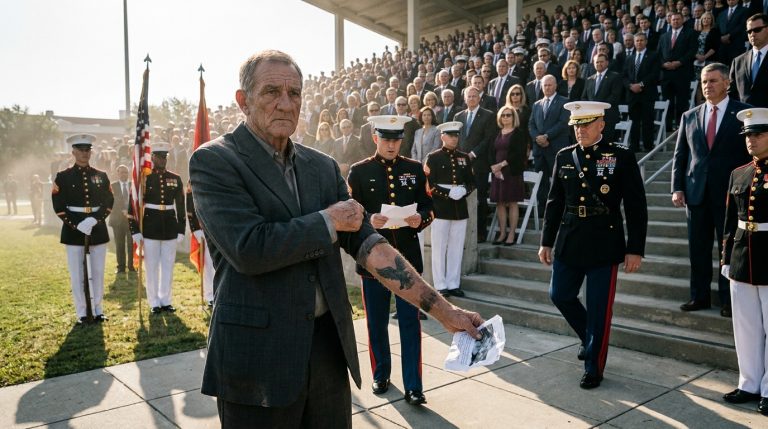
The air in the auditorium tasted like stale coffee and floor wax, a dull, synthetic environment that felt entirely divorced from the reality of the desert. Ethan Morrow stood at the very edge of the back row, his posture a singular line of resistance amidst a sea of stiff, uniformed backs. His daughter, Lily, leaned against him, her shoulder a warm, grounding presence against the cooling ambient temperature of the hall.
“Were you a seal, too?”
The voice hung in the air, acidic and sharp, cutting through the thin veneer of decorum. Admiral Richard Hail stood on the dais, his uniform a tapestry of medals that glimmered under the harsh overhead lights. He was smiling, but it was a predatory expression, designed to strip away layers of anonymity.
Ethan didn’t flinch. He felt the familiar, heavy pull of his own history—a density of memory that sat in his chest like iron. He didn’t look at Hail. He looked at the scuff marks on the floorboards, the tiny imperfections in the wood that had been walked over by thousands of feet seeking approval, seeking rank, seeking purpose.
“And what was your call sign?” Hail’s voice escalated, now carrying the weight of a public dare. “Or do men like you not have one at all?”
A low ripple of laughter moved through the crowd, a sound like dry leaves skittering over pavement. It was a rhythmic, collective release of tension, the kind that happened when a room full of people realized they were on the winning side of a hierarchy. Ethan reached down, his hand finding Lily’s shoulder. He tightened his grip, just enough to feel the pulse beneath her skin. It was steady, a heartbeat that didn’t know the frantic cadence of the life he had once lived in the dust.
The laughter grew, then withered, dying an unnatural, choked death as the silence stretched. Ethan didn’t provide the expected rebuttal. He didn’t offer a flash of irritation or a forced, polite smile to smooth over the jagged edge of the insult. He simply occupied the space he was in, his center of gravity lowered, his breathing rhythmic and deliberate.
The room began to shift. The young officers around him, previously comfortable, started to fidget. The silence wasn’t empty; it was a physical pressure, a rusted barrier that separated the room from the man who stood in the back.
Ethan looked at his palm, feeling the slight, irregular weight of the Damascus coin in his pocket. It felt colder than the air, a piece of metal that remembered the heat of a collapsed building and the texture of a lie. He didn’t know yet how he would use it, but he knew the moment of quiet was not for him—it was for the man on the dais. Hail’s smile, while still fixed, flickered at the edges, a hairline fracture in a screen of absolute confidence.
“Dad,” Lily whispered, her voice barely audible over the hum of the ventilation system. “Should we go?”
Ethan didn’t turn his head. He looked toward the front, his gaze passing through the back of Hail’s head, focused on the wall beyond, where a map of regional theaters hung, marked with outdated pins and forgotten strategies. He shook his head, a microscopic movement. He had made his choice long before he walked into this hall.
The older man in the middle row, the one with the gray temples and the unreadable eyes, leaned forward slightly. Ethan felt the scrutiny, the way the man measured his stance, the way he noticed the distance Ethan kept from the crowd. It wasn’t the look of a spectator. It was the look of someone trying to identify a ghost.
Hail cleared his throat, his face flushing a deeper, more urgent shade. He shifted his weight, his eyes darting to the side, searching for the validation he usually commanded without effort.
“Well then,” Hail said, his voice attempting a return to the playful, light-hearted tone of a mentor. “Maybe you worked in logistics. Or the kitchen. Those positions rarely come with call signs.”
This time, the laughter was forced, brittle and thin, like glass about to shatter. Ethan felt the weight of the air in the room condense further. He didn’t look at Hail. He looked at the coin in his pocket, feeling the etched, worn symbol against his thumb—the mark of a history that was supposed to have been erased.
The truth was a cold, hard thing, waiting for the right vibration to shatter the silence.
CHAPTER 2: THE WEIGHT OF THE EXIT
The silence did not break when the ceremony ended. It merely shifted, settling into the auditorium like a fine, gritty dust that coated everything in the room. As the crowd began to stir—a hesitant, awkward shuffle of movement—Ethan felt the atmosphere harden. The laughter that had been Admiral Hail’s armor only moments ago now felt like a liability, a jagged hole in the room’s collective dignity.
Ethan did not move toward the exits. He knew better. To move toward the door was to signal retreat, and retreat invited pursuit. He waited, his hand still resting firmly on Lily’s shoulder. She was still, her breathing shallow, her eyes fixed on the patterned carpet. She was learning, as he had, that in places like this, the most dangerous thing one could do was exhibit visible discomfort.
“Dad,” she whispered, her voice a thin line in the heavy, air-conditioned chill.
“Stay here,” Ethan said, his voice flat, stripped of all color. He didn’t look at her, but he felt the way her stance mirrored his—the way she leaned into the small, protective pocket of space he had created.
A few yards away, Admiral Hail was surrounded by a small, tightening circle of sycophants. He was talking rapidly, his gestures overly animated, his smile now a strained, fixed thing that didn’t reach his eyes. He was working hard to reestablish his authority, to fill the silence with the comfortable noise of rank, but the room was not responding. The young officers who had been the first to laugh were now staring at their own boots, avoiding his gaze as if they could retract their earlier amusement through sheer force of will.
Then, the phantom sound hit him.
It was a flicker of high-frequency static, the distinct, tinny crackle of a field radio on an encrypted channel—the sound of the Damascus mission’s final minutes. It ghosted through the auditorium, a synaptic firing in his brain that made his hand twitch toward his hip, toward a weapon that wasn’t there. The cold, mechanical reality of the desert flooded his senses, overlaying the polished wood and gold-trimmed banners of the hall. He smelled, for a fleeting, sickening second, the ozone of burning electronics and the dry, iron tang of heat-blasted earth.
He blinked, grounding himself in the reality of the floorboards beneath his feet. The phantom faded, replaced by the mundane, aggressive hum of the ventilation. But the tremor remained in his focus. He could feel the Damascus coin in his pocket. It felt warmer now, as if it were reacting to the proximity of the men who had signed the liquidation orders.
Commander James Vale was moving toward him. He didn’t march; he glided with the easy, measured gait of a man who had seen enough to know that haste was a symptom of panic. Vale stopped a few feet away, his gaze lingering on Ethan’s hands, then moving to his eyes. He didn’t salute. He didn’t offer a platitude.
“You’re a long way from nowhere, Morrow,” Vale said, his voice barely a murmur, shielded by the ambient noise of the dispersing crowd.
Ethan felt the observation like a probe. Vale was searching for something—a crack in the discipline, a sign of instability. Ethan gave him only the steady, unreadable look of a man who had already processed every possible outcome of this encounter.
“I’m just a guest, Commander,” Ethan replied, the words dropping like lead.
“Guests don’t hold a room hostage with silence,” Vale said, his eyes narrowing slightly. He turned his head, glancing toward Hail, then back to Ethan. “That coin you’re carrying. It’s an anomaly. It doesn’t belong in a civilian pocket, and it certainly doesn’t belong in a ceremony like this.”
Ethan felt the shift in the air. This wasn’t a challenge; it was a recognition. Vale knew the coin wasn’t just metal; he knew it was a ledger.
“Maybe you should ask the Admiral why it’s still being carried,” Ethan said softly.
Vale’s expression didn’t change, but his pulse flickered in the cord of his neck. “He’ll claim he doesn’t recognize it.”
“Then he’s a better liar than I remember,” Ethan countered.
The weight of the conversation hung between them, a fragile, dangerous thing. Ethan moved a fraction of an inch, his body instinctively adjusting to the flow of the room, keeping Lily shielded behind him. He wasn’t leaving yet. The exit was a bottleneck, and to be funneled out with the crowd was to be predictable.
He watched as an aide approached Hail, whispering something into his ear. Hail’s head snapped toward Ethan’s position. The look he wore was no longer predatory; it was deeply, violently afraid. The mask was slipping, the edges fraying under the strain of being known.
“They’re going to want to verify,” Vale warned, his voice low. “If you have more than the coin, leave it. Don’t let them find the source.”
“The source is already out,” Ethan said, a cold, jagged truth that sliced through the pretense of the ceremony.
Vale stood silent for a long moment, the gears in his mind clearly turning, calculating the fallout. He was a creature of the system, but he was a creature who valued survival, and he knew that when a foundation began to crack, the only rational response was to find higher ground.
“The parking lot will be monitored,” Vale said, turning to walk away. “Don’t take the main road. If you’re going to do this, make sure the trail leads somewhere they can’t burn.”
He left Ethan standing in the deepening silence of the hall. The crowd had largely dissipated, leaving only the stragglers and the officials who were now huddled near the stage. Ethan took a slow, steady breath. The phantom radio static had subsided, but the intent remained. He reached into his pocket, his fingers grazing the worn, scratchy surface of the coin. He would not leave this building through the front. He knew the layout of this facility as well as he knew his own breathing, and there were ways out that bypassed the eyes of the men who were currently watching him with newfound, desperate hatred.
“Ready?” he asked, not looking at his daughter.
Lily nodded, her jaw tight. “Ready.”
They didn’t walk toward the main entrance. They turned, moving toward the service corridors, slipping into the shadows where the light was yellow and flickering, and the floorboards echoed with the sound of a past that refused to stay buried.
CHAPTER 3: THE CIRCUIT OF SECRETS
The service corridor was a sharp, utilitarian contrast to the polished veneer of the auditorium. Here, the air was thick with the smell of floor wax and the metallic tang of heating pipes that snaked along the ceiling like rusted veins. Ethan kept his pace steady, his hand still firmly on Lily’s shoulder, guiding her with the minimal, efficient movements of someone navigating a minefield.
They moved past rows of storage closets and heavy, soundproofed doors that led to the utility bowels of the complex. Every step echoed with a dull, hollow resonance. Ethan’s mind was calculating, mapping the facility’s architecture against the blueprints he had committed to memory years ago. He wasn’t just walking; he was checking for indicators—the way the security cameras were angled, the specific, intermittent flicker of the overhead fluorescents that signaled a sensor’s blind spot, and the slight, irregular drag of his own feet against the concrete.
“Dad, they’ll know we didn’t go out the main entrance,” Lily said, her voice low, strained by the effort of keeping her breathing even.
“They already know,” Ethan replied, his eyes scanning a junction box mounted on the wall. He didn’t slow down. “The moment we left the hall, the dynamic changed. We aren’t just guests anymore. We’re variables they need to account for.”
They reached a heavy, reinforced steel door marked with a yellow warning placard. It was the primary egress for the service bay, but as Ethan reached for the handle, he felt the cold, unyielding resistance of a magnetic lock engaged from a remote station. It wouldn’t budge. A locked door in this facility wasn’t just an inconvenience; it was a silent alarm.
“Wait,” he whispered, pulling Lily into the alcove of a nearby broom closet.
The sound of footsteps echoed down the corridor—the sharp, staccato click of hard-soled shoes on concrete. They were rhythmic, disciplined, and too fast to be those of a janitor. Ethan felt the weight of the Damascus coin in his pocket, a small, hard lump against his thigh. He pulled it out, letting the light of the corridor catch its scratched, dull surface.
He didn’t look at it for sentiment. He looked at the edge, where the metal met the skin, and the subtle, irregular vibration that traveled up his thumb. The coin wasn’t just a relic; it was vibrating in resonance with the electronic locks in the building. It was a proximity trigger, a piece of hardware designed to bypass specific, localized security grids—the kind of specialized gear that was never supposed to be in the hands of a civilian. Whoever had given him this coin hadn’t just intended it as a memento; they had intended it as a key.
He pressed the coin against the card reader beside the locked door. For a heartbeat, nothing happened. Then, the reader pulsed a dull, sickly green, and the heavy bolt retracted with a muffled, mechanical clunk.
“Go,” he murmured, ushering Lily through the gap.
As they stepped into the service bay, the smell changed—the clean, industrial scent was replaced by the stale odor of ozone and old, dry earth. This was the loading dock, a vast, cavernous space filled with crates waiting for transit. It was dim, lit only by the sliver of moonlight filtering through the high, barred windows.
Ethan didn’t stop. He moved toward the shadows near the back wall, where a chain-link fence separated the bay from the administrative offices. He knew that if he could reach the secondary power control, he could cut the building’s internal feed—not just to escape, but to scramble the security logs. If the logs went down, the record of their presence would be temporarily erased, buying them the time they needed to reach the perimeter.
He saw the flicker of a flashlight beam sweep across the far wall of the loading bay. Someone was searching. He pulled Lily down behind a stack of shipping pallets, his hand finding the edge of a heavy canvas tarp. He pulled it over them, creating a small, dark cocoon.
“They’re looking for us,” Lily whispered, her hands trembling as she grabbed the hem of his jacket.
“Let them look,” Ethan said, his voice a low, steady anchor. He watched the beam of the light as it bounced off the concrete, illuminating the dust motes dancing in the air. He wasn’t afraid of the searchers; he was calculating the risk of engagement.
He pulled the Damascus coin from his pocket again, looking at the scratch on its face. It was getting warmer, the heat intensifying as the flashlight beam drew closer. It was definitely a tracker—a sophisticated, localized transponder that was syncing with the facility’s grid. The revelation hit him with the force of a physical blow: he hadn’t just brought a piece of history into the building; he had brought a beacon. They hadn’t just been insulted in that auditorium; they had been marked.
He realized then that the “Damascus” operation wasn’t just a military secret; it was a living, breathing mechanism that extended far beyond the battlefield. And Admiral Hail wasn’t just hiding a lie; he was protecting a machine that was still running, still tracking, and still liquidating anything that dared to stand outside the script.
Ethan stood up, his posture shifting, his movements becoming precise, lethal. He wasn’t just a father trying to protect his daughter anymore. He was a man who realized he had been lured into a trap, and for the first time, he felt the cold, sharp edge of a resolution that had nothing to do with honor and everything to do with survival.
He didn’t need to speak. He looked at Lily, saw the understanding in her eyes, and then turned back toward the shadows. He had a path to clear, and he wasn’t going to let them bury the truth in the dark.
CHAPTER 4: THE ARCHIVE OF DUST
Ethan did not waste time in the loading bay. The realization that the coin was a beacon—a sophisticated, localized transponder—changed the geometry of their flight. He understood now that he could not simply run; he had to neutralize the signal or lead them into a blind spot where the facility’s internal sensors were shadowed by the heavy iron shielding of the older, lower levels.
“Follow my lead, exactly,” Ethan whispered. He moved with a practiced fluidity, keeping to the periphery of the bay where the industrial crates cast long, irregular shadows.
He didn’t head for the parking lot. Instead, he angled toward the maintenance stairs, a rusted metal spiral that descended into the facility’s subterranean archives—a place where the digitizing process had stalled years ago, leaving the records in paper, microfilm, and magnetic tape. It was an environmental dead zone, encased in thick concrete and shielded by layers of lead lining that would, if he were lucky, scramble the coin’s signal.
As they descended, the air grew colder and tasted of damp paper and ozone. The spiral stairs groaned under their weight, a rhythmic, metallic protest that sounded like a warning. Ethan kept one hand on the railing, his knuckles white, his senses attuned to the vibration of the structure. He knew they were being tracked, but he also knew the architecture. He had built this facility’s protocols in his mind, and he knew where the blind spots were.
They reached the basement level, a vast, dimly lit expanse of floor-to-ceiling metal shelves packed with dusty folders. The silence here was different—it was the heavy, suffocating silence of an unvisited tomb. Ethan pulled the Damascus coin from his pocket. The metal was still warm, a dull, pulsing heat that radiated against his skin. He tucked it into a small, lead-lined pouch he’d scavenged from a tool kit in the service bay, then wrapped the pouch in a thick, grease-stained rag.
“We need to find the Damascus manifests,” Ethan said, his voice barely rising above a whisper. “If I’m right, they didn’t just document the operation; they logged the resource distribution.”
“Dad,” Lily said, her voice small in the vast space. “Why are we looking for papers? You said they’d already rewritten the files.”
“They rewrote the history,” Ethan corrected, his eyes scanning the rows of shelves. “But they couldn’t rewrite the logistics. Embezzlement leaves a paper trail, even if it’s buried under a mountain of administrative filler.”
They began the search, working in a methodical, grid-like pattern. Ethan’s movements were precise, his hands calloused and steady as he sifted through the boxes. He wasn’t looking for a confession; he was looking for a discrepancy. He was looking for the names of the suppliers, the shipping dates, and the internal audit numbers that didn’t align with the official Damascus narrative.
He stopped at shelf 402, a section labeled with dates that predated the mission by six months. He pulled a heavy, leather-bound ledger from the shelf. The cover was coated in a fine layer of gray dust, which he wiped away with the back of his hand, leaving streaks of black grime on his skin.
He opened the book, his flashlight beam cutting through the gloom. The pages were yellowed and brittle, filled with the neat, clinical handwriting of an accountant who had long since moved on. Ethan scanned the entries—numbers, dates, coordinates. Then, his thumb stopped.
There, in the margin of an entry dated three weeks before the Damascus operation, was a name: Vance.
Ethan froze. The air in his lungs felt thin, sharp. Vance hadn’t been in the official reports. Vance had been the team leader, the man who had supposedly died in the initial explosion, the man whose body was never recovered. If he was in these ledgers, it meant he had been part of the financial loop—a participant in the distribution of the very resources that were supposedly the target of the Damascus mission.
He hadn’t died covering the retreat; he had been paid to disappear.
The realization hit Ethan with a visceral, sickening clarity. The Damascus mission hadn’t been a tactical failure; it had been a calculated culling. The team had been sacrificed not to cover the loss of the hostages, but to silence the only men who could prove the embezzlement.
“Did you find something?” Lily asked, creeping closer.
Ethan closed the ledger, his heart rate spiking. He looked at the spine of the book, the date, and the shelf location. “I found the ghost,” he said, his voice hard as iron.
He didn’t have time to process the betrayal. A sudden, sharp click resonated through the archive—the sound of a safety being disengaged. Ethan spun around, his body already moving to shield Lily.
Two figures stood at the end of the aisle, their silhouettes framed by the harsh, singular light of the archive’s emergency strobe. They weren’t soldiers. They were men in suits, their faces obscured by the shadows, holding the heavy, controlled posture of men who were used to being the final word in any negotiation.
“Morrow,” one of them said, his voice lacking any inflection. “You were supposed to stay in the light.”
Ethan didn’t reach for a weapon. He didn’t have one. He simply stood, his hand tight around the leather-bound ledger. He knew now that they weren’t just going to silence him; they were going to ensure that everything he knew remained buried in the rust and the dust of this forgotten level.
“I prefer the dark,” Ethan said, his voice low and steady. “It’s easier to see the truth when the stage lights are off.”
He knew he had seconds before they moved. He kicked the metal shelving unit with all his strength, the heavy structure groaning and toppling outward, creating an improvised barrier of metal and paper between him and the men. In the ensuing crash, he grabbed Lily’s hand and dove into the narrow, dark gap between the shelving rows, moving deeper into the maze of the archives. He didn’t know where the exit was, but he knew that as long as they had the ledger, they had the weapon.
The game had shifted. It was no longer about honor. It was about exposing the rot, and he was no longer going to play by the rules of the men who had written the history of Damascus.
CHAPTER 5: THE SHADOWS RECOIL
The darkness of the lower archives was absolute, a thick, stagnant pressure that tasted of ancient dust and forgotten secrets. Ethan kept his hand locked onto Lily’s sleeve, feeling the frantic tremor in her grip. He didn’t speak. He moved by instinct, following the jagged, uneven contours of the floorboards and the tactile cues of the shelving frames as he steered them away from the aisle where the men had cornered them.
Behind them, the voices grew sharper, more precise. They were no longer just searching; they were hunting. The sound of heavy, polished shoes against the metal floor grate echoed with a predatory rhythm. Ethan counted their strides—click, click, pause, sweep—as if they were clearing a room. He knew that if he stayed in the aisles, he was a target. He had to cross the gap between the archive shelves and the service vent that led to the upper utility shafts.
“Stay low,” he whispered into the dark, his breath hitting Lily’s ear.
He moved forward, his movements stripped of all hesitation. He was no longer thinking about honor or the ledger; he was thinking in terms of lines of sight, structural friction, and the tactical advantage of silence. As he navigated the maze, the flickering emergency strobe from the aisle cast long, distorted shadows that danced like ghosts against the stacks of microfilm. For a split second, he saw a tall, angular shape detach itself from the dark at the end of the next row. His heart spiked—a flash of pure, cold adrenaline. He tensed to pivot, his muscles coiled to strike, only to realize a moment later it was just his own shadow thrown by the strobe, a trick of the light that momentarily distorted his perception.
He steadied his pulse, forcing his focus back to the physical reality of the space. The men behind them were closing in, their movements synchronized. They didn’t call out. They didn’t bark orders. They moved with the terrifying efficiency of a cleanup crew, a silence that was far more intimidating than any shout.
They reached the base of the wall where the large, rusted service vent lay. It was secured by a series of heavy bolts, each one showing the telltale oxidation of decades of neglect. Ethan knelt, his fingers finding the familiar, cold grip of a loosened nut. He pulled a small, multi-tool from his pocket—a habit, a relic of a life spent in the field—and began to work. Each twist of the tool felt like a gamble. He was fighting the rust, the friction, and the relentless, creeping sense of time.
Click. The first bolt gave way, falling into the palm of his hand.
“They’re coming,” Lily whispered. Her eyes were wide, reflecting the faint, dying strobe from the aisle.
Ethan didn’t look back. He kept his attention on the remaining bolts, his hands moving with surgical precision despite the growing tightness in his chest. He could hear them now—the low, controlled respiration of men who weren’t even breathing hard, the soft metallic rasp of a weapon being drawn from a holster. They were twenty feet away. Fifteen.
“Dad,” she warned, her voice tight with panic.
Ethan shoved his weight against the vent cover, the metal groaning in protest as the last bolt sheared away. He pushed the heavy frame aside and ushered Lily inside. The vent was tight, a cramped, dusty box that smelled of dry, metallic rot. He squeezed in after her, pulling the heavy cover back into place just as a flashlight beam swept over the spot they had occupied seconds ago.
He held his breath, his back pressed against the corrugated metal of the vent wall. He could see their legs through the narrow slats—dark, expensive slacks and polished leather shoes. They stopped.
“The ledger,” one of them said, his voice as cold as liquid nitrogen. “He won’t get far with that weight.”
“He’s not a courier,” the other replied. “He’s a witness. Ensure he doesn’t leave the basement.”
They didn’t search the vent. They didn’t need to. They turned and walked away, their steps receding into the distance, moving toward the primary elevator bank. Ethan realized then that they weren’t going to hunt him—they were going to seal the basement.
He waited until the silence returned, thick and heavy. He pulled the leather-bound ledger from his jacket. In the dark, he traced the embossed seal on the cover with his thumb. It felt heavy, a burden of truth that seemed to pulse with its own gravity. He realized that the ledger wasn’t just a collection of numbers; it was a blueprint of a betrayal so vast it threatened to topple the entire command structure of the region.
“They know we’re here,” Lily said, her voice shaking. “We’re trapped.”
“No,” Ethan said, his voice low and vibrating with a resolve that felt like granite. “We’re exactly where we need to be. If they think we’re trapped in the basement, they’ll stop watching the upper levels.”
He looked up into the darkness of the vent shaft. It wasn’t an escape route; it was a path to the maintenance control center. He knew the layout. If he could reach the master breaker for the sector, he could trigger an emergency lockdown of the entire archive level, trapping everyone inside while he used the secondary egress to breach the surface.
He didn’t move toward the exit. He moved toward the heart of the machine. He had seen the name Vance in the ledger, and he knew now that the betrayal wasn’t just administrative—it was personal. The men who had ordered the culling of his team were still here, still in charge, and they were still operating under the assumption that the dead couldn’t talk.
He was about to show them that some ghosts were not only capable of speaking, but of holding the living accountable for every drop of blood they’d traded for silence.