The Ghost of Ardennes: How One Man’s Forgotten Craft Repaired the Pulse of a Modern Icon
CHAPTER 1: The Silence of Steel
The heat was a physical weight, pressing down on the festival grounds until the air felt thick enough to chew. Mark Reading, the project lead, was currently tearing a strip off a technician, his voice sharp and brittle against the backdrop of a thousand impatient voices. He slammed his tablet onto the metal casing of the 101-year-old locomotive, the Big Boy 414, with a finality that suggested he wanted to shatter it.
“It’s a machine, not a pet, Derek,” Mark spat, wiping sweat from his forehead with the back of a pristine, logo-embossed sleeve. “It operates on code and input. If the diagnostic says the fuel lines are clear, then the fuel lines are clear. Why won’t it hold pressure?”
Derek, looking as though he might dissolve into the pavement, fumbled with his own tablet. “The EFI controller is green across the board, Mark. Every valve, every sensor… it’s all perfect. It’s like the system is rejecting the command to fire.”
Arthur Corrian stood just behind the velvet rope, his hands resting naturally on the cracked leather of his satchel. He was eighty-nine, but he remained as still as a statue, his eyes tracing the massive, cold driving wheels of the locomotive. He didn’t see the sleek, modern sensors the engineers had bolted onto the chassis. He saw the scars of a hundred thousand miles, the history etched into the grain of the steel.
“She’s not listening to your little boxes,” Arthur said. The voice was quiet, a low, gravelly rumble that seemed to cut through the panic like a knife through soft cloth.
Mark spun around, his face a mask of red-tinged indignation. He looked at Arthur—at the weathered skin, the plain woolen jacket, the archaic bag—and his lip curled. “You again? Listen, pops, we’re doing real engineering here. Thermodynamics, precision control. Not whatever nonsense you’re peddling.”
“Thermodynamics doesn’t care for your modern controllers when the metal is cold,” Arthur replied, his gaze returning to the engine’s side panel. “She’s got a G2 injector valve stuck, frozen in the heat. It’s a habit she picked up in the Ardennes. You have to bleed the auxiliary line before she’ll give you a drop.”
Mark barked a laugh, a sharp, hollow sound that turned heads in the nearby VIP stands. “A G2? There’s no G2 valve on the schematic. We stripped those out for the modern setup years ago. You’re talking about ghosts, old man.” He gestured dismissively to the security guard standing nearby. “Get him out of here. He’s a liability.”
The guard took a step toward Arthur, his hand hovering near his belt, his expression caught between obligation and pity. Arthur didn’t move. He felt the cold iron of the engine calling to him, a faint, rhythmic vibration that only he could hear. The present moment—the heat, the crowd, the arrogant young man—began to fade. In his mind, the air turned bitter, icy, and sharp with the scent of coal smoke.
He looked down at his satchel, and for a fleeting, terrifying second, the leather wasn’t aged; it was new, stained with the grime of a war-torn winter, holding the only tool that could bring the iron back to life.
“She’s not broken,” Arthur whispered to the indifferent air, “she’s just waiting for the right hand.”
The guard’s fingers tightened on his shoulder, pulling him back toward the reality of the festival, but Arthur’s eyes remained locked on the access panel. He knew that bolt. He had tightened it a thousand times under the cover of darkness while the world burned around them. But as the guard shoved him a step further from the rope, a new, heavy sound suddenly rumbled in the distance, cutting through the humid air—a sound not of a train, but of an incoming helicopter, its rotors beating a warning that changed the gravity of the entire afternoon.
CHAPTER 2: The Tang of Coal Smoke
The helicopter’s descent was a violent intrusion, a mechanical bird of prey banking hard toward the clearing. Dust and loose gravel swirled into a gritty cloud, forcing the crowd to shield their eyes. Arthur stood motionless amidst the chaos, his hand tightening on the cracked leather of his satchel. The roar of the rotors was all-consuming, yet beneath it, Arthur heard a different sound—the rhythmic, metallic heartbeat of a locomotive struggling against an impossible frost.
His eyes remained fixed on the engine, but the festival grounds began to blur at the edges. The stifling afternoon heat, thick with the smell of expensive perfume and sun-warmed asphalt, dissolved. In its place, a sharp, metallic tang filled his nostrils—the scent of wet coal, high-octane fuel, and the biting, thin air of a mountain winter.
It is 1944.
The world was monochrome, stripped of color by the oppressive darkness of the Ardennes. The engine under his feet, a sister to the 414, was a hulking, black-iron beast that groaned in protest against the sub-zero temperatures. Arthur was young, his face smeared with grease, his fingers numb inside thin, oil-slicked gloves. The crump of artillery in the distance was a constant, low-frequency pulse, a drumbeat for the desperate mission they were running. They were a ghost train—no lights, no signals, only the sheer, stubborn will of a few men and a machine that refused to die.
He shifted his grip on his satchel. It was heavy, weighted down by the schematics he had hand-drawn in the flicker of a dim flashlight and the weight of the hand-forged wrench—the only tool capable of overriding the G2 injector valve that kept seizing in the extreme cold. Every mile through the forest was a gamble; every hiss of steam was a potential beacon for the enemy. He remembered the way the iron felt beneath his palm then—not like the cold, dead steel of the festival display, but like a living, shivering creature, terrified and exhausted.
“Art, we’re losing pressure!” The voice of his fireman cracked through the frozen air, frantic and strained.
Arthur had looked at the gauge, the needle flickering near the red line. The modern systems were useless; the fuel had turned to sludge in the lines. He had grabbed the satchel, the worn leather biting into his palm, and climbed down onto the running board. The wind was a serrated blade, cutting through his heavy wool coat. He had knelt in the snow, his eyes searching for the access panel he had modified, his breath hitching as he felt the valve. It was frozen solid. He had needed the wrench, he had needed the leverage, and he had needed to know exactly how much pressure to apply before the metal shattered.
Back in the present, the helicopter’s blades slowed, the engine’s whine descending into a low, dying growl. The dust began to settle.
Arthur blinked, the monochrome forest of his memory receding like a tide. He was back in the heat. Mark Reading was standing a few feet away, his face still twisted in an expression of indignant fury, unaware that he was standing in the presence of a ghost. The security guard, confused by the shift in the atmosphere and the arrival of the corporate aircraft, had let go of Arthur’s arm.
Arthur adjusted his satchel. The leather felt the same—a constant, tactile anchor between the two realities. He felt the weight of the wrench through the fabric, a solid, immutable fact in a world of digital illusions.
Mark stepped toward him, oblivious to the history that had just played out in Arthur’s mind. “You’re done, old man. We’re going to handle this properly, without the interference of relics.”
Arthur didn’t look at Mark. He looked at the access panel of the 414. He could feel the engine’s pulse—a stuttering, irregular beat that spoke of a blockage, a refusal to engage with the sterile commands of the modern electronic controller. It was a cry for help that the engineers mistook for a malfunction.
“She doesn’t want your code,” Arthur murmured, his voice barely audible over the fading roar of the helicopter. He wasn’t speaking to Mark; he was speaking to the engine, to the ghost of the locomotive that had carried him through the hell of the Ardennes.
He took a slow, deliberate step toward the velvet rope. The security guard hesitated, looking at the unfolding drama of the arriving executives, unsure if he should stop the old man or step aside. Arthur didn’t wait for permission. He moved with a quiet, persistent grace, his gaze never leaving the iron flank of the 414. He had been a chief engineer in the dark of a world war; he was not about to be deterred by a young man who thought he knew the soul of a machine because he could read a tablet.
The air around the train seemed to grow cooler, or perhaps it was just the intensity of his focus. He could see the imperfection in the paneling, the tiny, weathered mark where the valve housing lay beneath. It was there. The secret was buried under decades of restoration, under layers of paint and ego. And he was the only one who could feel it.
CHAPTER 3: The Curators Leap
The generator behind the main stage emitted a low-frequency hum that vibrated through the soles of Sarah Jenkins’s shoes. It was a sterile, modern sound, a stark contrast to the thick, oppressive heat of the festival grounds. She had retreated here, into the narrow, dusty alley between two shipping containers, to escape the suffocating anxiety of the public square.
Her heart was a frantic drumbeat against her ribs. She stared at the screen of her phone, the blue light washing out the natural color of her face. The search results for Arthur Corrian and wartime logistics had finally yielded the hit she had been hunting for—a digitized military journal from 1946.
As she scrolled, the technical jargon of the report seemed to leap off the screen. “Non-standard field modification to the 4,000-class locomotive… manual bypass for injector cold-start… G2 valve sequence.”
Sarah’s breath hitched. She looked over the edge of the shipping container. In the distance, she could see the silhouette of the 414, massive and defiant against the bright, uncaring sky. Mark Reading and his team were huddled around their laptops, their faces masks of mounting panic and corporate frustration. They were looking for a software solution to a problem that, according to this half-century-old document, wasn’t software at all.
It was mechanical. It was physical. It was deliberate.
She tapped the screen, opening a secondary window—the museum’s internal digital archives. She cross-referenced the 414’s modern restoration logs. There, tucked away in an obscure, rarely accessed sub-folder of the 2024 restoration report, was a note that the restoration team had dismissed as a ‘legacy artifact.’ It was a mention of an original, hand-wrought bolt hidden beneath the primary injector housing. A bolt that wasn’t on the original blueprints.
“They didn’t just ignore it,” Sarah whispered to the dust-mote-filled air. “They didn’t even know it was there.”
She felt a surge of cold clarity. The irony was suffocating. The entire restoration had been built on modern diagnostics, ignoring the physical wisdom built into the iron itself. Mark Reading wasn’t just failing to fix a train; he was fighting a machine that had been designed by veterans to resist the very kind of standardized, automated force he was trying to impose upon it.
Sarah needed to make a choice. If she walked out there and told Mark, he would laugh her off. He was too deep in his own defensive shell of technical superiority to listen to a junior curator. She needed someone who understood the weight of the history they were dealing with, someone whose authority could bridge the gap between the corporate present and the historical reality.
She opened her contact list, her thumb hovering over the name James Richards. The Senior VP of Operations for Union Pacific. She had met him briefly during the museum’s fundraising gala—a man who spoke about locomotives with the kind of hushed reverence usually reserved for religious icons.
Her pulse raced. Calling a VP was a professional death sentence if she was wrong. If this turned out to be a misinterpretation of some obscure technical note, she would be out of a job by sunset. But then she looked again at the image of Arthur Corrian in the crowd—the way he stood, the way he watched the engine. He wasn’t just an old man. He was a piece of the story still walking, still breathing.
She pressed the call button.
The ringing was agonizingly slow. Each pulse of sound felt like a hammer strike against her resolve.
“Richards,” the voice on the other end was clipped, efficient, and immediately cold. “This is a private line, Ms. Jenkins.”
“Mr. Richards, I’m at the festival,” Sarah started, her voice betraying a tremor she couldn’t suppress. She pushed past the fear. “The 414 is stalled. Mark Reading’s team is trying to force a reboot on the EFI system, but the diagnostic is failing. It’s not the code, sir. It’s the mechanics. It’s an original field modification—a G2 injector bypass—that they’ve completely overlooked.”
The silence on the other end was absolute. It wasn’t the silence of confusion; it was the silence of a man who had suddenly had the rug pulled out from under him.
“Explain,” Richards said, his voice dropping an octave, losing its corporate polish.
Sarah explained, her words spilling out in a rapid-fire sequence of technical observation and historical discovery. She didn’t hold back. She described the discrepancy between the modern schematics and the archival notes. She mentioned Arthur Corrian, the man they were trying to remove.
“He said it to them, Mr. Richards,” Sarah added, her voice gaining strength. “He told them about the G2 valve. They thought he was senile. But the records support him. He’s not a spectator. He’s the original engineer.”
Again, the silence stretched, but this time, she could hear the faint, rapid-fire clack-clack-clack of a keyboard. Richards was looking, digging, confirming.
“My god,” he finally breathed. The coldness was gone, replaced by a raw, startled urgency that sent a chill down Sarah’s spine. “Miss Jenkins, do not let that man leave. If he moves an inch, I want to know. I am on my way. Do you hear me? Everything depends on keeping him there.”
The line went dead. Sarah stood still, the phone clutched to her chest. The reality of what she had done began to settle over her. The festival, the crowd, the stalled train—everything felt changed. She had stepped out of her role as a curator and into the path of a storm. She turned and walked back toward the edge of the crowd, her eyes scanning the sea of people for the small, stooped figure of Arthur Corrian. He was still there, a calm center in a rapidly spinning world. The cavalry was coming, but as she looked at Arthur, she realized the battle wasn’t just about the engine anymore. It was about the truth, and the world was finally, violently, about to learn it.
CHAPTER 4: The Arrival of Authority
The air was still thick with the residue of the helicopter’s landing—a fine, abrasive grit that coated the skin and clung to the back of the throat. The crowd, having been momentarily stunned into silence by the sheer spectacle of the aircraft’s arrival, began to ripple with a new, frantic energy. Phones were held aloft, their screens capturing the dark, sleek silhouette of the corporate chopper that now sat like an arrogant monolith on the festival’s edge.
Sarah stood near the generator, her knuckles white where she gripped her phone. She watched as James Richards descended from the helicopter. He didn’t look like a corporate executive; he moved with the precision of a man on a mission of penance. Behind him, emerging from the black SUVs that had swerved to a halt, were the two men in uniform. Their presence, sharp and authoritative, seemed to drain the color from the afternoon.
Mark Reading, however, was in denial. His chest was heaving, his face a mottled patchwork of exhaustion and stubborn, defensive anger. He didn’t see the military uniforms as a call for humility; he saw them as an audience for his final, desperate argument.
“They’re not supposed to be here,” Mark hissed, though whether to his team or himself, Sarah couldn’t tell. He straightened his polo shirt, pulling the fabric taut over his shoulders as if preparing for a fight. “This is a corporate restoration, not a museum piece. Whatever they want, tell them the engine is being handled.”
He started toward the velvet rope, his gait stiff, his jaw clamped shut. He was a man who had staked his entire identity on the belief that he was the smartest person in the room. To admit he was wrong would mean more than just failing to fix an engine—it would mean the collapse of the persona he had spent years crafting.
Sarah moved instinctively, cutting a path through the gathering crowd. She saw Arthur. He hadn’t moved. He was still standing by the barrier, his posture unchanged, his eyes fixed on the approaching figures. He looked, in that moment, as if he were waiting for a roll call from seventy years ago.
The two officers, a major general and a colonel, were walking with a measured, rhythmic cadence. When they were twenty paces out, the crowd seemed to part of its own volition. The ambient noise of the festival—the murmurs, the distant music, the rustle of programs—faded until there was nothing but the sound of boots on dry grass.
Mark reached the rope line just as James Richards arrived.
“Mr. Richards,” Mark began, his voice surprisingly steady, though his eyes darted nervously between the VP and the officers. “You’ve arrived at a difficult moment. My team is currently managing a significant diagnostic conflict. We’re close to a solution, but these—” he gestured vaguely toward the officers, “—these disruptions are complicating our progress.”
Richards didn’t even acknowledge him. The VP walked straight to the velvet rope, his gaze locked onto Arthur. He looked at the old man with a mixture of awe and genuine apology that was impossible to mistake. Behind him, the major general came to a halt. The air felt heavy, charged with a gravity that turned the surrounding spectacle into something inconsequential.
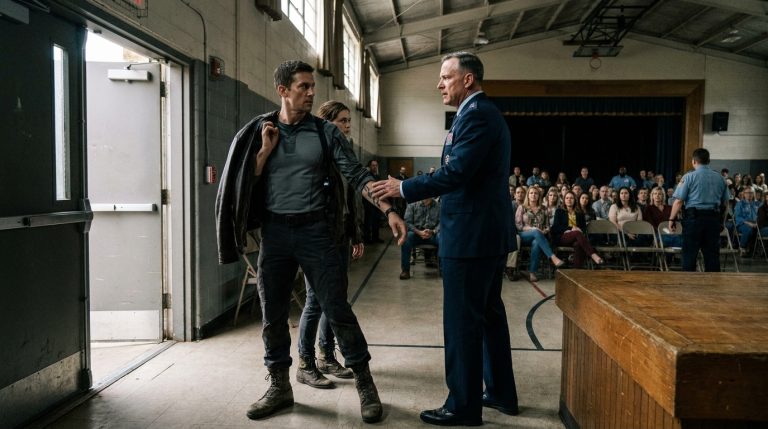
Without a word, the general squared his shoulders. His hand snapped up in a salute so precise, so devoid of hesitation, that it seemed to vibrate with history. The colonel followed suit.
Mark stopped mid-sentence. His mouth stayed open, his face falling as he processed the sight of two high-ranking military officers saluting an old man with a worn satchel and dust-covered shoes. The sound of a thousand people holding their breath was absolute.
“Chief Warrant Officer Corrian,” the general’s voice was clear, carrying across the silent field like a bell. “Major General Madsen, United States Strategic Command. It has been a long time, sir.”
Arthur slowly raised his hand. It wasn’t a military salute—it was a simple, informal acknowledgment, a nod to an old friend. His eyes, clear and sharp, held the general’s gaze, and for a fleeting, beautiful second, the difference in their ranks, their ages, and their stations simply dissolved.
Mark stepped back, his back hitting the cold, unyielding metal of the 414’s wheel. He looked at the engine, then at the men, and finally at Arthur. The realization of his own smallness seemed to strike him with a physical force. The diagnostic failure, the pride, the technical superiority he had clung to—it was all being stripped away in the face of a reality that wasn’t coded in ones and zeros, but in blood, sweat, and survival.
“I think,” Arthur said, his voice quiet but carrying clearly through the stillness, “she’s ready to talk now, if you’re all done shouting at her.”
The general turned toward Mark, and though his expression remained neutral, the weight of his rank felt like a physical pressure in the space between them. “Mr. Reading,” the general said, his tone clinical. “This isn’t a machine you’ve been struggling with. You’ve been trying to force a conversation with a veteran. Perhaps it’s time you learned how to listen.”
Sarah felt a tear sting her eye. She looked at Mark. He didn’t argue. He didn’t try to justify himself. He just looked down at his feet, his shoulders slumping under the weight of his own hubris. The barrier between them and the engine was about to be removed, and with it, the facade that had governed the entire project. The truth was here, standing in the dust, and it was far more complex than any software update could ever hope to be.
CHAPTER 5: The Ghosts Touch
The silence that blanketed the festival grounds was absolute, broken only by the rhythmic, heavy thumping of Arthur’s own heart. He knelt in the dust, the ground hard and unforgiving beneath his knees. The massive black driving wheels of the 414 loomed over him, a wall of cold, unyielding iron. Up in the cab, the modern instruments were still flashing their green, empty lights, unaware of the mechanical reality they were trying to override.
Arthur’s fingers found the access panel—the small, grimy square that the engineering team had ignored. It was cold, the metal slick with a fine layer of industrial grease. He didn’t look back at the crowd, or at Mark Reading, who stood a few feet away, his face etched with a mix of shock and dawning humility. For Arthur, the world had shrunk to the space between his hands and the iron.
He pulled the heavy, hand-forged wrench from his satchel. It felt substantial, balanced, and perfectly weighted—a tool made for a different kind of war. He slid the head of the wrench onto the hidden bolt head. It fit with a satisfying, precise click, a connection that felt less like a mechanical marriage and more like a greeting between two old friends.
He took a deep, steadying breath. His joints protested, a dull ache radiating from his shoulders, but his hands were steady. He was no longer eighty-nine years old; he was a chief engineer in the dark of a frozen forest, and he had a mission to complete.
“Alright,” he whispered to the iron. “Let’s see if you remember.”
He applied pressure. At first, the bolt didn’t budge. It was seized by time, by neglect, by the stubborn refusal of modern metal to accommodate an old-world design. Arthur shifted his weight, his boots digging into the loose earth. He didn’t rush. He didn’t use brute, blind force. He listened to the tension in the metal, feeling the point where the bolt wanted to yield.
Click.
The sound was subtle, but in the deathly quiet of the festival grounds, it rang out like a gunshot. Arthur gave it a firm, measured quarter-turn to the left.
Deep within the boiler, something shifted. It was a tectonic sound—a deep, resonant groan of iron and heat that vibrated through the ground and into Arthur’s chest. The engine, which had been a dead, silent mountain of steel moments ago, seemed to shudder.
Then came the hiss.
It started as a thin, piercing whistle—a sharp, high-frequency sound of steam finding a long-forgotten path. It grew into a roar, a powerful, rhythmic blast of white vapor that surged from the cylinder petcocks and billowed out into the afternoon air. The steam was so dense, so sudden, that it engulfed the running board, masking Arthur in a shroud of searing heat and noise.
He didn’t scramble away. He stayed knelt, his hand still on the wrench, feeling the intense, surging warmth of the engine as it began to breathe. The pressure gauge in the cab, which had been stubbornly showing zero, must have been swinging wildly into the green.
The rumble began—a deep, low-frequency tremor that made the very air feel thick. It was the sound of a giant awakening.
Arthur pulled the wrench away, his palm warm from the heat of the bolt. He stood up, slowly, his legs shaky. The steam began to dissipate, revealing the 414 in all its glory. The massive wheels were beginning to oscillate, just a fraction of an inch, as the cylinders filled with the power of a thousand horses.
The crowd erupted. It wasn’t just a cheer; it was a tidal wave of sound, a roar of pure, unadulterated relief and joy. People were clapping, shouting, and pointing. Phones were raised, capturing the sight of the legend, reborn.
Arthur turned, his eyes finding James Richards, who stood near the barrier, his hands clasped together in an expression of profound, quiet wonder. Beside him, Mark Reading was staring at the engine with his mouth agape, his world of digital diagnostics having been completely and utterly dismantled by a single quarter-turn of a hand-forged wrench.
Arthur took a step back, the engine’s rumble now a steady, pulsing rhythm that set the ground beneath his feet to humming. He felt a sudden, profound sense of peace. He hadn’t just fixed a machine; he had given it back its voice. He looked up at the cab, the brass fittings catching the afternoon sun, and for a moment, he thought he could see the faces of the men he had served with, the ones who had never come home from the Ardennes. They were there, in the steam, in the iron, in the rumble.
He tucked the wrench back into his satchel, the brass buckles clicking shut with a finality that signaled the end of the long, cold war he had been fighting, silently, for forty years. He was tired, deeper than he had ever been in his life, but his heart felt light. The truth was out, the ghost had been heard, and for the first time in a very long time, the engine was at rest.
CHAPTER 6: The Quiet Apprenticeship
The bungalow was small, nestled beneath the canopy of an old oak tree that seemed to shield it from the relentless pace of the modern world. Inside, the air was still and smelled faintly of roasted coffee beans and aged paper—a sharp contrast to the biting, metallic tang of the festival grounds. Arthur sat in his favorite high-backed armchair, the leather worn smooth by decades of evening study. Across from him, perched on the edge of a mahogany chair, sat Mark Reading.
The transformation was absolute. The arrogant, polo-shirt-clad engineer had vanished. In his place sat a man who looked, for the first time in his life, like a student. Mark held a simple, spiral-bound notebook in his lap, his pen hovering over the page. He wasn’t looking for a screen to interpret. He was looking at Arthur.
“You said it wasn’t just about the G2 valve,” Mark said, his voice stripped of its former defensive edge. “You said the engine… that it remembers.”
Arthur took a slow sip of his coffee, the mug warm against his gnarled hands. He looked around his living room. Shelves lined the walls, filled not with digital drives or trophies, but with physical artifacts: a rusted shackle, a worn-down gear, a black-and-white photograph of a locomotive buried in snow. “People think memory is something that happens in the mind, Mark. But steel has a memory of its own. It remembers the heat, the stress, the way it was forced to change to survive.”
He leaned forward, setting his mug on the side table. “When we were in the Ardennes, that engine wasn’t just metal to us. It was our shelter. It was our only way home. When you try to run it on nothing but cold logic, you’re missing the soul of the machine. You’re treating a survivor like a tool.”
Mark nodded slowly, his eyes fixed on the blank page of his notebook. “I spent years thinking that if I could just perfect the code, I could make it perform better than the original designers ever imagined. I thought I was improving the history.”
“You weren’t improving it,” Arthur said, his voice gentle but firm. “You were erasing it. That’s why she wouldn’t fire for you. She didn’t need to be optimized; she needed to be understood.”
Arthur reached out, his hand trembling slightly, and gestured to the satchel that sat on the floor beside his chair. He pulled out the hand-forged wrench, the dark, imperfect metal catching the soft light of the room. He held it out. Mark reached for it, his fingers hesitating before he took the cold, heavy weight into his own hands. He turned it over, feeling the rough hammer marks—the evidence of a blacksmith in a war zone who had forged a solution out of salvaged tank armor.
“This is the key,” Arthur said. “Not just to the injector, but to the perspective. You have to be willing to get your hands dirty. You have to be willing to work with the limitations, not just try to delete them.”
Mark looked at the wrench, then at Arthur. The silence in the room was warm, a stark, profound departure from the chaotic, noise-filled pressure of the festival. This was the true payoff—not the cheering crowds, not the military honors, but this moment of transmission. The knowledge wasn’t being uploaded to a server; it was being handed from one pair of hands to another.
“I don’t know how to start,” Mark confessed, his voice barely a whisper. “I don’t know how to look at the engine and see anything but the diagnostics.”
“You start by listening,” Arthur replied. “You go to the shop, you leave your tablets in the car, and you sit with her in the dark. You listen to the sound of the cooling metal. You look for the places where the iron is worn. You don’t ask what the machine can do for you; you ask what the machine has been through.”
Arthur rose slowly, his joints stiff, and walked to the small sideboard. He picked up a stack of original, hand-drawn schematics—yellowed, fragile paper covered in his own cramped, determined handwriting. He carried them back and laid them on the coffee table between them.
“We have work to do, Mark,” Arthur said, a small, genuine smile touching his lips. “If we’re going to restore her properly, we start here. Not with the computer. With the charcoal and the paper.”
Mark looked down at the schematics, the lines intricate and beautiful, a blueprint of a secret history. He clicked his pen, the sound sharp and deliberate, and bent over the table. The tension that had defined him for so long, the frantic need to prove his worth through complexity, had finally dissipated, replaced by the quiet, grounded intensity of a true craftsman.
Arthur watched him, a deep, weary peace settling into his bones. The mission he had been carrying for eighty years had finally found its next keeper. He looked out the window, where the old oak tree swayed gently in the evening breeze. The engine would run, the legend would endure, and the ghost of the Ardennes could finally, truly, go home. The world was still, the legacy was secure, and for the first time since the war, Arthur Corrian didn’t have to carry the weight alone.