The Silent Weight of the Trident: A Legacy Forged in the Quiet Geometry of Service
CHAPTER 1: THE FRICTION OF SILENCE
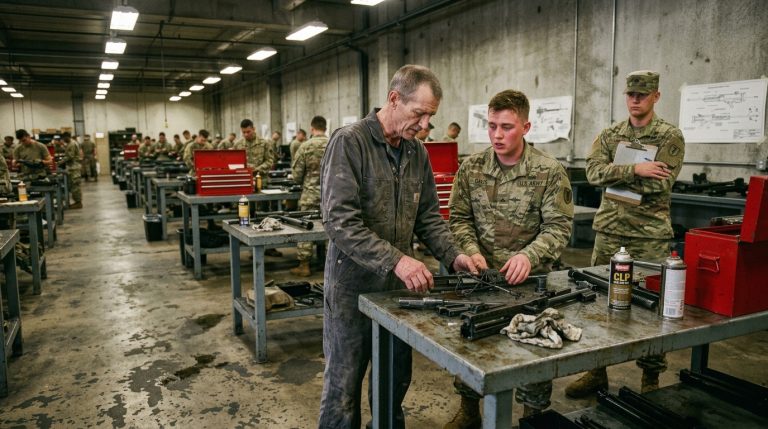
The scent of hot, burnt coffee hung heavy in the rigging facility, clinging to the humidity like a bad memory. Glenn Patterson did not look up. His hands, mapping the intricate weave of the nylon cordage, possessed a stillness that seemed to aggravate the younger man hovering before him.
Lieutenant Davies was a study in sharp edges—pressed white uniform, skin flushed with a righteous, unearned heat, and eyes that darted with the restlessness of a man who had never learned to be comfortable in his own company. He gestured at the parachute on the table, his hand trembling slightly with a suppressed rage.
“Two and a quarter, Patterson,” Davies hissed, the words cutting through the facility’s ambient clatter. “The brief stated a two-inch margin. Are you deaf, or do you just enjoy pushing the limit because you think your age makes you untouchable?”
Glenn’s only response was the rhythmic snip of his shears and the precise, surgical placement of a tacking stitch. He didn’t acknowledge the presence of the officer. He had been packing chutes since the world was a quieter, darker place, back when the gear was held together by little more than gumption and a prayer. He didn’t work for the stripes on Davies’s collar; he worked for the invisible men who would eventually trust their lives to this silk.
Davies surged forward, the heel of his boot clicking sharply against the concrete. “I’m talking to you. This is a SEAL team. We operate on the bleeding edge of physics. A quarter-inch of error is a death sentence, and here you are, acting like you’re retired in a rocking chair.”
The facility, usually a hive of steady, rhythmic industry, fell into a suffocating hush. Other riggers moved in slow motion, their eyes fixed on their own tables, hands hovering over their tools. They knew the dynamic—the inevitable collision between the theoretical precision of a new academy graduate and the hard-won, pragmatic wisdom of the old guard.
Davies reached for the logbook, his thumb flicking through the pages with a dismissive, arrogant speed. “I’m reviewing these. Every last one. And if I find a single flaw, consider your contract void.”
In his haste to assert dominance, Davies pivoted, his arm sweeping wide. The back of his hand caught the edge of Glenn’s thermos. The metal container tipped, sending a dark, steaming spill cascading across the table.
For a fraction of a second, time seemed to dilate. The coffee surged toward the pristine orange canopy like a black tide.
Glenn’s hand was a blur. It didn’t belong to a man of seventy-three years. It moved with the instinct of a reflex honed in the dark, snatching the thermos from the air before a single drop could touch the fabric. He didn’t swear; he didn’t even blink. He merely retrieved a rag from his pocket and began to wipe the surface with a steady, haunting composure.
Davies, frustrated by the lack of a panicked reaction, narrowed his eyes. He needed a crack in the old man’s armor. His gaze landed on the nape of Glenn’s neck, just above the collar, where a dark, faded smudge of ink marked the skin.
“What is that?” Davies sneered, leaning in until he could smell the stale coffee and industrial cleaner on the old man’s clothes. “Some kind of cheap, drunken mistake? A mark of a man who never amounted to anything but a warm body in a chair?”
Glenn paused. The rag stopped moving. For the first time, he looked up, and the look he offered the lieutenant wasn’t one of submission. It was a glance of profound, chilling distance, as if he were looking through the boy, back into the suffocating, freezing dark of a torpedo room half a century ago.
“You have no idea what that mark cost,” Glenn said, his voice a low, gravel-strewn whisper that didn’t rise to meet the Lieutenant’s volume.
The air in the room suddenly felt thin. Glenn turned his head slightly, and the Lieutenant’s face drained of color as he caught the full, stark outline of the trident—not the polished, modern insignia, but a primitive, jagged thing that seemed to pulse with an old, cold history.
CHAPTER 2: THE ECHO IN THE HUSH
The silence wasn’t empty; it was pressurized. It filled the rigging facility, vibrating against the high, industrial ceiling and pressing into the ears of every sailor present. Lieutenant Davies stood motionless, his hand still suspended in the air near Glenn’s collar. The red flush of his anger had migrated from his face to his neck, a raw, mottled irritation that spoke of a man suddenly realizing he had stepped off a cliff without checking for a parachute.
Glenn didn’t move. He kept his gaze fixed on the Lieutenant’s, his own eyes clouded with the sediment of decades, yet sharp as a surgeon’s needle. The trident tattoo—that faded, makeshift mark of a brotherhood born in the crushing deep—seemed to stand out against his weathered skin, a silent testament to a war that had never made the evening news.
Senior Chief Petty Officer Mike Romano took a subtle half-step forward, his eyes darting to the bay doors. The hum of the facility’s ventilation system, usually a background drone, sounded like the rhythmic chugging of a submarine engine. He could feel the phantom weight of the past in the room. He knew, with the instinct of a man who had spent twenty-five years watching the architecture of the teams, that Glenn wasn’t just defending his work; he was protecting a reality that Davies was far too fragile to comprehend.
“Lieutenant,” Romano said, his voice steady, grounded in the quiet authority of his rank. “That’s enough.”
Davies didn’t look at Romano. He couldn’t. His focus was locked on the old man, his breathing shallow and erratic. The young officer’s mind was racing, trying to reconcile the image of the slow, methodical contractor with the weight of the history that seemed to hang in the air like ozone before a storm. He was searching for a way to retreat that didn’t look like surrender, but his tongue felt thick, trapped behind the barrier of his own arrogance.
Glenn didn’t wait for the Lieutenant to regain his composure. He reached down and picked up his thermos, the metal cool and reassuring under his calloused palm. He took a sip of the tepid, bitter coffee, his movements deliberate, forcing the room to wait on his timeline. The world was shrinking, folding inward toward the small, wooden table where the orange nylon lay like a coiled secret.
“You look at the gear and you see failure, Lieutenant,” Glenn said, his voice quiet but carrying with the resonant authority of a man who had been at the bottom of the world and survived to walk on dry land. “You look at me and you see a relic. But you’re missing the point of the stitch.”
Glenn reached down and smoothed a wrinkle from the parachute canopy, his hands moving with the grace of a man caressing a memory. “It isn’t about the tension or the speed. It’s about the fact that when a man jumps, he’s putting his life in the hands of someone he’ll never meet. He’s betting that I didn’t get tired. He’s betting that I didn’t get distracted. He’s betting that I didn’t decide that one little shortcut would make my day easier.”
Davies took a half-step back, his boots scuffing on the concrete, a sound that seemed to shatter the tension like a stone dropped into a mirror. He looked around the room, feeling the sudden, cold weight of the stares from the other riggers—men who had respected Glenn long before Davies had even learned how to tie his own dress shoes.
The phantom sound of the torpedo room—the metallic groan of the hull, the frantic, desperate scratching of a guitar-string needle against skin—flickered in the periphery of Glenn’s mind. He saw Marcus, eyes wide and defiant in the dim red light of the sub, pressing the makeshift rig against Glenn’s neck. We go together, Glenn. We come back together. The memory was a dull ache, a ghost in the machine of the present.
“You’re scared, son,” Glenn continued, not as an insult, but as a simple, devastating observation. “You’re so afraid of being unworthy of that uniform that you’re trying to tear down everything that reminds you how much you still have to learn.”
Davies opened his mouth, a retort forming, but the words died in his throat. He looked at the trident on Glenn’s neck, then at the rows of perfectly packed gear in the background, then at Romano’s unwavering, granite expression. He realized, with a sickening drop in his gut, that the room wasn’t waiting for him to win. The room was waiting for him to crumble.
Romano turned his gaze toward the back offices, his jaw tight. He knew he had already placed the call to the Captain, and he knew that once the machinery of command began to turn, there would be no stopping it.
CHAPTER 2: THE ECHOES OF THE DEEP
The silence that followed the revelation of the ink was not empty. It had texture. It felt like the thick, recycled air of a pressurized hull, the kind that smelled of oil, damp steel, and the metallic tang of fear. Glenn stood before the lieutenant, his hand still gripping the rag, the coffee spill on the table a dark, cooling map of a mistake that had nearly cost him his focus.
Lieutenant Davies was still staring at the mark on Glenn’s neck, his breath hitching in a way that suggested the air had suddenly become too thin to breathe. He looked less like an officer of the Navy and more like a boy who had reached into a shadow expecting to find dust, only to have his hand clamped in a vice.
Senior Chief Romano, standing near the back office, kept his eyes fixed on the floor, his muscles coiled, waiting. He didn’t move. He knew the protocol of the old guard: when the past surfaced, you let the ripples settle before you tried to navigate the water.
“It’s not just ink, Lieutenant,” Glenn said, his voice barely audible over the hum of the overhead ventilation. The sound of his own voice seemed to drag him backward, away from the sterile, brightly lit floor and into the cramped, dark guts of a sub that hadn’t seen the sun in weeks.
He felt the vibration of the screws through the soles of his boots. He remembered the specific, grinding friction of the makeshift guitar-string rig. Marcus had been there—his brother in every way that mattered—his hands steady despite the frantic, muffled alarm of a dive gone wrong. No matter what, we go together. The memory was a phantom limb, an ache that flared with the Lieutenant’s prying gaze.
Glenn’s eyes didn’t leave Davies. He saw the shift in the young man’s posture, the way the arrogance had curdled into a genuine, raw confusion. The Lieutenant’s hands, which had been so eager to strip away a career, now hung uselessly at his sides.
“You think this is a hobby,” Glenn continued, his voice steadying, stripping away the ghost-world and returning to the reality of the rigging floor. “You think you’re protecting this unit by weeding out the ‘relics.’ But you don’t even know what you’re protecting. You’re looking at the equipment, Lieutenant. You’re measuring margins and stitches. You have yet to understand that the gear is the last thing that matters.”
Davies tried to speak, but the words failed him. The authority he had carried into the room—the crisp, academy-bred confidence—had been systematically dismantled. He looked around the room, meeting the eyes of the younger sailors. For the first time, he realized that he wasn’t the instructor in this scenario. He was the one under observation.
Romano saw the flicker of movement in the back office doorway. A junior ensign was hovering there, holding a tablet, waiting for a break in the tension. The call was coming. The Captain’s arrival was no longer a matter of ‘if,’ but ‘how soon.’ Romano caught the ensign’s eye and gave a sharp, imperceptible shake of his head. Wait.
Glenn turned his back on the lieutenant, resuming his work on the parachute. His movements were fluid, devoid of the frantic energy that usually defined the shop. He was meticulously re-verifying the tension on the main riser, his gnarled fingers finding the subtle inconsistencies that his eyes had already cataloged.
“The logbook,” Glenn said, his back still turned. “You wanted to review my recent packs. By all means, proceed. But don’t look for mistakes in the thread. Look for the intention. If you can’t find the intention, you won’t find anything worth your time.”
Davies remained rooted to the spot, a pale, jagged silhouette against the orange nylon. The silence stretched, becoming an agonizing feedback loop of his own miscalculations. He reached for the logbook, but his hand stopped mid-air. He looked at it as if it were a bomb. He didn’t want to open it. He didn’t want to see the neat, block-script entries that spanned a lifetime of quiet, terrifying vigilance.
The facility’s bay door sensors chirped—a high, piercing sound that cut through the tension like a razor. It wasn’t the soft, pneumatic sigh of the usual service vehicles. It was the sharp, rapid-fire sequence of a security lock-down.
Glenn didn’t turn around. He didn’t need to. He could feel the change in the air pressure, the sudden, sharp shift in the room’s electromagnetic field. Someone was approaching, and they were moving with the specific, terrifying efficiency of a command structure that had been pushed too far.
Romano stepped forward, his expression grave. He moved toward Glenn, putting himself squarely between the lieutenant and the table. He stood at ease, hands clasped behind his back, a silent bulwark of experience.
“Master Chief,” Romano said, his voice low and respectful.
Glenn finally straightened, his back cracking slightly in the cool air of the facility. He looked at Romano, then at the entrance where the shadow of a command vehicle was beginning to stretch across the concrete.
“It’s just Glenn, Mike,” he replied softly. “And we have work to finish before the day is out. Regardless of who walks through that door.”
Davies took a shaky step backward, his boots scraping on the concrete. He looked toward the door, then back at Glenn, his face a mask of dawning, catastrophic realization. The game had shifted. The environment he had claimed as his own was no longer under his control; the very air felt heavy with the looming presence of a history he hadn’t yet learned to respect.
The heavy bay door began to groan, the mechanism retracting with a slow, metallic screech that sounded like a warning.
CHAPTER 3: THE ARRIVAL OF THE TIDE
The bay door retracted with a series of rhythmic, metallic clangs that sounded, to Lieutenant Davies, like the final heavy strokes of a closing vault. The morning air of the base—crisp, salted with the scent of the nearby harbor—rushed into the stagnant, coffee-stained heat of the rigging facility, momentarily clearing the tension.
A black command vehicle, its finish polished to a mirror-like obsidian, rolled over the concrete floor and killed its engine with a soft, authoritative click. It was followed by the lumbering, boxy presence of two security trucks that fanned out, sealing the exits with practiced, geometric precision.
Glenn Patterson did not move. He stood at his table, his hands resting on the orange nylon as if he were pinning down the very floorboards beneath him. He was no longer looking at the lieutenant. His gaze was fixed on the driver’s side door of the lead vehicle.
“They aren’t here for the gear,” Senior Chief Romano muttered, his voice barely audible over the fading whine of the vehicle’s electrical systems. He shifted his weight, his presence acting as a physical shield between the bewildered, pale-faced lieutenant and the unfolding scene. Romano’s eyes were sharp, scanning the approaching figures with the clinical detachment of a veteran who knew exactly what kind of storm was about to break.
The door of the command vehicle opened. Captain Reynolds stepped out, his uniform crisp, his posture suggesting a man who carried the weight of the entire base on his shoulders. He didn’t rush. He moved with a heavy, deliberate grace that made the cavernous room feel suddenly small. Beside him, Master Chief Thorne followed, a mountain of a man whose presence usually signaled that the time for debate had long since passed.
Lieutenant Davies took a step back, his heel catching on the edge of a rigging mat. He looked like he wanted to vanish into the concrete. His hands, previously so bold in their dismissal of Glenn, were now tucked awkwardly into his pockets, his entire frame vibrating with a suppressed, frantic energy.
“Captain,” Romano said, stepping forward to render a crisp, informal salute. “The facility is secure, sir.”
Captain Reynolds barely acknowledged the Senior Chief. His eyes, burning with a cold, focused intensity, were locked on the small, unassuming figure of Glenn Patterson. The other officers in the facility, caught in the wake of the Captain’s arrival, faded into the background, their whispers dying instantly as the air in the room grew heavy with the weight of unstated protocol.
Reynolds walked across the polished concrete, his boots creating a cadence that seemed to count down the seconds of the lieutenant’s career. He bypassed Davies entirely. The young man stood in the path of the Captain, but Reynolds moved with such a singular, unwavering trajectory that Davies was forced to stumble aside, forgotten, like a stray piece of debris in the path of a rising tide.
The Captain stopped three feet from Glenn’s table. He stood at attention, his heels clicking together with a sound that echoed through the rigging bay like a gunshot. Then, in a motion that stunned the gathered sailors, Reynolds brought his hand up in a salute—sharp, deep, and held with a reverence that defied the rigid hierarchy of the naval command.
“Master Chief Patterson,” Reynolds said, his voice ringing through the cavernous space, stripping away the titles of contractor, old man, and relic. “It is an honor to have you on my base, sir.”
The word sir hung in the air, pulling the gravity out of the room. Glenn blinked slowly, the ghost of a smile playing on his lips—a weary, sad expression that spoke of long-buried memories. He didn’t return the salute in kind; instead, he offered a single, shallow nod, an acknowledgment between equals who had both, in their own time, walked through the fire.
“Captain,” Glenn replied, his voice remarkably steady. “You’re making a scene.”
“The scene was already made, sir,” Reynolds replied, his eyes finally shifting toward Lieutenant Davies, who was standing in the shadows of a rigging rack, looking as though he might physically dissolve. “I’m merely here to ensure the record reflects the truth.”
The room was held in a state of suspended animation. The junior riggers, who had spent the morning watching Davies bully an elderly man, now stood in a state of absolute shock. They saw the legends of the base—men who were usually only mentioned in hushed stories—treating the old man with a deference they reserved for no one else.
Romano watched the scene, feeling a complex mix of relief and melancholy. He knew what came next. He knew that the system, once triggered, would demand a sacrifice to balance the scales of honor. Davies was the sacrifice, but the cost would be the loss of the quiet, orderly life Glenn had cultivated at his table. The sanctity of the rigging bay had been violated, and it could never be truly reclaimed.
“Master Chief Thorne,” Reynolds said, not taking his eyes off the lieutenant. “Please ensure the Lieutenant is escorted to my office. He will wait for me there. And see that his record is flagged for an immediate review of his commission.”
Thorne moved forward, his presence filling the space where Davies had been standing only moments before. He didn’t use force; he didn’t have to. He simply looked at the lieutenant, and Davies, his spirit effectively broken, turned and began to walk. His gait was disjointed, the walk of a man who had suddenly realized he had spent his entire life running in the wrong direction.
As the lieutenant departed, trailed by the Master Chief, the heavy bay doors began to slide shut, blocking out the harsh glare of the morning sun. The room returned to its muted, industrial hum. Captain Reynolds remained, his posture relaxing just a fraction, his gaze returning to the parachute on Glenn’s table.
“I didn’t want this, Captain,” Glenn said, picking up his rag and beginning to wipe the table again, a nervous, repetitive motion.
“I know, sir,” Reynolds replied quietly. “But there are some things that cannot be left to rot in the dark. Silence is a choice. You’ve made yours. Now, it’s time for the rest of us to make ours.”
Glenn didn’t look up. He was busy checking the tension on the lines, his fingers moving with a tremor he couldn’t quite hide. The phantom weight of the past—the North Atlantic, the cold steel, the promise made to Marcus—was pressing down on him, and for the first time in fifty years, he felt the burden of that promise becoming a physical weight he could no longer carry alone.
CHAPTER 4: THE ARCHITECTURE OF FALLING
Lieutenant Davies walked as if the floor beneath him were made of cracked glass. Every step felt like a potential catastrophe. Behind him, the rigging facility had returned to its work, but the rhythm was broken. The steady, methodical clatter of tools and the low murmur of conversation felt distant, muffled by the ringing in his ears. He was moving toward the Captain’s office, a journey of perhaps three hundred yards that felt like a descent into an abyss.
Master Chief Thorne walked three paces behind him. He didn’t speak. He didn’t need to. His presence was a physical weight, a constant reminder of the bridge that had just been burned. Davies kept his eyes locked on his own boots, watching the scuffs on the leather, the way the polish had cracked around the edges. It was a detail he’d never noticed before, much like the way he had never noticed that the world didn’t stop to admire his authority.
They reached the administration building, a structure of cold, gray concrete that smelled of floor wax and stale air. Thorne opened the door, a heavy, unyielding slab of steel, and gestured for Davies to enter.
Inside, the Captain’s office was sparse, almost monastic. A single desk, a chair, and a view of the harbor through a window that had been reinforced against the coastal wind. Davies sat in the chair Thorne indicated. It was hard, uncomfortable, and offered no purchase. He felt small, the polished bars on his shoulders suddenly feeling like lead weights that were dragging him toward the center of the earth.
He started to reach into his pocket for his notepad, the one he had wielded with such obnoxious flourish only hours before. His fingers brushed against it, but he stopped. He pulled his hand back as if he had been burned. That notepad was a piece of trash now, a record of a failure so absolute it defied explanation.
He stared at the desk. There were no files, no photos of family, no tokens of a career well-spent. Just a clean, empty surface. It occurred to him then, with a sudden, sharp clarity, that he had nothing. He had invested everything in the idea of his own competence, the idea that he was the filter, the gatekeeper of excellence. If that was gone, there was nothing underneath.
The door opened. Captain Reynolds stepped in, his face unreadable. He walked to his desk and sat down, his movements slow and deliberate. He didn’t look at Davies right away. He spent a long, agonizing minute organizing a stack of papers, his hands steady, his breath even. The ticking of a wall clock grew louder, filling the room with a rhythmic, accusatory pulse.
“Do you know why you’re here, Lieutenant?” Reynolds asked, his voice low, lacking the fury that had defined their encounter on the rigging floor. It was worse. It was the voice of a man who was already looking past the problem, toward the disposal.
Davies cleared his throat, but his voice was thin, a reedy imitation of his former self. “I… I made an error in judgment, sir.”
Reynolds finally looked up. His eyes were like polished stone—hard, reflective, and utterly indifferent to the trembling young man before him. “Judgment is something that can be trained, Lieutenant. What you displayed was a failure of character. You chose to target a man whose history is woven into the very fabric of this service, not because he was failing his duty, but because you couldn’t stand the sight of a mirror.”
“I thought I was protecting the mission,” Davies stammered, the words sounding hollow even to his own ears. “I thought…”
“You thought of yourself,” Reynolds corrected, his voice cutting through the excuse like a scalpel. “You saw the Trident on his neck, and you didn’t see the sacrifice. You saw the age on his hands, and you didn’t see the thousands of hours of perfection he had put into the gear that keeps our men alive. You saw an obstacle to your own advancement.”
The Captain leaned forward, his hands flat on the desk. “I’ve spent the morning reviewing your record, Lieutenant. You have the technical skills, yes. But you lack the soul for this work. You treat the men and women of this base like components in a machine, entirely forgetting that they are the ones who have to live with the consequences of your ‘perfection’.”
Davies wanted to argue. He wanted to point to his transcripts, his commendations, his swift rise through the ranks. But as he looked at the Captain, he realized that every word he had ever spoken in defense of his own brilliance was now being used as evidence of his irrelevance.
“There is no path forward for you here,” Reynolds said, the finality of the statement hanging in the room like smoke. “Your reassignment to the Aleutians is not a punishment. It’s an opportunity to learn what happens when you’re removed from the machinery you’re so fond of abusing. You’ll have plenty of time to contemplate the silence of the North Pacific.”
Davies looked down at his hands. They were shaking. He felt a sudden, irrational longing for the rigging floor—for the smell of the coffee, the rhythmic snip of the shears, the quiet, unshakable presence of Glenn Patterson. He had tried to break the old man, only to find that he had only managed to break himself.
The door behind him opened again. Master Chief Thorne was there, his expression grim. It was time. Davies stood up, the chair scraping against the floor with a sound that seemed to signal the end of his life as he had defined it. He turned to go, but stopped, his hand on the doorframe.
“Captain,” he whispered, not looking back. “Is he… is the Master Chief really all that you said?”
Reynolds didn’t answer. He was already back at his paperwork, his attention shifted to the next problem, the next mission, the next life. Davies walked out, the hallway stretching before him like a long, dark tunnel. He realized he didn’t even know where he was going, only that he would never be returning to the place where he had finally learned the truth about himself.
CHAPTER 5: THE WEIGHT OF THE UNFINISHED
Glenn stood by his workbench, his fingers tracing the frayed edge of a rigging line. The facility was quiet now, the frantic energy of the morning’s confrontation having bled away into the sterile, fluorescent-lit silence of the afternoon. Outside the bay doors, the world continued to rotate on its axis, indifferent to the small, tectonic shifts that had just occurred within these walls. But in the shop, the air felt different—thinner, colder.
He heard the soft, hesitant click of the door to the office area. It wasn’t the brisk, authoritative stride of a Captain or the heavy, purposeful stomp of a Master Chief. It was the shuffling, uncertain gait of a man who had lost his center of gravity.
Lieutenant Davies stepped back onto the rigging floor. He looked diminished. The crisp, starched lines of his uniform seemed to hang off his frame, and the fierce, unearned color in his face had been replaced by a pallid, gray sheen. He didn’t look at the other riggers. He didn’t look at the gear. He walked straight toward Glenn’s table, his eyes fixed on the floor with a terrifying, hollow intensity.
Glenn didn’t stop his work. He kept his eyes on the parachute, his hands moving with the practiced, almost hypnotic rhythm that had been the foundation of his life for half a century.
“I’m leaving,” Davies said. His voice was a flat, dead thing, devoid of the sharp edges and the sneering cadence that had defined him only hours before.
Glenn glanced up. He saw the way Davies’s shoulders were hunched, the way his hands twitched at his sides. The lieutenant wasn’t acting. He was in the process of coming apart, the architecture of his arrogance having been leveled by the sheer weight of his own realization.
“The Captain says the car will be here in an hour,” Davies continued, his gaze drifting aimlessly over the rows of packed chutes. “I don’t know where I’m going. Not really. He called it an opportunity. I think… I think he meant it was a long way to go to find out that I’m not who I thought I was.”
Glenn set his needle down. He stepped back from the table, giving the young man his full attention. He saw the Lieutenant not as a villain, or even as an antagonist, but as a boy who had been fed a diet of theoretical superiority and had never been forced to taste the grit of real failure.
“You think you’re being sent away because you failed,” Glenn said, his voice soft, lacking any trace of malice.
Davies looked at him, his eyes swimming with a desperate, fractured confusion. “Isn’t that what happened? I was wrong. I was arrogant. I made a fool of myself.”
Glenn leaned against the workbench, the wood cool and solid beneath his palms. “You’re being sent away because you were operating on a map that didn’t match the territory. You had all the technical knowledge in the world, Lieutenant. You knew every regulation, every standard, every stitch-count. But you didn’t know the first thing about the men who actually do the dying.”
Davies shuddered. The mention of the word hung in the quiet shop, a heavy, unavoidable reality. “I thought… I thought if I pushed everyone to the edge, I was keeping them safe. I thought that was my job.”
“Your job,” Glenn corrected, “is to understand the cost of the work. You don’t get that from a manual. You get that when you realize that every piece of equipment in this room is a potential ghost. You get that when you understand that you are not the hero of the story. You’re just the one who has to make sure the gear holds.”
Davies looked around the shop, his eyes lingering on the senior riggers who were watching him from the corners of their own stations. They weren’t cheering. They weren’t gloating. They were looking at him with a tired, weary pity that was far harder to bear than the Captain’s fury.
“How do you stand it?” Davies asked, his voice cracking. “How do you do this every day, knowing that some of them might not come back? How do you keep your hands steady?”
Glenn reached into his pocket and pulled out his rag, beginning to meticulously polish the surface of his workbench. He thought of the sub, the dark, suffocating Atlantic, the desperate, flickering red lights, and the feel of that makeshift needle pressing into his skin. He thought of the names—the ones who had stayed behind in the deep.
“You don’t do it to stay steady,” Glenn said. “You do it to keep the promise. The promise that even if they don’t come back, you made sure they had the best possible chance to try. That’s the only thing that’s real, Lieutenant. Everything else—the rank, the office, the arrogance—is just noise. It’s all just noise.”
Davies stood there for a long time, the silence stretching between them, thick with the weight of things unsaid. Then, he nodded—a small, barely perceptible movement—and turned to go. He walked toward the exit, his movements slower now, more deliberate, as if he were finally beginning to feel the floor beneath his feet.
Glenn watched him go. He knew the young man would carry the scar of this day for a long time, maybe forever. And in a way, that was the most important lesson of all. He turned back to his table, picked up his needle, and resumed his work. The shop hummed, the familiar rhythm returning, but the texture of the air had changed. The silence was no longer heavy with tension. It was heavy with the quiet, exhausting work of simply moving forward.
CHAPTER 6: THE STITCH IN TIME
The shop was empty save for the rhythmic, low-frequency hum of the ventilation system. Glenn sat at his table, the same place he had occupied for decades, though the light hitting the floorboards had shifted, long shadows stretching toward the bay doors like fingers reaching for an exit.
In front of him lay a parachute canopy that had been snagged during the morning’s chaos—a small, clean tear near the apex, a physical casualty of the day’s friction. He took up his needle. The thread, a high-tensile, military-grade nylon, caught the late afternoon light. He began to stitch.
The physical act of sewing was a sanctuary. Every pass of the needle was a repetition of a lesson learned in the dark. He wasn’t just sealing a tear in fabric; he was pulling together the frayed edges of his own history. The memory of the North Atlantic—the crushing pressure of the sea, the claustrophobic red light of the sub, and Marcus’s hand on his neck—didn’t feel like a phantom anymore. It felt like a foundation.
He had spent his life thinking the promise he made in that torpedo room was a burden—a duty to the dead to ensure the living never suffered the same fate. But as he pulled the thread taut, looping it with the surgical precision that had defined his career, he understood the truth. It wasn’t a weight to be carried; it was a connection. Every stitch he had ever made was a way of saying that Marcus, and the others, still existed in the integrity of the work.
He remembered the Lieutenant’s face in the office—the look of a man stripped of his armor, finally seeing the world for what it was. Glenn’s work had done that. Not because he had tried to teach a lesson, but because he had refused to compromise his own. By standing still, he had forced the world to move around him, revealing the truth of its own fragility.
He finished the knot, snipped the thread with his shears, and ran his thumb over the repair. It was invisible. Seamless. The fabric was as strong as it had ever been.
The door to the shop opened. It wasn’t the Lieutenant. It was Senior Chief Romano, walking slowly toward the table, his hands in his pockets, his eyes scanning the shop with a quiet, lingering respect. He stopped a few feet away, watching Glenn.
“They’re painting the offices tomorrow,” Romano said, his voice unusually soft. “Starting fresh, I guess.”
Glenn nodded. “A coat of paint doesn’t change the architecture, Mike. It’s still the same room.”
Romano walked to the bench and leaned against it, looking down at the repaired chute. “The Lieutenant called from the holding area. He’s gone. Or he will be, in twenty minutes. He asked me to tell you something.”
Glenn paused, his hand resting on the fabric. “And what’s that?”
“He said he finally looked at the logbook,” Romano said, a strange, quiet smile touching his face. “He said he didn’t see the stitches. He saw the time.”
Glenn looked up at his friend, a realization settling into his chest like a warm, heavy stone. The Lieutenant had finally understood that the time spent wasn’t about the job—it was about the devotion to the people who would use the gear. He had seen the “intention,” just as Glenn had demanded.
“That’s good,” Glenn said quietly. “Maybe the fire didn’t burn him down after all.”
Romano lingered for a moment, then pushed off the table. “I’m heading out. You coming, Glenn?”
“In a minute,” Glenn replied. “I have one more line to check.”
Romano nodded and walked away, the sound of his boots echoing until the shop door swung shut, leaving Glenn in the hollow, companionable silence.
Glenn stood up, his joints aching slightly in the cooling air. He walked to the workbench, his gait steady and unhurried. He took the finished parachute and folded it, his movements economical, a dance of muscle memory that required no thought. He placed the chute in the bin, then turned to his own locker in the corner.
He opened the door. Inside, taped to the metal, was a small, faded photograph of five young men, their faces etched with a grim, youthful defiance. He looked at them—really looked at them—and felt, for the first time in his life, a sense of profound, quiet peace.
He didn’t touch the photo. He just closed the locker door, the metallic click signaling the end of the day.
The shop was silent, but it wasn’t the silence of absence. It was the silence of a house where the work had been done, the debt had been honored, and the ghosts had finally been invited to sit at the table. He walked toward the bay door, his stride slow, his head held in the light of the setting sun. He was just an old man, leaving his workplace, heading home to a life that was finally, truly, his own.