The Iron Ledger: A Silent War of Gears and Grit in the Heartland of Iowa
CHAPTER 1: THE RAVINES FIRST CLAIM
The mud in the ravine was thick, cold, and possessed a hunger that went beyond mere earth. It clung to the iron carcass of the Farmall 460, a jagged, broken-backed machine that Carl Hinton had hauled to the property line in a gesture of pure, spiteful resignation. Roy Hassel stood at the edge of the embankment, his boots sinking into the saturated prairie soil. He didn’t look at the sky, which hung like a heavy, bruised cloth over Harden County; he looked at the cracked block of the engine.
It was a failure. A textbook case of negligence—someone had let the coolant freeze, and the cast iron had surrendered, splitting down the side like a brittle bone. To most, it was scrap. To the scrap man, it was eight dollars a ton. To Roy, it was a structural puzzle.
He didn’t move toward the tractor immediately. He stood in the biting wind, his hands jammed deep into the pockets of his canvas jacket, watching the way the late afternoon light hit the twisted steering column. He noticed a discrepancy—a missing tension bolt on the alternator mount, something that shouldn’t have been absent unless someone had stripped it in a hurry before dumping the machine. It was a small, physical annoyance, an irregularity in the chaos of the dump.
“It’s not dead, Carl,” he whispered to the wind, his voice dry and devoid of the performative sentiment his neighbors favored.
Roy shifted his weight, testing the steep slope of the gully. The friction of the dead iron against the wet clay was the only sound in the field, a low, metallic groan as the tractor settled a fraction of an inch deeper. He felt the cold through his soles, a sharp, biting reminder of the Iowa winter that was clawing at the edges of the horizon.
He began the descent, his movements deliberate, calculated. He wasn’t walking; he was measuring the space, checking for instability. Every step was a calculation of load-bearing. If he slipped, the weight of the 460 would shift, potentially shearing the remaining fragile housing. He treated the ravine not as a graveyard, but as a triage center.
When he finally reached the tractor, he wiped a glove across the fuel injector manifold. The grime was thick, but underneath, the metal remained unpitted. A steady, predictable hum of wind passed through the ravine, vibrating against the hollow iron frames scattered along the creek bed—the ghosts of his father’s failures, now his responsibility.
He reached into his pocket and pulled out a small, steel-tipped scribe. He etched a line into the casing, marking the point where the frost had claimed the block. He wasn’t just saving the tractor; he was documenting the anatomy of the collapse. As he knelt, the silence of the farm felt heavy, pressing against his temples. He was alone, yet the weight of every farmer in the county seemed to rest on the rusted, silent steel before him. He pulled a wrench from his belt, the metal cold and biting, and placed it against the first nut. It was locked tight by years of neglect, but Roy applied pressure with a rhythmic, steady focus that defied the urgency of the storm clouds gathering above.
CHAPTER 2: THE DEALERS SHADOW
The bolt didn’t budge. It was fused to the manifold by a decade of oxidized iron and stubborn, frozen grease. Roy leaned into the wrench, his boots sliding half an inch deeper into the mud. He didn’t swear; he didn’t even grunt. He simply adjusted his grip, his calloused palms meeting the cold steel of the handle. He felt the phantom pressure of his father’s hand on his shoulder—a sensation that had been appearing with increasing frequency whenever the wind shifted to the north. His father, a man who measured his life by the rhythm of the soil and the silence of the ravine, would have stopped at the first sign of resistance. But Roy wasn’t his father.
He applied a slow, crushing force. There was a sudden, violent crack—not of metal breaking, but of rust shattering. The bolt turned.
Roy pulled the wrench back, his breath curling in the air like thin, white wire. He wiped the liberated grease onto a rag, his eyes scanning the ravine. The silence here wasn’t empty; it was heavy with the weight of machines that had been discarded because someone else lacked the patience to understand them. He felt a sudden, sharp intrusive memory—the image of a local bank circular he’d seen in the co-op trash bin, the print small and dense with warnings about high-interest leverage. It felt like a warning, a pulse of anxiety that didn’t belong to him. He shook the thought away, centering himself on the immediate physics of the tractor. He needed that alternator. He needed the integrity of the individual part to stave off the larger, systemic rust creeping into the county.
He finished pulling the alternator, his fingers numb but precise. He scrambled up the embankment, his breathing rhythmic and controlled, despite the incline. He emerged from the ravine just as a blue Ford pickup rumbled down the long, gravel drive.
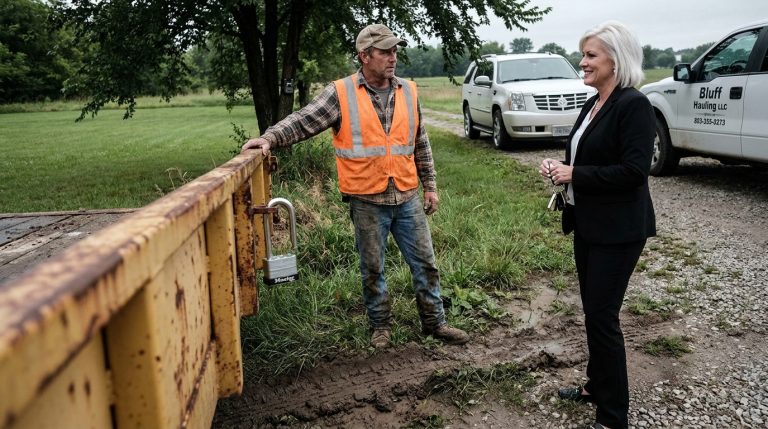
Roy didn’t need to look at the emblem on the door to know it was Merl Gustoson. The engine of the Ford had a high-pitched, manicured whine, a sound that belonged in a showroom, not on the dusty lanes of Harden County.
He set the alternator down on a flat stone, wiping his hands, and stood waiting. He didn’t try to look busy; he didn’t try to hide his work. He simply stood, a man of iron and grease, watching the truck pull to a halt.
Merl stepped out of the vehicle, his boots pristine, his coat uncreased. He looked at the ravine, then at the barn, his gaze lingering on the disorganized pile of scrap that Roy saw as a catalog of future potential. Merl’s lips curled into a familiar, thin-lined smile—the smile of a man who dealt in numbers, not mechanics.
“Still collecting ghosts, Roy?” Merl called out, his voice echoing too loudly in the quiet valley. “I’d have thought the frost would have discouraged you by now. Or at least the common sense of not turning your property into an eyesore.”
Roy picked up the alternator, the cold weight of it grounding him. “The machines aren’t ghosts, Merl. They’re just waiting.”
Merl laughed, a sharp, transactional sound. He walked closer, his eyes scanning the yard with the predatory appraisal of a salesman looking for a weakness. He stopped a few feet away, his gaze falling on the Farmall 460’s alternator in Roy’s hand. He recognized the part, his professional training identifying the brand and the utility before his brain could process the context. His brow tightened, a flicker of genuine irritation crossing his face.
“That 460 belongs to Carl Hinton,” Merl said, his voice dropping an octave. “He bought a new Deere from me last week. He shouldn’t be wasting your time with this junk. He should have let the scrap man take it.”
“He didn’t want to pay the hauling fee,” Roy said evenly.
“Nobody wants to pay for anything these days, Roy. That’s the problem with this county. Everyone’s looking for the cheap fix, the patch job, the secondhand shortcut. It’s bad for the industry. It’s bad for progress.” Merl stepped forward, encroaching on Roy’s space, his perfume of expensive tobacco and synthetic leather clashing with the scent of wet soil and hydraulic fluid. “You’re making it too easy for them to avoid the showroom. You understand that, don’t you? Every time you pull a part out of the mud, you’re hitting the service department in the gut.”
Roy looked at him, really looked at him. He saw the tension in Merl’s jaw, the slight tremor in his hand as he adjusted his watch. Merl wasn’t just a salesman; he was a man holding onto a precarious tower of credit, watching the wind pick up.
“I’m not in the business of business, Merl,” Roy replied softly. “I’m in the business of maintenance.”
Merl scoffed, spinning on his heel to look back at the ravine. “It’s a junkyard, Roy. Don’t dress it up with high-minded talk. A year or two from now, when the interest rates really start to bite and the banks want their land back, you’ll be sitting in the middle of a graveyard with nowhere to go. There’s no profit in what you’re doing.”
“You’re right,” Roy said, his voice dropping to a whisper that cut through the wind. “There isn’t any profit here. That’s why you’ll never understand it.”
Merl stiffened, his face reddening. He glanced at the barn door, his eyes darting toward the shelves, and for a second, he looked like a man who wanted to rip the hinges off. He climbed back into the blue Ford, the engine roaring to life with an aggressive, forced pitch.
“Enjoy the rust, Roy,” Merl snapped as he backed away. “It’s all you’ll ever have.”
Roy watched the truck disappear down the lane, the dust settling slowly in the fading, bruised light. He turned back to his barn, the alternator still heavy in his hand. He hadn’t told Merl about the ledger inside, or the fact that he’d already accounted for the part in a notebook that was more accurate than anything in Merl’s office. He walked inside, the darkness of the shed wrapping around him like a shroud. He began the work of cleaning the alternator, his movements slow, rhythmic, and perfectly, dangerously calm.
CHAPTER 3: THE ANATOMY OF JUNK
The silence in the barn felt different now, punctuated by the faint, lingering trace of Merl’s expensive tobacco—a sharp, synthetic contrast to the grounding smell of aged grease and cold metal. Roy stood under the singular, swaying incandescent bulb that hung over his workbench, his silhouette cast long and thin against the wall of labeled coffee cans. He didn’t rush. Rushing was a luxury for men who didn’t understand the internal geometry of a machine. He set the alternator on the workbench, the metal still radiating a faint, residual chill from the ravine.
His hands were steady, despite the residual tremor of adrenaline that usually followed a confrontation. He picked up a flathead screwdriver, its wooden handle worn smooth by thirty years of friction. He needed to inspect the internal bearings—the heart of the machine’s failure.
He moved with the economy of a man who had stripped a thousand such devices. First, the tension housing. He slid the screwdriver into the seam, feeling for the resistance of the aged seal. It gave with a soft, audible protest. He worked the edge, prying the casing apart just enough to peer into the inner workings. There, caught in the copper windings like a microscopic splinter, was the failure—a fractured bearing race. It was a simple, elegant death for a machine.
Roy pulled a magnifying glass from his tool roll, the lens capturing the light and distorting the fine dust motes dancing in the barn. He studied the fracture. It hadn’t been a sudden snap; it was a fatigue failure, the kind that happened when a machine was operated beyond its capacity, pushed to the brink of its structural limits, day after grinding day. He’d seen this before, and he knew he would see it again as the season deepened.
He reached for a small, shallow tray—the “To Be Cleaned” bin. He placed the housing and the shattered bearing inside. The work was mindless, yet it required a total, unrelenting presence of mind. In this state, he didn’t think about Merl, or the bank notices, or the way the neighbors looked at him with a mix of suspicion and desperate need. He only thought about the metal.
He spent the next three hours in a state of absolute, granular focus. He cleaned each individual component with a stiff-bristled brush dipped in kerosene. He scrubbed the copper windings until they shimmered, then dried them with a clean, lint-free rag. He examined every screw, every washer, every spring. By the time he reached the final reassembly, his joints were aching, his neck stiff from the hunched, predatory posture he’d adopted to see the work more clearly.
As he began to seat the new bearings—pulled from a bin labeled ‘IH-Alternator-Misc’—he noticed a pattern in the way the parts wore down. It was a map of the county’s hardship. Every alternator that had come through his door in the last six months showed the same signs of stress. They were being run too hard, kept too long, and pushed until they quite literally vibrated their own components to pieces.
He didn’t need a newspaper to tell him that the local economy was unraveling. He could feel it in the wear patterns of the iron.
When the alternator was fully reassembled, he clamped it into his test rig—a hand-cranked setup he’d cobbled together years ago from an old washing machine motor and a drive belt. He hooked the leads to a small lightbulb mounted on a wooden board. He gripped the handle and began to crank, the rhythm slow and deliberate. The alternator whirred, a clean, high-pitched note that sounded like a song to his ears. The bulb flickered, then flared with a steady, bright, yellow light.
He stopped, the silence of the barn rushing back in to fill the void.
He walked to his ledger, the spiral notebook that sat on a pedestal made from a discarded tractor axle. He picked up his grease pencil, the wax tip soft and pliable. He wrote the entry: September 14. 460 Alternator. Bearing failure. Rebuilt. He hesitated for a second, then recorded the total time spent and the origin—Carl Hinton’s ravine dump.
He closed the book. The barn felt colder now, the lightbulb swinging slightly in the draft. He knew he wouldn’t sleep. The work was done, but the system remained, and he could hear the wind outside beginning to howl, a low, predatory sound that carried the promise of a long, unforgiving winter. He walked to the barn door and slid the heavy, corrugated metal panel open just a crack.
Outside, the darkness was absolute. The Iowa prairie was a void, a vast, flat sea of black soil that didn’t care about harvests or interest rates or the men who tried to tame it. In the distance, he saw the faint, flickering light of a house—a single, lonely beacon in the dark. He wondered if that was where the next part would come from. He wondered if the owner of that house was staring at his own broken equipment, listening to the same wind, and waiting for the moment when he’d have to swallow his pride and drive down to the junkyard.
Roy turned back to the workbench, his shadow looming massive and misshapen against the back wall. He began to organize his tools, placing them back into their slots with the precision of a surgeon resetting a tray. He wouldn’t be surprised if there was a truck in the lane by morning. The need was growing, a quiet, insistent pressure building in the background of the county. He wasn’t just a farmer, and he wasn’t just a mechanic. He was the keeper of the gears, and tonight, the gears were still holding. But he knew, with a certainty that settled in his bones like the winter chill, that the breaking point was coming closer.
CHAPTER 4: THE ZONING THREAT
The knock on the barn door was not a polite inquiry; it was a rhythmic, official strike of knuckles against corrugated metal. Roy didn’t jump. He finished wiping his hands on the grease-stained rag, took a slow breath to settle his heart rate, and stepped out from the shadows of the workbench.
The morning air outside was biting. A thin layer of frost coated the machinery in the ravine, turning the rusted iron into something that looked like sculpture. Dale Lungquist, the county zoning officer, stood by his sedan, his coat collar turned up against the wind. He was clutching a clipboard, the paper trembling slightly in the gusts. He looked tired—the weary look of a man tasked with enforcing rules that the landscape had long since rendered obsolete.
“Roy,” Dale said, nodding. He didn’t offer a smile. “I’m sorry to bother you this early.”
“You’re here about the complaint,” Roy said. It wasn’t a question.
Dale looked at the clipboard, then out toward the ravine, where the collection of tractors had grown by two since the last time the officer had stood on this ground. “You know how it goes, Roy. An anonymous tip came across the desk at the courthouse yesterday. Someone’s claiming you’re running a commercial salvage operation without a license. I have to document the inspection.”
Roy watched him. He saw the way Dale’s eyes darted toward the barn, not with genuine malice, but with a fearful calculation. The county was changing. The pressure was mounting, and someone, somewhere, had decided that Roy’s organized collection of iron was a liability that needed to be accounted for.
“I’m not selling parts for profit, Dale,” Roy said, his voice steady. “I’m a farmer. This is my property, and these are my machines. If a neighbor comes by and needs a bolt or a pump, and I give it to him, that’s not commerce. That’s how a community survives.”
Dale stepped forward, moving with a hesitant, ginger gait over the uneven, frozen mud. He peered into the barn, his gaze sweeping over the shelves of labeled parts. Roy saw him freeze for a second, his eyes catching on a small, handwritten index card tucked into a shelf of hydraulic pumps. Dale stepped closer, tilting his head. He pulled a pen from his pocket and tapped it against the clipboard, his brow furrowed in concentration.
“I counted forty-two pumps on that rack, Roy,” Dale said, his voice dropping. “That’s quite an inventory for a private farmer.”
“I have a lot of broken machines,” Roy replied.
Dale didn’t answer immediately. He began to walk the length of the barn, his boots crunching on the dirt floor. Roy followed him, keeping the same distance, his own hands tucked into his pockets. He watched as Dale stopped by his ledger, the spiral-bound notebook that Roy had used to track every piece of iron that had passed through his hands since the first Farmall arrived. Dale reached out, his finger hovering over the spine, but he didn’t touch it.
“The complaint mentions a pattern,” Dale said, his voice quiet. “They say you’re hoarding specific components—injectors, governors, steering assemblies. Things that are getting impossible to find at the dealers. They think you’re positioning yourself to leverage the shortages.”
Roy felt a prickle of cold air against the back of his neck. He stepped forward, his boots hitting the floor with deliberate force. “Is that what they think? That I’m waiting for them to go broke so I can sell them a twenty-dollar part for two hundred?”
Dale turned to face him, the clipboard acting as a shield between them. “I’m not saying that, Roy. I’m saying that in the eyes of the zoning board, the volume you’re maintaining is beginning to look less like a hobby and more like a warehouse. If I report this as a commercial enterprise, you’ll have to comply with health and safety codes, fire regulations, insurance requirements… it’ll shut you down.”
Roy didn’t flinch. He looked past Dale, out toward the ravine, where the iron ghosts stood in their rows. He thought about the ledger entry he’d made just last night. He remembered the specific count on the fuel injector shelf—he had counted seven, but as he scanned the shelf now, he saw only six. Someone had been there while he was sleeping. Someone had taken a part, and the inventory was off. A discrepancy. A hole in the record.
“I’m not a warehouse,” Roy said. “I’m a safety net. The dealers aren’t carrying these parts, Dale. You know that as well as I do. If I’m not here, those tractors stop. If those tractors stop, the harvest doesn’t happen. Is that the safety you’re looking for?”
Dale looked back at his clipboard, his expression tight. He scribbled something down, then closed the clip. “I have to file a report, Roy. I’ll list it as ‘personal collection, historical preservation’. But you need to thin out the ravine. The county board is under a lot of pressure to clean up the sightlines, and they’re looking for reasons to act.”
Dale walked back to his car, his movements stiff and unhappy. He didn’t look back as he started the engine. Roy watched the dust trail rise in the air, a long, gray plume that settled slowly over the fields. He walked back into the barn, the silence returning, deeper and more insistent than before. He went to the shelf where the fuel injectors were stored. He counted again. Six.
He pulled the ledger from the pedestal. He opened it to the page for IH76 Injectors. The last recorded transaction was three weeks ago. There was no entry for a seventh injector. Someone had stolen a piece of his inventory, and the record was broken. Roy stood there in the quiet, the smell of grease and cold metal hanging in the air, and he realized that the war wasn’t just coming from the dealers or the zoning office. It was already inside his walls. Someone knew exactly what he was keeping, and they were watching.
CHAPTER 5: THE LIBRARY OF RUST
The missing injector was a phantom, a void on a shelf that had, until yesterday, been a testament to absolute order. Roy stared at the empty space where the coffee can sat, its masking-tape label peeling at the corners. He ran a thumb over the wood of the shelf; it was clean, free of the dust that settled on everything else in the shed. Someone had touched this. Someone had been here.
He took a slow, measured step back, his boots barely making a sound on the dirt floor. The barn, which usually felt like a sanctuary, suddenly felt like a cage. He had spent twenty years ensuring that every nut, bolt, and hydraulic cylinder was accounted for, a physical manifestation of his refusal to let the world discard its own history. Now, that history was being rewritten without his permission.
He didn’t panic. Panic was for men who lived in the light of the dealership showroom, men who thrived on the chaos of quarterly sales targets and shifting market trends. Roy lived in the world of mechanical truth, where an engine either turned or it didn’t, and every effect had a cause. He turned his attention to the floor.
He knelt, the cold of the packed earth seeping through the fabric of his trousers. He began to scan the ground with the intensity of a bloodhound. The barn floor was a mosaic of compressed dirt, old grease, and the fine, metallic dust of a thousand disassemblies. It was a difficult canvas to read, but as he shifted his angle, the light from the swaying bulb caught a faint, distorted impression.
A footprint.
It was partial, the heel pressed deeper than the toe, suggesting someone who had been moving in a hurry, perhaps someone trying to keep their balance in the gloom. It wasn’t the heavy, treaded boot of a farmer. It was too narrow, the arch too pronounced. It was a dress shoe—or at least a boot that tried to mimic one.
Roy stood, his joints popping in the quiet. He didn’t need to guess who wore such shoes. The image of Dale Lungquist’s polished, stiff-soled boots flashed through his mind, but they hadn’t looked like this. No, this was someone else. Someone who spent more time on asphalt than on the soft, forgiving soil of a pasture.
He walked to the back of the barn, his gaze sweeping over the racks of alternators, starters, and water pumps. He began to cross-reference the inventory in his head, his thoughts a rhythmic, ticking clock. If they had taken the injector, they had taken it because they had a specific machine to fix. It wasn’t just a random act of theft; it was a targeted acquisition.
A sudden memory surfaced—his father’s voice, a gravelly, half-whisper he hadn’t heard in years. Don’t ever trust the quiet, Roy. It’s when the wind stops that the roof starts to creak.
He pushed the memory down, focusing instead on the shelves. He walked the length of the storage area, his hand trailing over the coffee cans. He noticed another discrepancy—a box labeled IH-560-Gaskets had been moved three inches to the left of its usual position. He knew this because he didn’t just store parts; he memorized the landscape of his own shelves. He adjusted the box, the dry rasp of cardboard against wood the only sound in the barn.
Whoever had been here wasn’t looking for money. They were looking for the same thing Roy was—the ability to keep a machine alive when the rest of the world had moved on.
He walked to the barn door and slid it open to the gray, mid-morning light. The ravine sat below, a long, deep scar of iron and shadow. He looked at the row of Farmall carcasses. The 460—the one he’d just scavenged—was stripped, its guts piled neatly in the barn. But the 560 next to it was still mostly intact, its engine block covered by a thick, protective layer of frost.
He walked down the slope, his boots finding purchase in the frozen mud. He reached the 560 and knelt beside the engine, his fingers tracing the block. He felt the cold iron, but as he moved toward the fuel pump, he felt something else. A fresh, metallic smear. Someone had been working on this tractor recently. Someone had tried to force the fuel pump, the marks on the bolt heads fresh, the rust scraped away to reveal the raw, silver steel underneath.
They hadn’t just been in the barn. They had been out here, under the cover of the night, working on his collection.
Roy stood and looked back up at the house, the light from the kitchen window barely visible through the trees. Dela would be expecting him for coffee, but he couldn’t go in yet. He reached into his pocket and pulled out his grease pencil. He didn’t write on his ledger; instead, he took a small, jagged piece of scrap metal and scratched a mark into the side of the 560’s engine block—a vertical line, followed by a cross. A tally.
He knew now that the salvage yard wasn’t just a place of quiet preservation. It was a battlefield, and the enemy was already inside the wire. He didn’t feel fear; he felt the cold, hard clarity of a man who realized that his life’s work was under siege. He walked back toward the barn, his shadow stretching out before him, long and sharp. He was going to have to change his systems. He was going to have to watch the shadows as closely as he watched the machines. And if someone else wanted his parts, he would make sure they knew exactly what it cost to take them.
CHAPTER 6: THE CRACKS IN THE SHOWROOM
The silence Roy had long cultivated was no longer a comfort; it was a vulnerability. He spent the remainder of the afternoon moving in the shadows of the barn, his movements deliberate, his ears tuned to the subtle shifts in the wind. He wasn’t just checking inventory; he was mapping the perimeter. He moved the most valuable parts—the fuel injectors, the rare steering gears, the high-demand hydraulic pumps—away from the barn’s main floor and into a hidden sub-floor cavity beneath his workbench. It was back-breaking work, the heavy cast iron weighing against his chest as he shifted bins in the fading light.
As the sun dipped below the horizon, the sky curdled into a bruised purple. The wind, which had been a low, persistent whistle throughout the day, began to shriek, a sharp, metallic sound that rattled the corrugated siding of the barn. It was a storm-maker, the kind of Iowa wind that stripped the paint off houses and toppled anything that wasn’t anchored to the core of the earth.
He stepped out to check the ravine. The stacks of iron were groaning, the weight of the carcasses shifting in the sudden, violent gusts. A pile of cultivator shovels, stacked precariously against the north slope, tumbled, sliding down toward the creek bed with a sharp, resonant clatter.
Roy didn’t hesitate. He scrambled down the embankment, his boots finding purchase in the slick, frozen clay. The wind whipped at his jacket, threatening to pull him off balance. He reached the bottom, where the iron piles were most exposed, and began to shift the heavy components by hand, bracing them against the stable frame of a buried threshing machine.
It was grueling, primal work. He was effectively fighting the weather, his muscles burning as he locked the heavy steel into place, creating a counterweight to the gusts. He was so focused on the physics of the stack—calculating the center of gravity, testing the shear strength of the frozen soil—that he didn’t hear the truck pull into the driveway until it was already halfway up the lane.
He straightened, his back aching, and looked up toward the house. A pair of headlights cut through the swirling dust and debris, swaying erratically. The vehicle didn’t pull into the drive—it idled near the property line, right where the ravine began to narrow.
Roy didn’t move. He stood in the ravine, a shadow among shadows, his hands covered in a mixture of black soil and oil. The headlights flickered, then extinguished, leaving the world in a sudden, jarring dark.
He waited. His heart hammered a steady, calm rhythm against his ribs. He knew this move. It was the same tactic he’d seen Merl use when he was scouting for market leads—park, wait, observe, look for signs of weakness in the competition. But Merl didn’t drive a beat-up pickup with a rusted tailgate. This was someone else.
He waited for ten minutes, the wind roaring overhead, until the truck finally flickered to life and pulled away, not toward the house, but back out toward the county road.
Roy climbed out of the ravine, his body heavy with exhaustion and something colder—a grim, hard-won clarity. The person who had stolen the injector wasn’t a random thief. They were conducting surveillance. They were testing the limits of his protection, seeing how long it would take for him to notice, how he would react when his system was breached.
He entered the barn, the interior now pitch black. He didn’t turn on the light. He knew the layout of every shelf, every bin, every stray bolt by heart. He walked to the workbench and sat, the darkness enveloping him like a heavy, familiar coat. He reached out and touched the ledger, his fingers tracing the embossed title.
He didn’t need to see the pages to know what was written there. He could see the whole county in his mind—the crumbling dealerships, the over-leveraged farmers, the empty bank accounts. Merl had laughed at him, but Merl had been the first to fold. The others would follow. And when they did, they wouldn’t come looking for new, overpriced parts. They would come looking for the pieces that could keep them on their land for one more season.
Roy leaned forward, resting his forehead against the cool, oily surface of his workbench. He heard the wind hammer against the roof one last time, a defiant, screaming sound, before it seemed to break, the air going unnaturally still. He realized then that he had been preparing for this his entire life. The scrap in the ravine, the labeled cans, the meticulously cross-referenced notebook—it wasn’t just a collection. It was a barricade. And he was the only one who knew how to hold the line. He would stay in the dark, he would keep his hands on his tools, and he would wait for them to come back. Because when they did, he would be ready.
CHAPTER 7: THE BLACK TUESDAY
The clink of metal against iron echoed up from the ravine, a sharp, dissonant note that cut through the silence of the post-storm night. It wasn’t the sound of a tool being handled by a master; it was the frantic, clumsy metallic scraping of a thief who didn’t know the geometry of the machines. Roy was off the stool before the second strike registered. He didn’t turn on the barn lights—he didn’t want to alert whoever was down there. Instead, he moved by memory, his feet finding the gaps in the cluttered floor, his hand closing around the handle of a 14-inch pipe wrench. The tool felt cold, heavy, and reassuringly solid.
He reached the barn door and pressed himself against the metal frame, peering out. The moon was obscured by thick, fast-moving clouds, casting the yard in a shifting, monochromatic gray. He squinted, trying to discern the source of the noise. The ravine was a pit of shadow, but near the base, where the 560 rested, he saw a faint, rhythmic flicker. A flashlight, shielded and dimmed, reflecting off the polished surface of a tractor frame.
Roy moved. He didn’t take the direct path; he circled wide, stepping into the tall, wet grass of the north field, the cold soaking into his boots immediately. He kept low, his body angled to minimize his silhouette against the horizon. Every instinct he possessed—the same instincts that told him when a bearing was about to seize or when the soil was ready for the plow—was screaming that this was not a random grab. The thief was systematic. They were working on the fuel injector lines.
He reached the edge of the ravine, the slope treacherous and slick with the evening’s rain. He didn’t rush. He descended with the silence of a predator, his weight balanced perfectly on the balls of his feet. He could hear them now—a low, strained breath, the sound of metal fighting against decades of torque.
“It’s not going to turn that way,” Roy said, his voice low but cutting through the dark like a knife.
The movement below stopped instantly. The flashlight beam snapped off.
Roy stood at the top of the embankment, his presence a dark, immovable silhouette against the sky. He could feel the tension in the air, the physical weight of the trespasser’s fear. He didn’t wait for a response. He slid down the last few feet of the bank, landing with a dull thud in the mud, closing the distance between himself and the 560.
He reached out and clicked his own heavy-duty flashlight on.
The beam hit the figure huddled against the tractor. It was young, thin, and wearing a jacket that was far too light for the Iowa chill. The boy—he couldn’t have been more than twenty—flinched, shielding his face with a greasy, trembling hand. Beside him, spread out on a flat piece of plywood, were tools that had clearly been pilfered from the local co-op’s clearance bin.
“I didn’t mean… I just needed the part,” the boy stammered, his voice cracking. He looked at Roy, then at the wrench in Roy’s hand, his eyes widening. “My dad’s tractor, it won’t… he said if it didn’t run by tomorrow, we were going to lose the place. The bank is already coming.”
Roy stared at him. The rage that had been building in his chest all day didn’t dissipate, but it shifted. It wasn’t the anger of a man being robbed; it was the cold, hollow anger of a man watching a neighbor’s house burn. He recognized the boy—the Brewer kid, from the farm over on the county line. The land that had been in the Brewer family for four generations.
“You don’t take a part by force, Brewer,” Roy said, his voice devoid of heat, hard as stone. “You ask. You check the ledger. You find out if the part is compatible.”
“I don’t have any money, Mr. Hassel,” the boy cried, his hands shaking so hard they dropped a wrench into the mud. “And you weren’t here. I saw the light in the barn, but I was scared.”
Roy looked at the tractor, then back at the boy. He saw the genuine, raw desperation in the kid’s eyes—the same desperation that was rippling through every farm in Harden County, a slow-motion catastrophe that was tearing the heart out of their world. He thought about the bank notices, the interest rates, the way the silence at the co-op had become a physical weight.
“Pick up your tools,” Roy commanded.
The boy hesitated, then scrambled to comply.
Roy gestured toward the barn. “Come on. If you’re going to fix that tractor, you’re going to do it right. You force that line and you’ll crack the manifold. Then you’ll have a real problem.”
He turned and began the climb back to the barn, the heavy pipe wrench still tight in his hand. He didn’t look back to see if the boy was following, but he heard the soft, squelching steps in the mud behind him. As he walked, he felt the heavy burden of the secret he’d been guarding—the ledger, the parts, the entire system he’d built as a wall against the tide. He was holding back a flood with a single, rusted gate, and tonight, the gate had creaked. He realized, with a sinking, heavy certainty, that he couldn’t keep the salvage yard a secret anymore. The county was breaking, and the pieces were going to land right at his door.
CHAPTER 8: THE PADLOCKED DOOR
The transition back into the barn was stifling. The air, which had been crisp and invigorating in the ravine, felt heavy and tainted with the smell of machine oil and the sudden, sharp, metallic tang of unease. Roy set the pipe wrench on the workbench, the clatter echoing too loudly in the quiet space. He gestured for the Brewer boy to stand by the light, but the boy remained in the shadows, his eyes wide and scanning the rafters.
“You said you were scared,” Roy said, his voice steady. “Scared of what? You didn’t come here because you were afraid of the dark, Brewer. You came here because someone told you the parts were here.”
The boy froze. He looked down at his boots, the mud from the ravine caked thick along the welts. “I didn’t… I just heard talk at the feed store. They said if you needed anything, Roy had it. And that he’d help if you were in a bind.”
Roy stepped closer, his shadow falling across the boy. He wasn’t intimidating him; he was stripping away the evasion. “The feed store hasn’t been a source for anything but rumors for six months. Who told you, specifically?”
The boy shifted, his hands balling into fists. “It was… it was a man in a blue truck. He stopped me on the county road yesterday. He said he was looking for parts, too. He told me you were holding out on the county, that you had everything hidden away. He said if I needed that injector, I should come take it before the county shut you down for good.”
Roy felt the cold iron of the situation settle into his chest. A blue truck. Merl. It was a calculated move, one that leveraged the desperation of a starving family against the integrity of a neighbor. Merl wasn’t just losing his dealership; he was actively sowing discord, turning the farmers against the one person who still had the resources to keep them afloat.
“Stay here,” Roy said, turning toward the back of the shed.
He moved toward the hidden sub-floor panel he’d secured only hours before. He lifted the heavy plank, reaching into the dark cavity where he kept the most sensitive items—the fuel injectors, the high-precision governors. He needed the 706 injector, the one he’d promised the boy, but as he reached for the bin, his hand brushed against something that didn’t belong.
It was a small, leather-bound book, tucked behind a cluster of hydraulic pumps. He didn’t recognize it. He pulled it into the light, his heart stuttering in his chest. It wasn’t his ledger. It was a logbook, filled with names, dates, and dollar amounts—a systematic record of every farmer in the county who had come to him for help over the last year. It was a hit list.
He opened it to the last page. The entries were dated through the end of the month, mapping out a future he hadn’t yet seen. His hands shook, the grease on his fingers smearing against the crisp, unfamiliar paper. Someone hadn’t just been stealing parts. They had been tracking the entire network of survival he had been building, documenting every trade, every handout, every desperate exchange.
He looked at the boy, who was watching him with a mixture of confusion and growing fear.
“Is this yours?” Roy asked, holding the book up.
The boy shook his head, backing away. “No. I’ve never seen that.”
Roy turned back to the ledger. He saw his own name listed at the top, his farm’s acreage, his tax status, and a column labeled Liability Status. Below his name were dozens of others—farmers he’d helped, neighbors he’d traded with, even the names of the kids he’d taught at the vocational school. It was an audit of misery, a record of the farm crisis written by someone who viewed the struggle not as a tragedy, but as a ledger to be balanced.
The realization hit him like a physical blow. The pressure from the zoning board, the anonymous complaints, the stolen parts—it wasn’t about cleaning up an eyesore. It was about acquisition. Someone was using the crisis to consolidate the farm holdings of the entire county, and they were using his own records to identify the most vulnerable targets.
“Brewer,” Roy said, his voice hard as iron. “Get out. Go home. Tell your father he’s to stop talking to anyone about where he gets his parts. Tell him to go to ground. Do you understand?”
The boy didn’t ask questions. He grabbed his tool roll and scrambled toward the door, the metal sliding open with a shriek that pierced the night air. He disappeared into the darkness, leaving Roy alone in the center of the barn.
Roy turned back to the workbench, his gaze fixed on the stolen logbook. He knew he had to act, but the options were closing in. If he destroyed the book, he’d lose the only proof of the conspiracy. If he kept it, he was walking around with a target painted on his back. He reached for the pipe wrench, his grip white-knuckled. He didn’t know who was behind it, but he knew one thing for certain: they had made a grave mistake. They thought they were dealing with a simple farmer, a man who collected junk because he couldn’t let go of the past. They didn’t realize that in the heart of that junk, he had forged something far more durable. He wasn’t just guarding his parts anymore. He was going to dismantle the people who were trying to dismantle his county.
CHAPTER 9: THE FIRST CUSTOMER
The ledger in Roy’s hand felt heavier than it had minutes ago, as if the names inscribed on its pages were physically anchoring him to the spot. He looked around the barn, at the thousands of parts he had meticulously collected, cleaned, and labeled over two decades. They were no longer just tools for farming; they were evidence. If the names in the logbook were correct, every part he had provided over the last year had been tracked, analyzed, and used to build a profile of the county’s collective debt. He wasn’t just a mechanic. He had unwittingly provided the intelligence for a systematic foreclosure operation.
The rage, cold and precise, returned. He didn’t pace. He didn’t shout. He moved to the workbench and retrieved a heavy, canvas tool bag. He began to pack it—not with the standard wrenches or screwdrivers he usually carried, but with his most specialized tools, the ones he reserved for the deepest, most complex engine reconstructions. He didn’t know what he was going to find in Eldora, but he knew he wouldn’t be returning as a mere observer.
He walked to the barn door and checked the latch. The night outside was still, the storm having passed, leaving the fields bathed in a sharp, cold moonlight. He stepped out, his boots crunching on the frozen crust of the drive. He didn’t go to the house. Dela would be asleep, and he couldn’t bring the weight of this onto her. Instead, he walked toward his own truck—an old, reliable flatbed that had carried more scrap iron than anyone in Harden County.
He climbed into the cab and started the engine. It turned over with a familiar, mechanical growl, the sound of an engine that had been rebuilt, tuned, and respected. He didn’t take the main road toward town. He knew the back lanes, the gravel paths that crisscrossed the north quarter, the ones the local dealers ignored. He drove with his lights off until he hit the county line, his eyes adjusted to the dark.
His mind was a map of every failure he’d witnessed over the last two years. Merl Gustoson’s showroom was the nexus, but he suspected the true reach went further than that. The logbook suggested an orchestration—a coordinated effort to push the farms to the brink and then swoop in once the land became cheap.
He parked the truck in the brush two miles from the site of Merl’s former dealership. The structure sat like a tomb in the moonlight, its windows dark, the once-vibrant John Deere sign now twisted and hanging at a jagged angle. He left the truck and moved on foot, his path taking him through the fallow cornfields where the stalks rattled like dry bones in the wind.
He approached the rear of the service bay. He had spent his entire life learning how machines were built, and because of that, he knew exactly how they were meant to be broken into. He didn’t need a crowbar; he needed the right leverage. He found the service door, the one Merl used to drive the combines into the workshop, and examined the locking mechanism. It was a standard, high-tension latch—the kind that looked secure but relied entirely on a specific tension-pin that could be depressed with a stiff piece of high-gauge wire.
He pulled a length of copper wire from his pocket, the one he’d pulled from the 460’s ignition system. He manipulated the wire, his fingers moving with a dexterity born of years of detail work. He felt the pin click, the tension release, and the door swung open with a dry, protesting moan.
He stepped inside. The air was stale, smelling of cold concrete and the lingering, synthetic scent of new grease. He moved through the darkness, the beam of his flashlight cutting a sharp, clinical path. The showroom was empty, the displays stripped. But the back office—the one where Merl had sat, counting the margins and calculating the losses—was a different story.
Papers were scattered across the desk, a chaotic sprawl of banking documents and legal notices. Roy stepped forward, his heartrate steady as he began to sort through the debris. He wasn’t looking for parts anymore. He was looking for the architect. And as he found the first invoice—a document bearing the letterhead of a holding company he didn’t recognize, tied directly to the land titles of the farmers in his logbook—he realized the scale of the trap. They weren’t just taking the farms. They were erasing the history of the county, one tractor at a time. He leaned over the desk, the light of his torch fixed on the final line of the document, the name at the bottom causing the world to stop for a heartbeat. It wasn’t Merl. It was someone far closer, someone he had trusted as a fixture of the community since the day his father first took him to the bank.
CHAPTER 10: THE BLUE FORD
The name at the bottom of the invoice was not Merl Gustoson. It was Dale Lungquist. The county zoning officer—the man who had stood in Roy’s barn, acting the role of the beleaguered bureaucrat, his clipboard shaking with feigned empathy—was the architect of the entire maneuver. Roy stared at the signature, the ink still crisp on the heavy bond paper. It wasn’t a clumsy forgery. It was the elegant, practiced script of a man who spent his days signing the death warrants of family farms under the guise of municipal regulation.
The click of the padlock behind him was not a malfunction. It was a statement.
Roy stood frozen, his torch beam wavering across the desk. The office, which had felt like a repository of records, now felt like a closed box. He turned, the pipe wrench in his hand feeling heavier, the balance shifting. He moved toward the door, his boots making no sound on the floor, and placed his ear against the heavy oak.
He heard it then—the faint, rhythmic scratch of a key against metal, followed by the heavy, muffled tread of someone walking across the service bay. It wasn’t the fast, manic pace of an opportunist. It was the slow, steady stride of a man who knew he had already won.
Roy extinguished his flashlight. He didn’t want to be seen when the door opened. He moved to the corner of the office, sliding behind a heavy, metal filing cabinet that had been shoved against the wall. He was breathing through his nose, shallow and controlled, his mind already calculating the structural weaknesses of the room. The office had one window, high and narrow, reinforced with steel mesh. It was a dead end. But the office had a ventilation shaft—a wide, rectangular opening near the ceiling that fed into the main service bay.
The door handle turned. The lock, held by the heavy padlock from the outside, rattled, but the door didn’t budge.
“I know you’re in there, Roy.”
Dale Lungquist’s voice drifted through the gap in the door, cool and detached. There was no tremor in it now. “You always were too curious for your own good. You should have stuck to the ravine. You should have kept playing the ‘junkyard farmer’. It was a nice, quiet ending for a man like you.”
Roy stayed silent. He moved toward the wall, his hands feeling for the seam of the vent cover. It was bolted from the inside—a fortunate oversight by a man who valued aesthetics over physical security. Roy took the pipe wrench, jammed the tapered end behind the bolt, and applied steady, unyielding pressure. The metal groaned.
“You think you’re saving this county,” Dale continued, his voice pacing back and forth outside the door. “You think those parts are helping. You don’t see the math, Roy. You don’t see that the land is worth more empty than it is with a tractor on it. We’re doing the work of the future. We’re clearing the board.”
The bolt snapped. Roy caught the vent cover before it could clatter to the floor. He leaned out, peering into the service bay. The space was cavernous, lit only by the sliver of moonlight filtering through the high windows. Dale was standing near the door, his silhouette illuminated by the dash-lights of a truck parked just outside.
Roy didn’t hesitate. He pulled himself into the shaft, the metal edges biting into his shoulders. He felt the sharp, abrasive texture of the ductwork, the fine layer of soot that coated everything in this tomb. He crawled, his knees scraping against the ridged aluminum, his ears tracking the movement below.
He reached the end of the shaft—a wide, open grate that looked down over the service pit. He looked down and saw his own truck—the flatbed he’d parked in the brush—being hooked to a heavy-duty tow cable.
They weren’t just going to leave him locked in the office. They were going to impound his truck, destroy his tools, and leave him with nothing. The realization hit him with a physical force. They weren’t just taking the farms; they were methodically dismantling the infrastructure that made survival possible. Roy looked down at his hands, covered in the grease and dust of his own life’s work. He had been playing by the rules of mechanics, assuming that if you kept the parts clean and the machine running, the system would hold. He had been wrong. The system didn’t care about the machine. It only cared about the leverage.
He braced his feet against the side of the shaft, gripped the heavy wrench, and prepared to drop. He wouldn’t be leaving this place as a victim. He was going to ensure that whatever leverage they had, whatever record they had built, was going to be met with the only thing that actually mattered: the blunt, undeniable weight of the truth. He kicked the grate free. It hit the concrete floor with a resonant, metallic clang that echoed through the entire bay, and before the sound had even faded, Roy was already in the air, falling toward the man who had traded his neighbors’ lives for a ledger.
CHAPTER 11: THE DEBT OF IRON
The impact of Roy’s boots hitting the concrete floor was a shockwave that seemed to vibrate through the entire structure of the workshop. Dale Lungquist, caught mid-stride toward the truck, stumbled, his composure splintering instantly. He spun around, his hand instinctively diving into his coat pocket—but Roy was faster. He didn’t use the wrench as a weapon; he used it as an anchor, lunging forward and pinning Dale against the side of the idling truck with a speed that defied his age.
“The ledger,” Roy commanded, his voice a low, vibrating growl that held the weight of twenty years of unvoiced resentment. “Give me the rest of it.”
Dale’s eyes were wide, the polished veneer of the county official cracking to reveal the shivering, terrified man beneath. He struggled against Roy’s grip, but Roy’s hands were like tempered steel, conditioned by years of turning seized bolts and wrestling cast iron. “You don’t understand, Roy,” Dale gasped, his voice thin. “It’s not just me. The banks, the investors—they’re already here. This county is a dead horse, and I’m just making sure the carcass is picked clean before the interest rates spike in the spring.”
Roy leaned in, his face inches from Dale’s. He could smell the desperation on him, a sour, nervous sweat that had nothing to do with the winter air. “You didn’t just pick it clean. You poisoned the well. You made sure the farmers couldn’t hold on, and then you used my own inventory to track their demise. That’s not business. That’s theft.”
Roy reached into Dale’s inner pocket and retrieved the remaining files—a thick, bound portfolio of land titles and debt obligations. He didn’t look at them. He threw them onto the concrete floor of the bay. “The parts I saved, the machinery I kept running—that wasn’t for profit. It was to keep this place breathing while the parasites looked for an opening. You didn’t realize that a machine, properly maintained, can outlast any debt cycle. And you’re about to find out exactly how much resistance a man with nothing left to lose can provide.”
Roy tightened his grip, pushing Dale backward until the man’s back hit the metal bed of the truck. The engine of the truck hummed, a low, rhythmic thrumming that seemed to mock the silence of the bay. Roy grabbed the tow cable—the very cable Dale had intended to use to steal Roy’s livelihood—and looped it around the trailer hitch, securing it with a series of quick, brutal knots that he had learned on a hundred different farm sites.
“You want to dismantle the county?” Roy asked. He moved to the truck’s driver-side door, pulling the handle. It was locked. He didn’t hesitate; he smashed the side window with the base of the pipe wrench, the glass shattering into a thousand diamonds that shimmered in the flashlight beam. He reached in, unlocked the door, and shoved Dale into the passenger seat.
“We’re going to the co-op,” Roy said, sliding into the driver’s seat. “And you’re going to tell everyone exactly how you balanced your books. You’re going to read these names, Dale. You’re going to look every single one of them in the eye and tell them how you planned to turn their heritage into a line item.”
Dale turned his head to look at Roy, his expression shifting from terror to a jagged, broken defiance. “They won’t believe you. They’re broken, Roy. They’ll take the money. They’ll take the buyout just to stop the bleeding. You’re fighting for a ghost town.”
Roy put the truck in gear. The engine surged, the tires spinning for a fraction of a second before biting into the concrete. “Maybe. But they’ll know the truth. And in this county, that’s the only currency that matters.”
He backed the truck out of the service bay, the headlights swinging across the yard to reveal the empty, darkened husk of the dealership. As he drove out onto the county road, the engine of the Ford hummed a steady, powerful note, the sound of an iron heart refusing to stop. He felt the weight of the ledger on the seat beside him, a tangible, heavy record of the betrayal. The journey ahead was long, and he knew the coming months would be a battle for every acre, every machine, and every family in Harden County. But as he looked out at the vast, dark expanse of the prairie, he felt a strange, quiet sense of peace. The machine was running. The parts were aligned. And for the first time in his life, he was driving it exactly where it needed to go.
CHAPTER 12: THE FINAL CANISTER
The co-op parking lot was already filling with trucks when Roy pulled in, the gravel crunching beneath the flatbed’s tires like breaking bone. He didn’t park in the shadows. He pulled directly to the center of the lot, the headlights of the Ford cutting through the pale, pre-dawn light, illuminating the faces of the farmers already gathered there. They stood in small, tight clusters, their coffee mugs steaming in the biting air, their expressions guarded and tired. When they saw the truck—and the man driving it—the murmurs died down, replaced by a sudden, expectant silence.
Roy killed the engine. The sound of the silence was absolute. He climbed out, the cold wind whipping his jacket against his chest. Dale Lungquist, slumped in the passenger seat, didn’t move. He looked small, broken, his hands still trembling where they rested on his knees.
Roy walked to the rear of the truck and lowered the tailgate. He reached into the truck bed, past the tools and the scrap iron, and retrieved the ledger and the heavy, black binder he had taken from the dealership office. He walked toward the group of farmers, his stride measured and heavy, the sound of his boots the only rhythm in the world. He reached the center of the lot, under the flickering floodlight of the main building, and dropped the documents onto the hood of a rusted grain truck.
“This is the ledger,” Roy said, his voice carrying over the lot, steady and devoid of triumph. “This is the list of every farm in Harden County that they marked for acquisition. This is the timeline of the sell-off.”
The farmers crowded in, their faces tight with confusion, until a man stepped forward—Carl Hinton. He picked up the binder, his calloused thumbs flipping through the pages. As he read, the look on his face shifted from confusion to a slow, rising horror. He looked up at Roy, then toward the truck where Dale sat. The silence held for a long, agonizing minute before the roar began—a low, visceral sound of men realizing they had been sold out by the very system they had trusted to protect them.
It wasn’t a riot. It was a cold, quiet turning. The co-op manager came out, followed by two of the county board members, but as they saw the ledger, as they saw the list of names and the calculated margins of their own destruction, they went pale and stepped back into the shadows. The betrayal was too blatant, the evidence too concrete. The architect of the county’s collapse was sitting in a truck, shivering in the dawn light.
Roy didn’t stay to watch the aftermath. He didn’t need to hear the explanations or the pleas for mercy. He walked back to his truck, climbed in, and turned the key. He didn’t look back at the co-op. He drove home, the road unfolding before him in the gray light, the weight of the last two years finally lifting from his shoulders.
When he reached the farm, the sun was just beginning to crest the horizon, painting the black soil of Iowa in a deep, burning gold. He didn’t go to the house. He walked to the ravine, the place where he had started, where the ghost-machines of his father’s life still rested in the frost. He walked down the steep, narrow path to the very bottom, to the first shelf he had ever built.
He reached up and pulled down the original coffee can—the one labeled IH460 Injectors. The last one. He walked to the edge of the creek, the water running cold and clear over the stones. He held the can in his hand, feeling the weight of the metal, the thousands of hours of labor, the grease, and the dirt. He opened it, tipped the final injector into his palm, and studied it one last time. It was a simple, elegant piece of engineering, built to last. He knew now that the salvage yard wouldn’t be needed for much longer. The county was beginning to heal, the farmers were starting to look at their old equipment with new eyes, and the systemic greed that had nearly swallowed them was being systematically dismantled.
He placed the injector back into the can, but instead of putting it on a shelf, he tucked it into a small, dry crevice in the rocks of the ravine. A marker. A testament. He turned and climbed out of the ravine, his movements fluid, the ache in his joints replaced by a quiet, physical resilience.
He walked back to the barn, the door open, the light spilling out to greet him. He saw Dela standing in the doorway, a mug of coffee in her hand, her expression one of quiet, knowing relief. He didn’t say a word. He didn’t need to. He walked to the workbench, picked up his grease pencil, and made the final entry in the master ledger: System Restored. Preservation Complete.
He set the pencil down, the silence of the barn settling around him like a warm, familiar blanket. He took the coffee from Dela’s hand, the warmth of the ceramic seeping into his skin, and looked out over his fields. The farm was still there. The soil was still black. And for the first time in his life, the silence wasn’t a warning. It was peace.